




Private Fleets Investing in Growth, Safety, Drivers
The nation’s large private fleets have weathered the COVID-19 pandemic, supply chain challenges, and a driver shortage, and many are looking to grow in 2022, according to the National Private Truck Council’s annual benchmarking report.

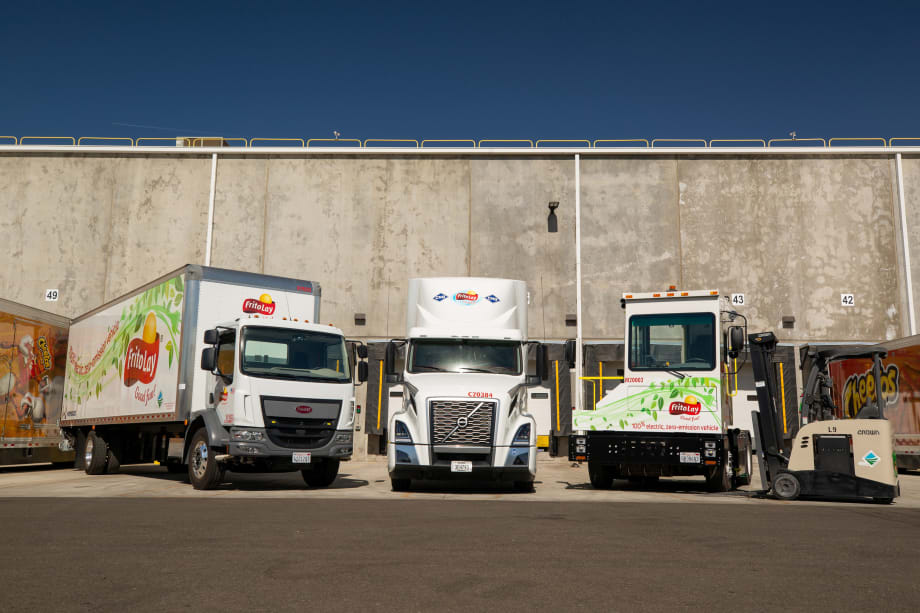
Environmental initiatives are a priority for fleets such as Frito-Lay.
Photo: PepsiCo
The nation’s large private fleets have weathered the COVID-19 pandemic, supply chain challenges, and a driver shortage and are looking to grow in 2022, according to the National Private Truck Council’s annual benchmarking report.
The 2021 report captures key metrics from the 2020 calendar year. This, of course, was a time period like no other, as businesses and their private fleets were forced to make constant adjustments to the pandemic-related restrictions. For some companies, business demands and pressures surged. For others, the bottom fell out. Private fleets were able to respond to market conditions by flexibly using outside carrier capacity.
This year, 112 companies participated in the survey, the second highest number since the association has been doing the survey.
NPTC and Penske Truck Leasing, the sponsor of the survey, held a conference call for trucking reporters to dig into the results. The call featured Tom Moore, executive vice president of education at NPTC; Chuck Amen, transportation operations manager for Missouri-based private fleet Hillyard; and Mari Roberts, VP of Transportation for Frito-Lay
Since the survey’s inception in 2005, customer service has been cited by the overwhelming majority of private fleets as the primary reason they are in business. However, more and more private fleets are looking at a wider range of ways to measure customer service than simply on-time delivery. For instance, Roberts said one thing she found impressive was that 80% of the private fleet respondents are measuring service in 10, 20, 30, or 60 minute delivery windows.
In many ways, the NPTC benchmarking results change only slightly from year to year in many of these metrics, reflecting the stability that a private fleet offers the parent company as well as the drivers who work there.
However, these fleets continue to operate more efficiently, and there are some trends apparent in the survey results.
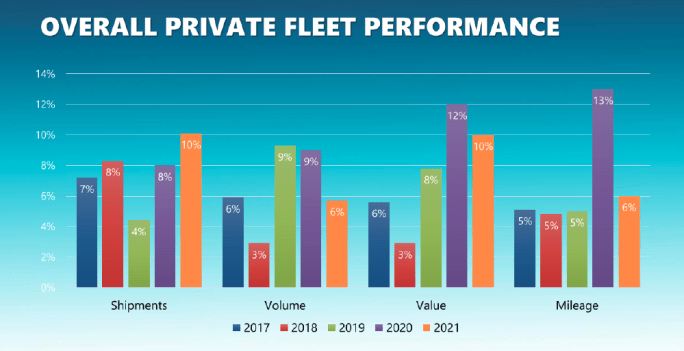
Shipments were up but mileage was down, as private fleets operate more efficiently and move closer to customers.
Graph: NPTC
For instance, private fleets seem to be positioning their facilities closer to customers, as reflected by the growth in multiple locations, explained Moore. In the past six years, the average private fleet has expanded its number of locations, he said. Although the average number of locations appears to be down for this year’s survey, he said, the number of fleets expanding locations was twice the number of those that had kept them the same or shrunk them.
When asked to look into the future, 76% of the respondents report that they expect their fleet to grow (add equipment or handle more of their company’s freight) over the next five years. That compares to 68% in 2019 and 72% the previous year. Another 14% of the fleet respondents expect to stay the same size, up from the 10% that so reported last year. Only 9% expect a decline in their fleet operations, measured in terms of fleet size or a shrinking share of the freight volume. That figure is down 16% from 2019. The average anticipated decline is 5%.
Frito-Lay, one of the largest private fleets in north America, is looking to grow its private fleet, Roberts said. "You’ll hear a lot of companies say they will hire X number of drivers, which is different from growing. We are looking to grow our fleet by 25% over the next few years, 500 drivers by 2025."
Driver shortage?
Although labor issues remain a significant challenge for survey respondents, with 98% reporting it as a top issue for 2020, these fleets also continue to report retention and turnover performance far better than their for-hire colleagues. Reversing a two-year trend of higher driver turnover, respondents in this year’s survey report driver turnover falling to 15.8% in 2020, down nearly three full percentage points from 2019’s 18.5% turnover rate. To keep things in perspective, turnover has averaged 14.25% over the 15-year history of the survey.
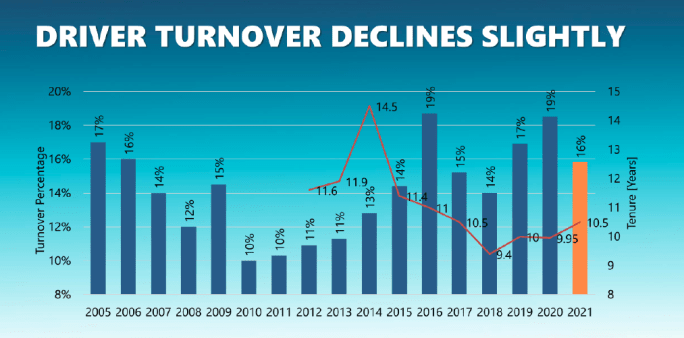
Driver turnover in the private fleet world continues to be less than in the for-hire fleet world.
Graph: NPTC
One of the reasons for that low turnover, Moore said, is average driver compensation, which came in at more than $75,000 per year for 2020. In addition, a typical workweek for drivers at these NPTC fleets is about 42.4 hours. And the majority, 71% in 2020, are home every night.
Hillyard’s Amen cited the company’s investment in driver-friendly equipment, including auxiliary power units and refrigerators, as well as programs that allow drivers to earn extra through bonuses for performance in areas such as safety and fuel mileage.

Private-fleet drivers spend about two-thirds of their workday driving.
Graph: NPTC
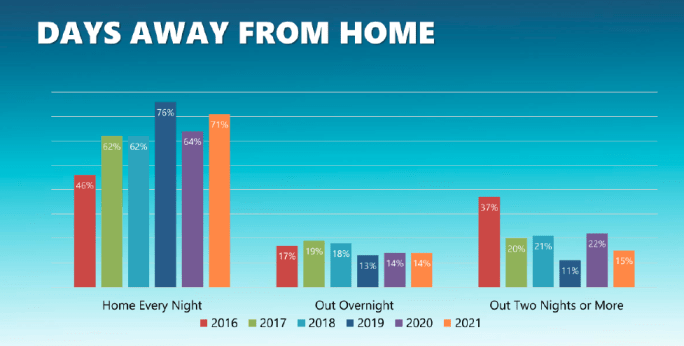
Private-fleet drivers are typically home every night or nearly so.
Graph: NPTC
Frito-Lay’s Roberts said with not as many new drivers coming into the industry, the company has started growing its own, recruiting warehouse and distribution center employees and paying for them to get a commercial driver’s license, teaching them to drive a truck and service customers.
“It’s a culture of retention” Moore said, “where the drivers are treated like people, they’re part of a team, their contributions are recognized, and they’re paid for that. The whole culture is just radically different, I think.”
Roberts pointed to the stability of the driver job at private fleets like Frito-Lay. “During the lockdowns last year, we were busier than ever,” she said. “A lot of drivers are looking for careers, not jobs. Stability, growth; I think a lot of drivers want to be in an organization where even during shutdowns we didn’t slow down, we were still hiring.”
Safety and the environment
The safety culture at private fleets is seen as another attraction to drivers.
The number of DOT recordable accidents, Moore said, is another differentiator for private fleets. At 0.45 accidents per million miles of travel, he said, that’s about three times better than what the overall trucking industry records.
Private fleets are major adopters of safety technologies, with significant gains this year in areas such as in-cab cameras, adaptive cruise control, collision warning and lane-departure warning.
Frito-Lay’s Roberts said a culture of retention and safety go hand in hand.
"To me, no company, private fleet or for-hire, can be run efficiently if it's not safe," Moore said.
Environmental issues are also important to private fleets, noted Moore, saying respondents in this year's survey are "really working to offset the environmental impact of their companies." The report indicates that 90% are invested in environmental strategies, such as idle reduction, speed governance, trailer skirts, increased load density, alternative fuels. And 9% cited electric trucks.
"We've got a pretty aggressive sustainability target," Roberts said. "About 50% of our heavy-duty equipment operates on compressed natural gas and even renewable natural gas, and as we continue to expand into more electric vehicles, it’s neat to see how the private fleet industry is leaning more toward those alternative fuels."
More Fleet Management

How Better Freight Data Helps Trucking Teams Get Ahead of Disruption
Trucking and logistics teams have plenty of data. The problem is getting the right information in front of the right people soon enough to act. Better-connected data can help teams spot trouble earlier and make smarter decisions before small problems become big ones.
Read More →
Trimble: Taking Artificial Intelligence in Trucking Beyond Faster Tasks
At Insight 2026, Trimble executives argued that fleets may need to redesign workflows to get more from AI as it introduced new products and enhancements. AI’s value will depend on how fleets combine automation with their people's knowledge.
Read More →
Nominations Open for HDT Emerging Leaders
Heavy Duty Trucking is looking for accomplished trucking fleet professionals under 40 who are making an impact and helping lead the industry forward.
Read More →


Why Private Fleets Are Taking More Freight
Private fleets are putting their own trucks on demanding customers and high-cost lanes as companies seek greater control over service, costs, and capacity.
Read More →
Color Match Smarter: Tools That Restore & Perform
For fleet managers and collision repair professionals keeping heavy-duty trucks on the road, getting the color right the first time isn't just about appearance — it's about efficiency, turnaround time, and bottom-line results. Discover how today's digital color tools are transforming the repair process from guesswork to precision.
Read More →
FMCSA Pauses Biennial-Update Enforcement Amid Motus Transition
Carriers whose updates were due on or after June 1 have more time, while FMCSA works to stabilize its new registration system and warns of phishing sites impersonating its new carrier registration system, Motus.
Read More →
2026 Blueprint for Countering Smarter Supply Chain Theft
Cargo theft is no longer just the cost of doing business. It's a multi-billion-dollar criminal enterprise exploiting vulnerabilities across your fleet, drivers, and supply chain.
Read More →
How Telematics Improves Visibility, Control, and Performance in Refrigerated Fleets
Explore how telematics help refrigerated fleets improve visibility, uptime, efficiency, compliance, and cargo protection across connected cold chain operations.
Read More →
What the U.S.-Canada Trade War Means for Trucking
Escalating U.S.-Canada tariffs could disrupt cross-border freight, reduce truck volumes, raise costs, and create new uncertainty for carriers on both sides of the border.
Read More →
What Are Trucking’s Top Concerns for 2026?
The American Transportation Research Institute wants to know what's worrying trucking fleet managers, drivers, and other stakeholders in its annual Industry Issues survey.
Read More →