




Pickups Perform Well in Resale Market
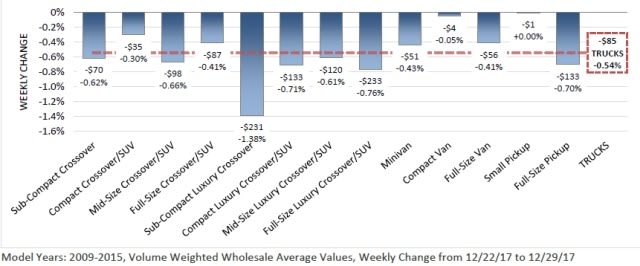
While the end of 2017 brought a record decline in weekly depreciation for cars, volume-weighted, overall truck segment (including pickups, SUVs, and vans) values declined by 0.54% the last week of 2017, according to Black Book. This is in line with the average weekly adjustment of 0.57% over the previous four weeks.
Courtesy of Black Book
Courtesy of Black Book
While the end of 2017 brought a record decline in weekly depreciation for cars, volume-weighted, overall truck segment (including pickups, SUVs, and vans) values declined by 0.54% the last week of 2017, according to Black Book. This is in line with the average weekly adjustment of 0.57% over the previous four weeks.
The medium-duty wholesale market continues its downward trend as we get ready to open the doors to 2018. This past month, late model units (2015-2016) dropped a weighted average of $296 (0.6%), which is less than the previous five months. This is the smallest decline in December that the vehicle valuation company has seen for this segment in many years.
The older model-year segment dropped an average of $127 (0.6%) in December, which is less than the previous month when this segment dropped an average of $154 (0.8%). Black Book noted that this is the third consecutive month where the depreciation on this segment has eased up a bit.
Wholesale and retail demand remains strong as fewer and fewer units find their way to the auction blocks. This makes for a stable market with less data supporting a large downward adjustment. Some units performed better in December compared to November. The units in these segments are veritable and perform countless daily jobs that Black Book expects the demand for these units to increase. Also, we feel like there is some pent-up demand in these segments. So, even as supply slowly increases over the next few years Black Book does not expect prices to fall drastically.
For the heavy-duty market, according to Black Book, late-model over-the-road units are a group of trucks that stand to lose the most from the original dollar invested. Condition and mileage dominate how this segment performs, and they dropped 0.3% more in December than they dropped in November. Savvy late model buyers continue to pay up for these units while expanding or replacing older equipment. These buyers take advantage of the first and second year "depreciation" plus not having to pay the federal excise tax, which is included in the price when a new truck is purchased. This tax can range between $13,000 to $16,250 based on what most new over-the-road trucks are selling for.
Since this tax is a huge part of the first year drop in value, according to Black Book it assists the late-model used-truck buyer in reducing their investment while updating their equipment. Construction/Vocational trucks continue to bring strong numbers at all levels.
Construction, highway infrastructure, and highway expansion projects are the major factors in maintaining their values. Even the older and much older trucks in this segment continue to sell for record values especially if the buyers are check writers. Even though these trucks must comply with federal engine emission standards they don't have to comply with much of the additional requirements imposed on the over-the-road units. Regional Tractors don't bring the premium that they once did over long-haul road tractors except for a few models but if they are equipped properly they still hold their value well.
Courtesy of Black Book
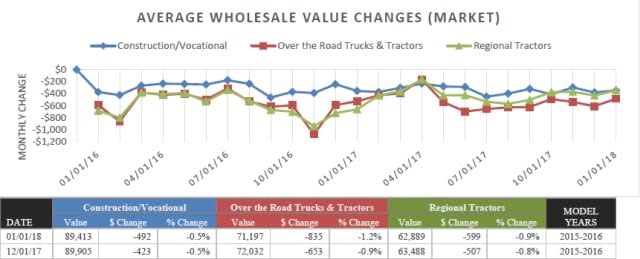
2015-2016 HD Construction/Vocational segment dropped an average of $492 (0.5%) in December compared to the average decline of $423 (0.5%) in November.
2015-2016 HD Over the Road Tractor segment dropped an average of $835 (1.2%) in December compared to the average drop of $653 (0.9%) in November.
2015-2016 HD Regional Tractor segment dropped an average of $599 (0.9%) in December compared to the average depreciation of $507 (0.8%) in November.
More Fleet Management

Color Match Smarter: Tools That Restore & Perform
For fleet managers and collision repair professionals keeping heavy-duty trucks on the road, getting the color right the first time isn't just about appearance — it's about efficiency, turnaround time, and bottom-line results. Discover how today's digital color tools are transforming the repair process from guesswork to precision.
Read More →
FMCSA Pauses Biennial-Update Enforcement Amid Motus Transition
Carriers whose updates were due on or after June 1 have more time, while FMCSA works to stabilize its new registration system and warns of phishing sites impersonating its new carrier registration system, Motus.
Read More →
2026 Blueprint for Countering Smarter Supply Chain Theft
Cargo theft is no longer just the cost of doing business. It's a multi-billion-dollar criminal enterprise exploiting vulnerabilities across your fleet, drivers, and supply chain.
Read More →


How Telematics Improves Visibility, Control, and Performance in Refrigerated Fleets
Explore how telematics help refrigerated fleets improve visibility, uptime, efficiency, compliance, and cargo protection across connected cold chain operations.
Read More →
What the U.S.-Canada Trade War Means for Trucking
Escalating U.S.-Canada tariffs could disrupt cross-border freight, reduce truck volumes, raise costs, and create new uncertainty for carriers on both sides of the border.
Read More →
What Are Trucking’s Top Concerns for 2026?
The American Transportation Research Institute wants to know what's worrying trucking fleet managers, drivers, and other stakeholders in its annual Industry Issues survey.
Read More →
American Trucking Associations Looks for a New Leader
ATA President and CEO Chris Spear abruptly left his job at the association on August 21, at a pivotal time for the trucking industry.
Read More →
Public Wi-Fi Cybersecurity Risks: How Truck Drivers and Fleets Can Protect Their Data
Public Wi-Fi can expose truck drivers and fleets to credential theft, malware, and other cyber threats. Here’s how to reduce the risk on the road.
Read More →
For Nicky Cupp, Fleet Innovation Starts With Frustration
HDT Truck Fleet Innovator Nicky Cupp turns everyday pain points at Fraley & Schilling into opportunities for better technology and smarter processes.
Read More →
Adam Buttgenbach’s Approach to Electric Trucks: Start With Where They Fit
HDT Truck Fleet Innovator Adam Buttgenbach helped PepsiCo build one of North America’s largest EV fleets by focusing on where electric trucks make operational sense.
Read More →