




Phillips Industries Celebrates 90 Years
Phillips Industries embarked on a year-long celebration of its 90th year in business with a press conference during Heavy Duty Aftermarket Week.
by Staff
January 23, 2018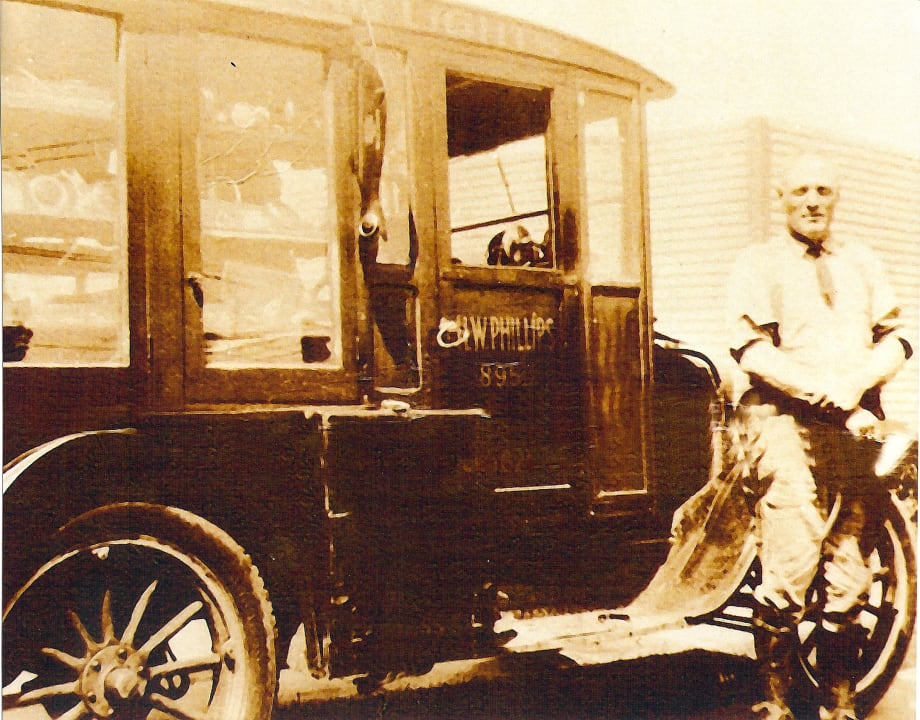
Hugh Wallace Phillips, founder of what was then H.W. Phillips. Photo: Phillips Industries
3 min to read
Hugh Wallace Phillips, founder of what was then H.W. Phillips.Photo: Phillips Industries
LAS VEGAS – Phillips Industries embarked on a year-long celebration of its 90th year in business with a press conference during Heavy Duty Aftermarket Week.
Rob Phillips, president and COO, detailed historical milestones and cultural principles important to the formation and development of the company into an innovator of commercial vehicle electrical and air brake components and global supplier.
From its beginning in 1928, as a Los Angeles auto and truck parts distributor, to a global business, manufacturing and distributing over 8,000 products in more than 40 countries, Phillips Industries said it has stayed true to the family values of taking care of customers and employees, a can-do solve it attitude for any problem, determination and reinvesting in the business. Phillips Industries operates three manufacturing facilities, in California, Mexico and China staffed with more than 1,000 employees.
Some facts about Phillips Industries:
Every truck that is manufactured in North America has Phillips products on it.
Mercedes trucks manufactured in Europe are standard with Phillips products.
Over 55% of North-American-produced trailers are shipped with Phillips components.
The largest trailer manufacturer in China uses Phillips harnesses as standard.
“While we’re exceedingly proud of our history, we’re even more excited about our future,” Phillips said. “We are not going to concede our position simply because the commercial vehicle industry is changing. We’ve identified, through listening to our fleet contacts as well as other component suppliers, what the future needs are for communicating and analyzing the data generated through the increasing number of sensors in a user-friendly way. [Phillips Connect Technologies] is working today with fleets to fully develop and launch this new capability. Stay tuned.”
As part of the 90th year celebration, Phillips is rolling out a number of videos with Bob Phillips talking about the history of the company.
Some key milestones in the 90-year history of Phillips Industries:
1928 – H.W. Phillips began as an auto and truck parts distributor in California.
1936 – Hugh Phillips designed and patented the first reflective directional signal arm for trucks.
1968 – Straight 7-way electrical assemblies were manufactured and introduced by Phillips Industries.
1976 – Bob Phillips, currently CEO, designed the Supercoil, which he says was the industry’s first 7-way coiled electrical assembly in North America.
1982 – Phillips introduces Sta-Dry weather-proof socketbreakers to fight corrosion.
1985 – The distribution business was sold to focus on manufacturing due to increased demand from fleets and OEMs.
1991 – Phillips acquired and opened an Electrical Harness Division dedicated to manufacturing sealed modular trailer harness systems. EHD would expand in production relocating twice in the next 20 years to accommodate its growth.
1999 – New 130,000-square-foot headquarters and manufacturing facility is constructed in Santa Fe Springs, California.
2001 – The QCS (Quick-Change Socket) becomes standard at 80% of North American truck OEMs.
2010 – Phillips Industries begins production of 12v and 24v products in China for the global trucking market.
2013 – Rob Phillips takes the helm of Phillips Industries.
2013 – The Sta-Dry QCMS2 is introduced as what Phillips says is the industry’s first 7-way electrical assembly with a plug and socket hybrid connection.
2014 - Permalite XT lighting with Boardfree technology is introduced.
2015 – The Electrical Harness Division (EHD) moves to its current location in Arteaga, Mexico.
2016 – Phillips China moves to new 8.5-acre site.
2017 – A new division, Phillips Connect Technologies (PCT), emerges with the advancement of technology, to develop solutions for future intelligent commercial vehicles.
As part of the anniversary celebration, Phillips put out an ad starring Nikola Motors' new zero-emissions truck:
More Equipment

How Volvo Updated Its D13 for EPA 2027 [Watch]
Volvo’s updated D13 promises lower emissions without sacrificing performance or fuel economy. Take a closer look at what changed inside the engine in this HDT Spotlight video.
Read More →
Michelin Tire Improves Efficiency and Durability for Regional Fleets
The Michelin X Multi Energy D2 is a regional haul drive tire engineered to help fleets improve fuel efficiency, durability and traction in demanding stop-and-go operations.
Read More →
ZF Expands Commercial Vehicle Push in North America
ZF is expanding its North American commercial-vehicle presence with new transmission applications, electrification, trailer technology and autonomous-driving systems.
Read More →
Tesla Wants a Self-Driving Semi. Are Cameras Enough?
Could Tesla’s camera-only autonomous driving technology work on an 80,000-pound Semi? In this commentary, HDT's Deborah Lockridge takes a look at Tesla, Cybercab, and how autonomous trucks see the road.
Read More →
Kodiak: Driverless Long-Haul Truck Launch on Track for 2026
Kodiak AI says its driverless long-haul safety case is 93% complete and it remains on track to begin commercial operations by year-end 2026.
Read More →
What DOT’s Automated Vehicle Strategy Means for Trucking
The U.S. Department of Transportation issued a new automated-vehicle strategy that outlines plans for driverless-truck regulations, cross-state freight corridors, and federal safety standards.
Read More →
East Coast Port Launches $45M Electric Truck Push
The Port Authority of New York and New Jersey announced millions in incentives for zero-emission drayage trucks, yard tractors, and new charging hubs near the port.
Read More →
PlusAI Going Public to Fund Autonomous Truck Launch
A SPAC deal could provide PlusAI with up to $300 million as it works toward a 2027 commercial launch of factory-built autonomous trucks.
Read More →
NHTSA Moves to Rewrite Truck Fuel-Economy Rules
The National Highway Traffic Safety Administration says it lacks authority to regulate medium- and heavy-duty truck engines separately from complete vehicles, but the existing standards have not yet been eliminated.
Read More →
Detroit Opens Orders for EPA 2027 Engines
Detroit isn’t starting from scratch to meet EPA 2027 diesel emissions standards. Its Gen 6 DD13 and DD15 engines keep much of today’s platform while updating the fuel and aftertreatment systems.
Read More →