




Ontario's MTO to Sideline Three Truck Inspection Sites
The Ministry of Transportation in Ontario says it will close three truck inspection stations and scale facilities in October
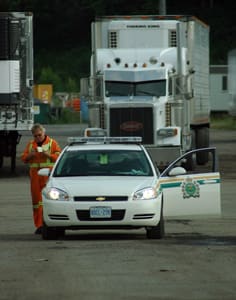
The closures and redeployment are, in part, a response to criticisms leveled against MTO's roadside enforcement record by the province's Office of the Auditor General. (Photo by Jim Park)
The Ministry of Transportation in Ontario says it will close three truck inspection stations and scale facilities in October.
A ministry spokesperson, Bob Nichols, says the move is intended to better focus both capital and human resources to higher volume sites to ensure the number of inspections remains the same and that the province's roads remain safe.
"The number of inspections and enforcement officers will not change. There are no job losses are associated with this," he said. "We are simply using our resources more efficiently where traffic demand warrants, without compromising truck safety."
The three inspection sites slated to close are the Sarnia North site, located on the westbound lanes of Highway 402 approximately five miles from the U.S. border at Sarnia/Pt. Huron; the Winona (Stoney Creek) site, located on the Niagara-bound lanes of the Queen Elizabeth Way (QEW) between Hamilton, Ontario, and the U.S. border at Buffalo, N.Y.; and the Fort Erie site, located on the Toronto-bound lanes of the QEW about two miles from the U.S. border at Buffalo.
"The Sarnia and Winona sites are close to the U.S. border. These trucks would have already been inspected at other truck inspections stations located further east," Nichols says. "The Fort Erie site is located close to our Vineland truck inspection station; to make better use of our resources we are focusing on our Vineland location, less than 45 minutes away. It can accommodate the extra volume."
The closures and redeployment are, in part, a response to criticisms leveled against MTO's roadside enforcement record by the province's Office of the Auditor General -- a government watchdog in place to ensure government departments deliver value for dollars spent on public programs (similar to the U.S. Government Accountability Office) in 2008. The report noted that in 2007, "only three out of every 1,000 commercial vehicles were subject to roadside inspection," and, "between 2003 to 2007, only 20 percent of Ontario operators were subject to any roadside inspections."
The OAG specifically highlighted the lack of nighttime, weekend, and holiday inspections noting that number of inspections, and the number of open inspection stations drops dramatically during non-business hours.
"One of the criticisms the OAG had was the hours of operation -- mostly daylight hours -- at our inspection stations," Nichols said. "By increasing the staffing levels at our priority sites by closing low priority [stations] and transferring staff to priority sites, we will be able to operate more hours through a 24hr period. That would address one of the OAG concerns. The changes also result from a review of our operations and a new strategic enforcement plan, which was implemented in April 2010."
In the report, the OAG noted that in 2007/08, MTO employed approximately 250 field enforcement officers, who conducted some 99,000 roadside inspections. Nichols says truckers can expect MTO to maintain that level of enforcement.
"We remain committed to conducting approximately 100,000 commercial driver and vehicle inspections, six province-wide and 250 regional truck safety blitzes every year."
Despite consistent annual increases in truck traffic on Ontario highways in previous years, there has been a decrease in the number and frequency of fatal collisions involving large trucks over the last 19 years. Nichols noted that Ontario's roads are among the safest in North America, and MTO is committed to ensuring it stays that way.
"This move will not affect the public traveling on our highways," he stressed. "We are simply using our resources more efficiently without compromising truck safety. Last year we implemented a law requiring speed limiters on large trucks - proof of our ongoing commitment to road safety."
More Equipment

ZF Expands Commercial Vehicle Push in North America
ZF is expanding its North American commercial-vehicle presence with new transmission applications, electrification, trailer technology and autonomous-driving systems.
Read More →
Tesla Wants a Self-Driving Semi. Are Cameras Enough?
Could Tesla’s camera-only autonomous driving technology work on an 80,000-pound Semi? In this commentary, HDT's Deborah Lockridge takes a look at Tesla, Cybercab, and how autonomous trucks see the road.
Read More →
Kodiak: Driverless Long-Haul Truck Launch on Track for 2026
Kodiak AI says its driverless long-haul safety case is 93% complete and it remains on track to begin commercial operations by year-end 2026.
Read More →
What DOT’s Automated Vehicle Strategy Means for Trucking
The U.S. Department of Transportation issued a new automated-vehicle strategy that outlines plans for driverless-truck regulations, cross-state freight corridors, and federal safety standards.
Read More →
East Coast Port Launches $45M Electric Truck Push
The Port Authority of New York and New Jersey announced millions in incentives for zero-emission drayage trucks, yard tractors, and new charging hubs near the port.
Read More →
PlusAI Going Public to Fund Autonomous Truck Launch
A SPAC deal could provide PlusAI with up to $300 million as it works toward a 2027 commercial launch of factory-built autonomous trucks.
Read More →
NHTSA Moves to Rewrite Truck Fuel-Economy Rules
The National Highway Traffic Safety Administration says it lacks authority to regulate medium- and heavy-duty truck engines separately from complete vehicles, but the existing standards have not yet been eliminated.
Read More →
Detroit Opens Orders for EPA 2027 Engines
Detroit isn’t starting from scratch to meet EPA 2027 diesel emissions standards. Its Gen 6 DD13 and DD15 engines keep much of today’s platform while updating the fuel and aftertreatment systems.
Read More →
Carrier Transicold Adds All-Electric TRU for Stationary Cold Storage
Carrier Transicold’s new Vector 8200 all-electric transport refrigeration unit gives fleets a diesel-free option for temporary refrigerated and frozen trailer storage.
Read More →
A Closer Look at Kenworth’s Electric T880E Vocational Truck [Video]
Learn more about Kenworth's T880E battery-electric vocational truck at the Paccar Technical Center, including its range, applications, upfitting considerations, and PTO options, in this HDT Spotlight video.
Read More →