




Study: The Dangers of Distracted Truck Drivers
The most distracted truck drivers are nearly 72% more likely to be involved in a “near collision” than other drivers, according to new data insights released July 22 by Omnitracs.

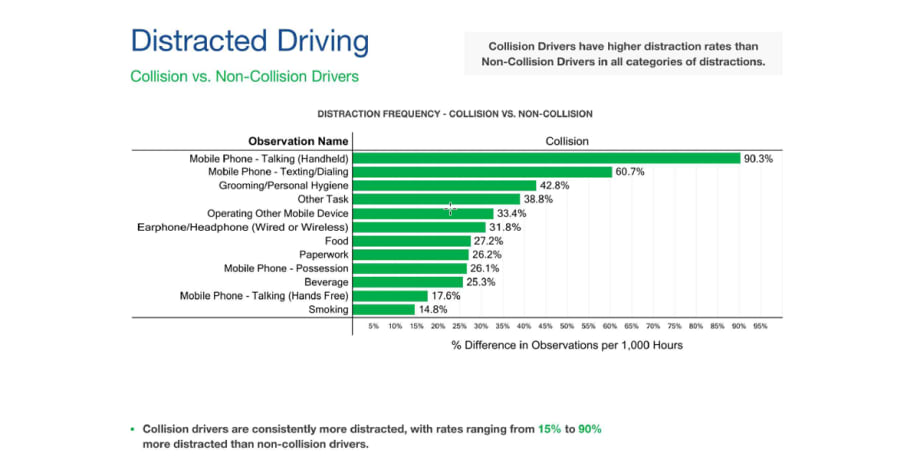
"Collision Drivers" have higher distraction rates than "Non-Collision Drivers" in all categories of distraction.
Graphic: Omnitracs
The most distracted truck drivers are nearly 72% more likely to be involved in a “near collision” than other drivers, according to new data insights released July 22 by Omnitracs.
The company said that the data analysis, based on aggregated and anonymized data from its SmartDrive video‐based analytics platform among trucking fleets, “clearly demonstrates that the most distracted drivers are less safe overall, commit significantly more fundamental driving errors, and drive faster than the speed limit compared to all other drivers.”
And despite federal law limiting commercial drivers while driving to using only a hands-free phone “located in close proximity,” the report shows that “drivers who are distracted by mobile phones are three times more likely to drive 10 plus miles over the speed limit.” Given the danger inherent in that noncompliance, perhaps it is little wonder that SmartDrive data also indicates that the most distracted drivers are less likely to wear a seatbelt.
Or as Omnitracs puts it sharply, “The data analysis clearly demonstrates that the most distracted drivers are less safe overall, commit significantly more fundamental driving errors, and drive faster than the speed limit compared to all other drivers.”
More specifically, the analysis of in‐cab video and observation data — gathered over 29 billion driving miles — shows that distracted drivers are more likely than all other drivers to have a near collision, fail to stop at an intersection, and exceed the speed limit. Omnitracs also noted that this “confirms the widely held assumption that mobile devices are the predominant cause of distracted driving.”
These latest insights were developed over a 12-month analysis period and validated via video analysis. Omnitracs said the findings prove that distraction has a correlation to near collisions and collisions, and the most distracted drivers are significantly more dangerous than others (and least likely to wear seatbelts).
Other significant conclusions include:
Truck drivers distracted heavily by mobile phones are involved in collisions at a rate 2 times higher than the least distracted drivers
Drivers identified as “most distracted” roll through stop signs and traffic lights at a rate 2.7 times higher than the least distracted drivers
Drivers distracted heavily by mobile phones had speed incidents of 10 plus mph over the speed limit at a rate 3.2 times higher than the least distracted drivers
Drivers identified as “most distracted” drift out of lane at a rate 2.3 times higher than those identified as “least distracted” drivers.
Drivers identified as “most distracted” fail to wear a seatbelt at a rate over 3 times higher than “least distracted” drivers
A key aspect of the methodology was performing “distraction segmentation” three times, once for each subset of distraction types:
All Distractions(a total of 13 types of distractions): Drivers in the highest 25% bracket for distraction observation rate (distraction observations per 1,000 hours) for each company in a given month. (Minimum of three distraction observations.)
Mobile Only (a subset of four types of distraction): Drivers in the highest 25% bracket for mobile phone observation rate for each company in a given month. (Minimum of three mobile phone distraction observations.)
Non-Mobile(a subset of nine types of distraction): Drivers in the highest 25% bracket for non-mobile phone distraction observation rate for each company in a given month. (Minimum of three non-mobile phone distraction observations.)
"Preliminary National Safety Council data indicates that 42,060 people died in motor vehicles crashes in 2020,” commented Jason Palmer, Omnitracs’ general manager, Transportation Intelligence. “That’s an 8% rise from 2019, and 2020 was a year where people drove significantly less frequently because of the pandemic. In addition, the rate of death on the roads spiked 24% over the previous 24‐ month period, despite miles driven dropping 13%. Unfortunately, distracted driving is still an epidemic.”
The complete Distracted Driving Data Insights report is available from Omnitracs online. It includes a list of nine top tips to help fleets eliminate distracted driving in their operations.
More Drivers

Truck Drivers Need More Than Another Alert
Fleets have more visibility into truck health, safety events, and driver activity than ever. The next challenge is turning all that information into useful guidance for the person who has to decide what to do next.
Read More →
FMCSA Removes 110 Truck Driver Training Schools from Certified ELDT List
Federal regulators also are targeting more than 160 additional training providers and launching a nationwide audit of third-party CDL skills testers as part of a broader crackdown on trucking fraud.
Read More →
Hours of Service Pilot Programs: FMCSA Readies for 2027 Rollout
Two pilot programs could eventually reshape hours-of-service rules, giving truck drivers options to pause their 14-hour clock or use longer split sleeper rest periods.
Read More →
Medical Cards, English Proficiency Reshape Roadcheck Violations
Medical-card violations jumped to the top of the driver out-of-service list during CVSA’s 2026 International Roadcheck, while English-language proficiency violations appeared among the leading violations for the first time.
Read More →
Driver Trust Can Make or Break the Success of Fleet Safety Technology
New Teletrac Navman research suggests that onboarding, transparency about driver data, and positive feedback can play a significant role in how commercial drivers respond to safety and coaching technology.
Read More →
EEOC Sues KLLM Over Alleged Sex Discrimination in Driver Training
KLLM is facing a federal sex-discrimination lawsuit over policies the EEOC alleges put female truck driver trainees at a disadvantage.
Read More →
FMCSA Moves to Codify English Language Requirements for Commercial Drivers
By changing regulations on English-language proficiency requirements for commercial drivers, rather than relying on a guidance memo, the FMCSA said future administrations won't be able to walk back the Trump administration's stricter enforcement with just a memo.
Read More →
Drivers Put Western Star Trucks to the Test at Star Nation Experience
Watch to get an inside look at the Western Star trucks, technology, and community behind the Star Nation Experience 2026!
Read More →
Trump Administration Looks to Put More Veterans Behind the Wheel
The Freedom Haulers program pulls together existing and expanded programs at several federal agencies to recruit veterans to drive commercial heavy-duty trucks and cut the red tape for them to get a CDL, training, and employment.
Read More →
Putting Mack’s Command Steer to the Test
A test drive of Mack’s Command Steer active steering system evaluates how it can make truck driving easier and less tiring.
Read More →