




Related: Ore. Beverage Fleet Reduces Fuel Costs with Autogas
NYC Beer Distributor Adds CNG Volvo Tractors
Manhattan Beer Distributors recently purchased 35 compressed natural gas (CNG)-powered Volvo VNM 200 model tractors for its New York City fleet.
by Staff
October 30, 2015
Photo courtesy of Volvo Trucks.
2 min to read
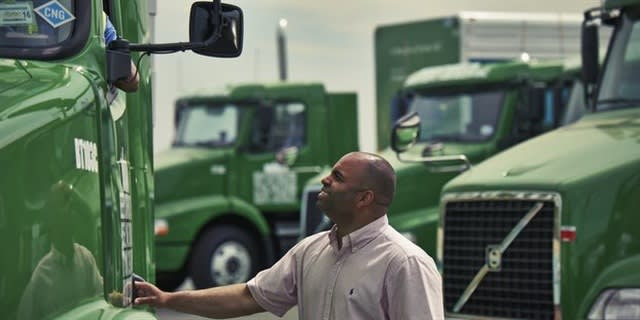
Photo courtesy of Volvo
Manhattan Beer Distributors recently purchased 35 compressed natural gas (CNG)-powered Volvo VNM 200 model tractors for its New York City fleet. Manhattan Beer executives said they chose Volvo models due to the strong relationship with its dealer and because the VNM 200 – Volvo’s regional haul daycab – offered the durability of a Class 8 model paired with the maneuverability necessary for urban deliveries.
The Volvo VNM 200 models, powered by 9.0L Cummins Westport ISL-G CNG engines, emit about 20% less greenhouse gas emissions than comparable diesel-powered models.
Manhattan Beer’s new Volvo models also improve the company’s freight efficiency. The company is using its single rear axle Volvo VNM 200 tractors with trailers that have 16 beverage bays to replace straight trucks with 10 beverage bays. In New York City, straight trucks are limited to 35 feet in length while combinations can run 55 feet. Manhattan Beer cannot cover a typical route with a single straight truck, but it can with a combination. The company specified the tractors with single rear axles to provide maximum maneuverability in challenging New York City distribution routes.
Juan Corcino, director of fleet operations for Manhattan Beer, said that freedom from the operation and maintenance of diesel particulate filters (DPFs) and selective catalytic reduction (SCR) systems played a major role in justifying the investment in CNG.
Volvo offers CNG and liquefied natural gas (LNG) solutions for both the Volvo VNM 200 and the Volvo VNL 300 that's powered by the 12.0L Cummins Westport ISX12 G engine.
Manhattan Beer Distributors operates 110 CNG-powered trucks in a total fleet of more than 500, which are predominantly medium-duty straight trucks.
More Fuel Smarts

How Volvo Updated Its D13 for EPA 2027 [Watch]
Volvo’s updated D13 promises lower emissions without sacrificing performance or fuel economy. Take a closer look at what changed inside the engine in this HDT Spotlight video.
Read More →
Diesel Price Spike Shortens Payback for Natural Gas Trucks, Report Says
Energy Vision estimates fleets could recover the higher purchase price of an RNG-fueled Class 8 tractor in 1.3 to 2.8 years under current fuel-price scenarios.
Read More →
Calstart Becomes Catalyst Mobility, Reflecting Broader Focus
Calstart is now Catalyst Mobility, reflecting the nonprofit’s growing national role in clean transportation, including zero-emission trucks, infrastructure and incentive programs.
Read More →

Record Diesel Prices Squeeze Trucking Fleets
Average U.S. diesel prices have climbed to nearly $6 a gallon, surpassing the 2022 record as tight refinery capacity and Middle East disruptions keep fuel costs elevated.
Read More →
Sponsored•September 9, 2026
How Fuel Delivery Shapes Engine Performance
Fuel delivery depends on more than what happens at the injector. For fleet, maintenance and technical professionals, looking at the full path from pump to injector can provide useful context for understanding engine performance.
Read More →
East Coast Port Launches $45M Electric Truck Push
The Port Authority of New York and New Jersey announced millions in incentives for zero-emission drayage trucks, yard tractors, and new charging hubs near the port.
Read More →
California Bill Could Shed Light on Electric Truck Prices
Why do battery-electric Class 8 trucks remain so expensive? A California bill headed to Gov. Gavin Newsom would give fleets and state agencies more visibility into what manufacturers charge.
Read More →
Detroit Opens Orders for EPA 2027 Engines
Detroit isn’t starting from scratch to meet EPA 2027 diesel emissions standards. Its Gen 6 DD13 and DD15 engines keep much of today’s platform while updating the fuel and aftertreatment systems.
Read More →
Zero-Emission Truck Corridor Planned for West Coast
California, Oregon, Washington, British Columbia and Baja California are coordinating plans for truck charging and hydrogen fueling from Canada to Mexico.
Read More →
A Closer Look at Kenworth’s Electric T880E Vocational Truck [Video]
Learn more about Kenworth's T880E battery-electric vocational truck at the Paccar Technical Center, including its range, applications, upfitting considerations, and PTO options, in this HDT Spotlight video.
Read More →