




New York City Congestion Pricing Plan Takes Effect
New York City has officially started its controversial congestion pricing plan, which trucking interests have vowed to keep fighting.

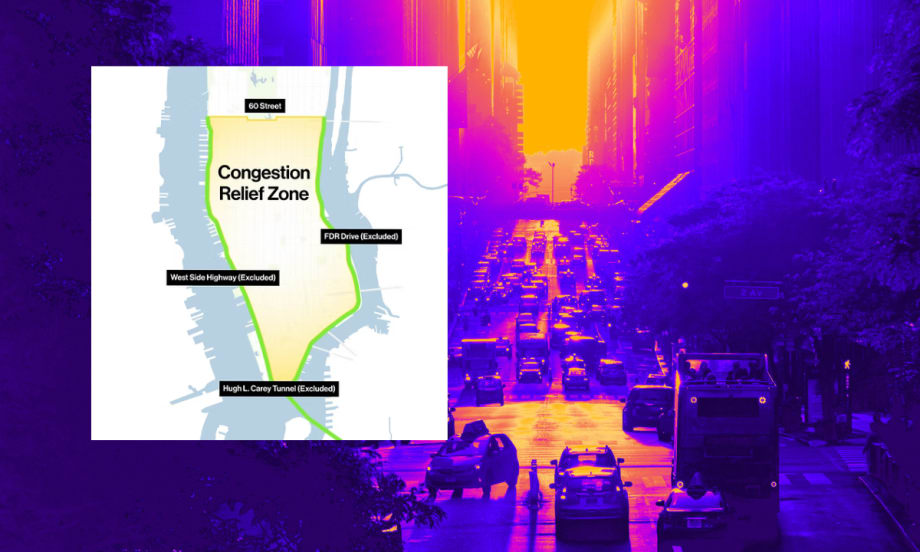
Trucks going into part of Manhattan now face congestion-pricing tolls.
Image: HDT Graphic
New York City has officially started its controversial congestion pricing plan, which trucking interests have vowed to keep fighting.
As of January 5 in New York City, heavy-duty trucks must pay $21.60 each time they enter Manhattan south of 60th Street between 5 a.m. and 9 p.m. on weekdays and between 9 a.m. and 9 p.m. on weekends.
The fee for heavy-duty trucks under the Central Business District Tolling Program is scheduled to rise to $28.80 in 2028 and $36.00 in 2031.
An article from the Wall Street Journal’s Logistics Report points out that other cities are watching closely with an eye toward enacting similar programs. San Francisco and Los Angeles have explored their own versions of business-district tolls.
The congestion plan has been making its way through the courts for years. Recently a judge rejected the Trucking Association of New York’s motion for preliminary injunction against the plan, allowing it to move forward.
Why the Trucking Association of New York Opposes NYC's Congestion Pricing
The association contends that the disproportionate pricing structure unfairly targets trucking operators (4% of all NYC vehicle traffic) on a per-trip basis, while passenger vehicles (which constitute 87% of all NYC vehicle traffic) are only charged once per day.
“This burden — which is far heavier for the trucking industry than any other — will have significant downstream impacts on the entire economy,” said TANY President Kendra Hems in a statement.
“While congestion pricing has only just taken effect, our drivers are already bracing for the severe impact these tolls will have on their operations in the days and weeks ahead," Hems said.
The association is not inherently opposed to congestion pricing, she explained. But it objects to the disproportionate pricing structure.
"The trucking industry is not able to adapt like commuters who have the ability to use alternative modes of transportation," Hems said. "Grocery stores, after all, can’t be stocked with shipments that travel on the subway.
"Additionally, while we fully support overnight deliveries, our drivers do not determine when and where deliveries occur — their customers do. In other words, drivers do not have the luxury of being able to drive during off-peak hours.
"The trucking industry fully supports finding a way to reduce traffic and improve the environment, but these efforts should not come at the cost of businesses and residents who in many cases serve as a lifeline to New Yorkers.”
The On-Again, Off-Again Congestion Pricing Plan
Last summer, New York Gov. Kathy Horchul put the program on pause just weeks before it was scheduled to go into effect. She revived it in November with lower pricing. For large trucks, for instance, the fee came down from the original proposal of $36 to $21.60.
“When congestion pricing was delayed earlier in 2024, we had the chance to go back to the drawing board to ensure parity for much of the city’s economic backbone, including the trucking industry, which moves nearly 90 percent of goods in the five boroughs,” Hems said.
The association said the congestion pricing program could lead to unstocked store shelves, restaurants unable to get needed food and supplies, and a lack of immediate access to life saving medications.
“We will continue to advocate for the needs of the communities we serve. As such, we will take this challenge as far as we need to.”
There have been a number of other legal challenges against the congestion pricing plan, including one from the state of New Jersey, which predicted environmental harm if traffic gets worse on the other side of the river.
According to published reports, there’s been a rush to get the plan implemented before President Donald Trump takes office Jan. 20. The New York Times reports that the president-elect has promised to end it permanently once he takes office on Jan. 20, but his options are limited now that the plan is underway.
Updated 1/7/2025 to add new statement from TANY
More Fleet Management

Color Match Smarter: Tools That Restore & Perform
For fleet managers and collision repair professionals keeping heavy-duty trucks on the road, getting the color right the first time isn't just about appearance — it's about efficiency, turnaround time, and bottom-line results. Discover how today's digital color tools are transforming the repair process from guesswork to precision.
Read More →
FMCSA Pauses Biennial-Update Enforcement Amid Motus Transition
Carriers whose updates were due on or after June 1 have more time, while FMCSA works to stabilize its new registration system and warns of phishing sites impersonating its new carrier registration system, Motus.
Read More →
2026 Blueprint for Countering Smarter Supply Chain Theft
Cargo theft is no longer just the cost of doing business. It's a multi-billion-dollar criminal enterprise exploiting vulnerabilities across your fleet, drivers, and supply chain.
Read More →


How Telematics Improves Visibility, Control, and Performance in Refrigerated Fleets
Explore how telematics help refrigerated fleets improve visibility, uptime, efficiency, compliance, and cargo protection across connected cold chain operations.
Read More →
What the U.S.-Canada Trade War Means for Trucking
Escalating U.S.-Canada tariffs could disrupt cross-border freight, reduce truck volumes, raise costs, and create new uncertainty for carriers on both sides of the border.
Read More →
What Are Trucking’s Top Concerns for 2026?
The American Transportation Research Institute wants to know what's worrying trucking fleet managers, drivers, and other stakeholders in its annual Industry Issues survey.
Read More →
American Trucking Associations Looks for a New Leader
ATA President and CEO Chris Spear abruptly left his job at the association on August 21, at a pivotal time for the trucking industry.
Read More →
Public Wi-Fi Cybersecurity Risks: How Truck Drivers and Fleets Can Protect Their Data
Public Wi-Fi can expose truck drivers and fleets to credential theft, malware, and other cyber threats. Here’s how to reduce the risk on the road.
Read More →
For Nicky Cupp, Fleet Innovation Starts With Frustration
HDT Truck Fleet Innovator Nicky Cupp turns everyday pain points at Fraley & Schilling into opportunities for better technology and smarter processes.
Read More →
Adam Buttgenbach’s Approach to Electric Trucks: Start With Where They Fit
HDT Truck Fleet Innovator Adam Buttgenbach helped PepsiCo build one of North America’s largest EV fleets by focusing on where electric trucks make operational sense.
Read More →