




Natural Gas' Early Adopters See Few Hiccups During Startup
According to the first-hand accounts presented at the Green Fleet Conference & Expo in Schaumburg, Ill., integrating natural gas trucks into previously diesel-only operations has gone surprisingly well.

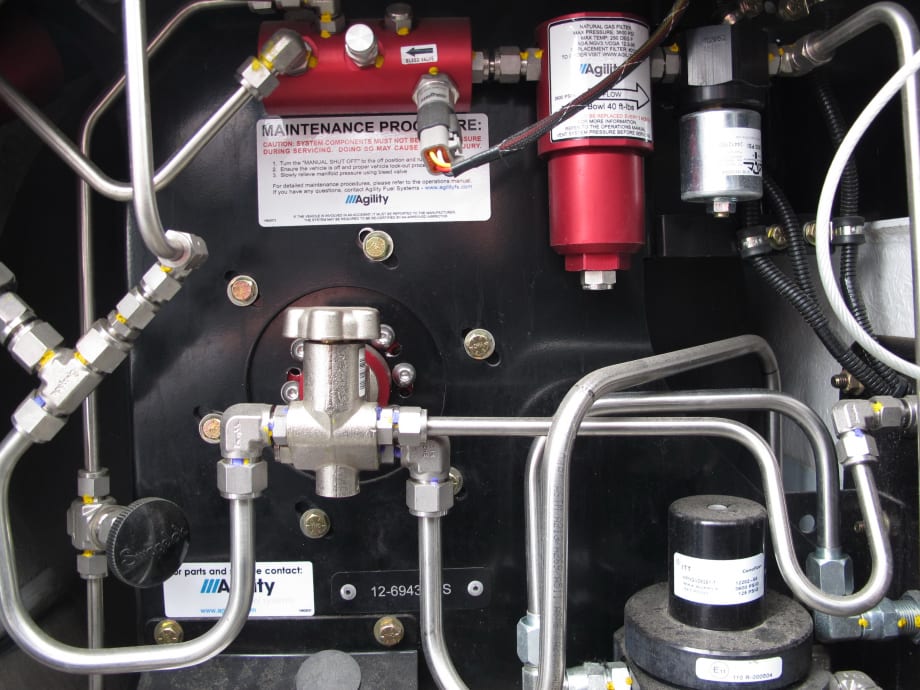
Sorting out the natural gas maze has been easier than expected for these fleets.
Sorting out the natural gas maze has been easier than expected for these fleets.
CORRECTED -- Carriers considering switching all or some portion of their fleets from diesel to natural gas heard first hand Wednesday from three early adopters how their transitions proceeded. According to the accounts presented in a panel discussion during the Green Fleet Conference & Expo in Schaumburg, Ill., integrating natural gas trucks into previously diesel-only operations went surprisingly well.
The panel discussion, moderated by Annalloyd Thomason, vice president and general manager of the Las Vegas-based Natural Gas Vehicle Institute, featured Joe Shefchik, vice president of business development at Paper Transport of Green Bay, Wis.; Joel Fasnacht, business development director for alternative and commercial fuels at Kwik Trip, based in La Crosse, Wis.; and Tim Ozinga, director of marketing communications at Ozinga Bros of Chicago.
Each of the participants was a relatively early adopter of natural gas engines for heavy trucks. The business models are varied. Ozinga operates a fleet of concrete mixers at several terminals around the Chicagoland area. Paper Transport is a regional truckload operation that adopted natural gas in February 2010. The company has 101 CNG trucks on the road today operating across the Midwest and Southeast and has accumulated over 1 million miles per month on its natural gas trucks. Kwik Trip has 72 trucks with about 9 million total miles to date.
None of the three reported anything surprising as the fleet roll-outs proceeded, noting that they knew very little about natural gas going into the program.
"Nothing was really a surprise because we came in knowing almost nothing," said Shefchik. "It has worked better than most people led us to believe it would. We found fewer hurdles than we expected."
Among the hurdles were maintenance schedules, particularly oil change intervals. Natural gas engines require more frequent oil changes than diesels, but the precise intervals can vary with the application. Ozinga's concrete mixer fleet spends more time at idle than Paper's over-the-road fleet, for example, so direct comparisons are difficult.
"The manufacturers were good with guidance and helping us understand what was needed and why," Ozinga said.
Paper Transport also had some challenges determining oil change intervals early on.
“The 9L engine we were running in our first new trucks had principally been used in different applications,” Shefchik said. "What they knew about mileage-based oil changes suggested the intervals should to be very short on a miles-per-hour ratio. In truckload, it's all mileage-based, not hours, so those first estimates proved to be very expensive."
Even though oil samples taken during PMs are coming back consistently clean, the OEs are still holding the reins on the drain intervals.
"We have increased the intervals from the outset, but they are still governed by warranties," Fasnacht said.
In the end, Shefchik was surprised to see how willing the OEs and the service providers were to work out the differences. Maintenance is now cost competitive with diesel, he said.
Fuel prices were one of the reasons the fleets decided to try natural gas, though Shefchik said he was anxious to differentiate his company from other fleets in the market.
"When you're running around with a 53-foot box that you can put anything in, it can be difficult to differentiate yourself from the competition," he noted. "We saw an opportunity to save money, but the distinction was the most important factor."
When asked what would spur any of the panelists' fleets into 100% adoption of CNG, the answer was $4.50 diesel fuel.
"When we began, diesel prices were higher than today and very unstable," said Fasnacht. "That's changed slightly today, with diesel trending downward and stabilizing. Natural gas has increased, but remained fairly stable relative to diesel over the long term. In the end, everybody loves green but they have to see the green in the wallet too. From a cost standpoint, it needs to be cost competitive."
Kwik Trip is running 72 natural gas trucks right now, 14 of which are LNG. Fasnacht said they will be buying all CNG going forward. "By the end of this year, we'll be at 50% of the fleet," he said. "We'll be closer to 70% by September of next year."
The big question, however, did not produce any concrete answers. Return on investment is a huge consideration when switching from diesel to natural gas. All three fleets reported positive ROI, but noted that it fluctuates with a number of factors, including the operation itself, the cost of fuel, maintenance costs, driver acceptance, customer acceptance, availability of fuel and more.
But there are intangible benefits too.
Ozinga reports that labor costs have dropped since the trucks now slow fill overnight, virtually on their own, rather than the drivers spending time at the yard fuel pumps.
"We have a unionized workforce and labor is one of our biggest expenses," he said. "That saved us about a half an hour per driver per day. And the publicity that extended from being an early adopter of the cleaner fuel hasn't done us any harm either. That was really the frosting on the cake."
While the early adopters suffered few insurmountable challenges, many of those problems are now behind them. Among them were the lack of fueling stations. That's changing rapidly, as are the quality of the fueling locations.
"Our drivers weren't happy at first with the natural gas fuel sites," noted Shefchik. "They were accustomed to the amenities found at truck stops, and many of the natural gas sites in the early years didn't really cater to drivers. That has changed, and we're certainly hearing fewer complaints."
While natural gas is still in the early years, experience gained from the first adopters in the earliest years suggest conditions for making the switch are getting easier, even if the price component of the discussion is becoming murkier. Diesel is dropping and some analysts seem to think it will remain low for the foreseeable future. But natural gas prices are still lower, even on a Diesel Gallon Equivalent (DGE) basis, and will likely remain lower than diesel even in the very long term. As equipment costs continue to decline, the ROI argument should become more compelling still.
Corrected 10/31/2014 to clarify Paper Transport's early oil change challenges.
More Fuel Smarts

How Volvo Updated Its D13 for EPA 2027 [Watch]
Volvo’s updated D13 promises lower emissions without sacrificing performance or fuel economy. Take a closer look at what changed inside the engine in this HDT Spotlight video.
Read More →
Diesel Price Spike Shortens Payback for Natural Gas Trucks, Report Says
Energy Vision estimates fleets could recover the higher purchase price of an RNG-fueled Class 8 tractor in 1.3 to 2.8 years under current fuel-price scenarios.
Read More →
Calstart Becomes Catalyst Mobility, Reflecting Broader Focus
Calstart is now Catalyst Mobility, reflecting the nonprofit’s growing national role in clean transportation, including zero-emission trucks, infrastructure and incentive programs.
Read More →

Record Diesel Prices Squeeze Trucking Fleets
Average U.S. diesel prices have climbed to nearly $6 a gallon, surpassing the 2022 record as tight refinery capacity and Middle East disruptions keep fuel costs elevated.
Read More →
How Fuel Delivery Shapes Engine Performance
Fuel delivery depends on more than what happens at the injector. For fleet, maintenance and technical professionals, looking at the full path from pump to injector can provide useful context for understanding engine performance.
Read More →
East Coast Port Launches $45M Electric Truck Push
The Port Authority of New York and New Jersey announced millions in incentives for zero-emission drayage trucks, yard tractors, and new charging hubs near the port.
Read More →
California Bill Could Shed Light on Electric Truck Prices
Why do battery-electric Class 8 trucks remain so expensive? A California bill headed to Gov. Gavin Newsom would give fleets and state agencies more visibility into what manufacturers charge.
Read More →
Detroit Opens Orders for EPA 2027 Engines
Detroit isn’t starting from scratch to meet EPA 2027 diesel emissions standards. Its Gen 6 DD13 and DD15 engines keep much of today’s platform while updating the fuel and aftertreatment systems.
Read More →
Zero-Emission Truck Corridor Planned for West Coast
California, Oregon, Washington, British Columbia and Baja California are coordinating plans for truck charging and hydrogen fueling from Canada to Mexico.
Read More →
A Closer Look at Kenworth’s Electric T880E Vocational Truck [Video]
Learn more about Kenworth's T880E battery-electric vocational truck at the Paccar Technical Center, including its range, applications, upfitting considerations, and PTO options, in this HDT Spotlight video.
Read More →