




NACFE: Hydrogen Has a Future in Long-Haul Despite Lingering Questions
NACFE's second report on the future of hydrogen found that its future as a long-haul fuel is bright, but many fundamental issues still must be worked out.

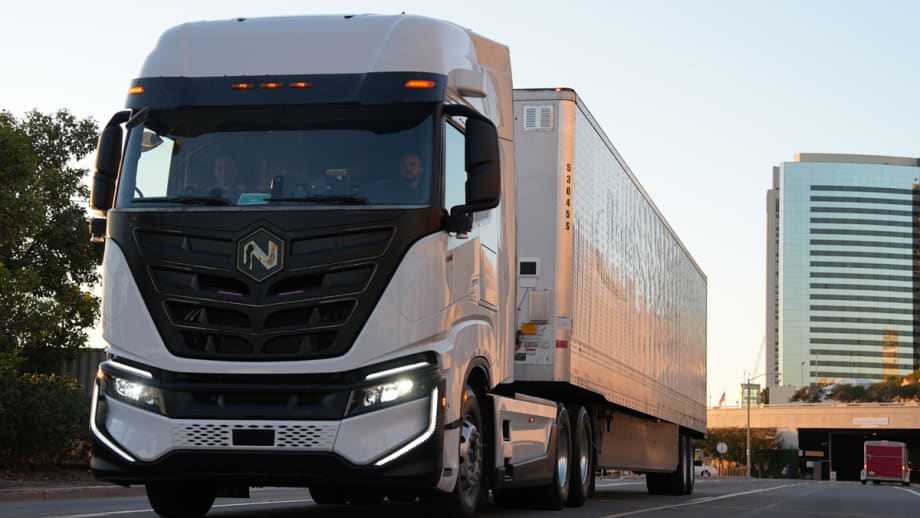
Whether as a liquified fuel in an international combustion engine, or in a fuel cell-powered tractor like the Nikola Tre, NACFE believes hydrogen will likely be the preferred clean fuel of choice for future long-haul freight fleets.
Photo: Nikola
Is hydrogen the fuel of the future?
That’s the question on many of trucking’s inquiring minds today. The North American Council for Freight Efficiency is doing its best to uncover some answers.
During an online press conference held on April 4, Mike Roeth, NACFE’s executive director, and analysists Rick Mihelic and Kevin Otto, released the organization’s second report on the future of hydrogen in trucking – building on a first report issued in 2020.
The report, “Hydrogen Trucks: Long Haul’s Future?," focuses on using hydrogen-based powertrains for Class 8 long-haul freight routes pulling van trailers. These powertrains include a range of fuel-cell battery-electric types and internal combustion engines (ICE) based on the diesel cycle. The new report is based on two previous NACFE reports — “Viable Class 7/8 Electric, Hybrid and Alternative Fuel Tractors” and "Making Sense of Heavy-Duty Hydrogen Fuel Cell Tractors" — which compared a range of alternative-fuel heavy-duty truck technologies including hydrogen.
“We got some things right in our first report,” Roeth said. “And we missed a few things – most notably the rise of hydrogen as a fuel in diesel-style, internal combustion engines. But the overall story here is that hydrogen will not be a solution to every duty cycle that is out there. Rather, it is part of the spectrum of duty cycles that diesel does today. And we believe that means that hydrogen will likely be primary future fuel for heavy duty, long-range, freight-carrying vehicles."
Rick Mihelic, report author and NACFE's director of emerging technologies said that in the long run there will only be two choices to power zero-emissions freight: battery electric and hydrogen fuel cell.
The NACFE study team determined that hydrogen is a complex topic and hydrogen for use in freight transportation is just in its infancy.
The report contains the followingconclusions:
Hydrogen and battery electric are not an “either/or” but an “and” for the zero-emission freight future.
Hydrogen fuel-cell tractors are the only zero-emission solution for many duty cycles for heavy-duty tractors.
Alternative fuels like renewable natural gas, renewable diesel, and hydrogen used in internal combustion engines will be required to support the transition in the next two decades to help make progress toward zero-emission goals, while in parallel ramping up the hydrogen and battery-electric infrastructure and manufacturing base.
“We used battery-electric trucks as the baseline for evaluating hydrogen as a fuel," Mihelic said. "But it has to be noted that battery-electric trucks aren’t ideal for really long-haul applications with heavy loads.”
As with trucking today, Mihelic said he believes optimizing specs will be critical for fleets looking to use hydrogen propulsion for trucks, whether in a fuel cell arrangement or in an otherwise conventional ICE.
“One of the appealing things about hydrogen ICEs is that they primarily look a lot like the engines fleets currently buy,” he added. “So, it may be less of a leap of imagination for fleets to move to hydrogen ICEs before moving on to hydrogen fuel-cell trucks. Although, there are certain duty applications where we believe fleets will want hydrogen ICEs – offroad vehicles and emergency vehicles, for example, are particularly well-suited to hydrogen ICEs.”
NACFE Electrification Technical Lead Kevin Otto added: “From an efficiency point of view, hydrogen ICEs are not going to match hydrogen fuel cells in terms of consumption of hydrogen. On the other hand, ICEs will certainly be quite a bit easier on the powertrains in the vehicles – basically using the same kinds of transmissions, rear ends and other components.”
Basic Questions on Hydrogen in Long-Haul Trucking Remain Unanswered
Roeth, Mihelic and Otto all cautioned that while there is currently a lot of discussion around how hydrogen is produced today, the conversation really needs to focus on how hydrogen will be transported and distributed as a vehicle fuel in the future.
Roeth noted that industry agreement is needed on whether hydrogen long-haul fuel-cell tractors and the transport of the hydrogen fuel itself, will be based on gaseous or liquid hydrogen.
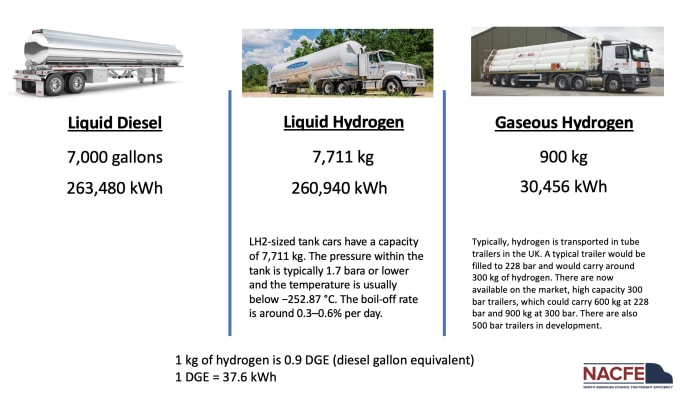
Transporting liquid hydrogen and gaseous hydrogen is a fundamental problem trucking will have to resolve as its role as a vehicle fuel grows.
Graphic: NACFE
“For instance, if you transport liquid hydrogen in a tanker trailer, it’s basically the same amount as you’d have if you were carrying diesel fuel,” Roeth noted. “But if you’re transporting compressed hydrogen gas, then you’re looking at many more trucks and trailers required to move the same amount of fuel. So, these are the kinds of basic industry issues that will have to be worked out.”
Roeth called out these key findings in the report:
Hydrogen powered freight is required for a zero-emission freight future.
There is a significant amount of funding going toward establishing the basis for a hydrogen economy that includes long-haul freight transportation.
The cost of hydrogen production, transportation, storage and dispensing will not be cost competitive with diesel without significant assistance from tax credits and other subsidy mechanisms.
Managing the actual retail cost of hydrogen is perhaps more important than continuing discussion of reducing the production cost at the hydrogen plant.
Hydrogen is closely tied to electricity. You can’t have hydrogen without significant amounts of electricity.
Hydrogen is a significant factor in federal, state and local planning and regulations for the zero-emission freight future.
Purpose-built hydrogen trucks optimized for specific duty cycles may not be valued well in the secondary market, leading to first owners keeping the vehicle until it is salvaged.
Hydrogen costs decrease as the scale of the hydrogen plants increase. Large production requires multiple industries to increase demand for hydrogen. Trucking alone is insufficient to reach demand scale needed to justify large hydrogen plants.
Hydrogen used for creating alternative fuels like renewable diesel will reduce net emissions but at the cost of delaying adoption of zero-emission alternatives.
All the answers do not need to be known on day one of hydrogen. Production supply and market demand will evolve in lock step over time. Innovators will find market opportunities where there is an oversupply of hydrogen, creating new market demand.
Hydrogen and electricity supply are inherently resilient as there are multiple methods of producing them, leading to competitive forces mitigating price and supply volatility.
“Battery electric vehicles will inherently be the most economical and efficient choice for shorter distance zero-emission duty cycles, and hydrogen will be the only viable economic choice for long-haul zero-emission duty cycles," Roeth added. "Ultimately fleets in the market will make decisions on which technology succeeds for which duty cycles.”
More Fuel Smarts

How Volvo Updated Its D13 for EPA 2027 [Watch]
Volvo’s updated D13 promises lower emissions without sacrificing performance or fuel economy. Take a closer look at what changed inside the engine in this HDT Spotlight video.
Read More →
Diesel Price Spike Shortens Payback for Natural Gas Trucks, Report Says
Energy Vision estimates fleets could recover the higher purchase price of an RNG-fueled Class 8 tractor in 1.3 to 2.8 years under current fuel-price scenarios.
Read More →
Calstart Becomes Catalyst Mobility, Reflecting Broader Focus
Calstart is now Catalyst Mobility, reflecting the nonprofit’s growing national role in clean transportation, including zero-emission trucks, infrastructure and incentive programs.
Read More →

Record Diesel Prices Squeeze Trucking Fleets
Average U.S. diesel prices have climbed to nearly $6 a gallon, surpassing the 2022 record as tight refinery capacity and Middle East disruptions keep fuel costs elevated.
Read More →
How Fuel Delivery Shapes Engine Performance
Fuel delivery depends on more than what happens at the injector. For fleet, maintenance and technical professionals, looking at the full path from pump to injector can provide useful context for understanding engine performance.
Read More →
East Coast Port Launches $45M Electric Truck Push
The Port Authority of New York and New Jersey announced millions in incentives for zero-emission drayage trucks, yard tractors, and new charging hubs near the port.
Read More →
California Bill Could Shed Light on Electric Truck Prices
Why do battery-electric Class 8 trucks remain so expensive? A California bill headed to Gov. Gavin Newsom would give fleets and state agencies more visibility into what manufacturers charge.
Read More →
Detroit Opens Orders for EPA 2027 Engines
Detroit isn’t starting from scratch to meet EPA 2027 diesel emissions standards. Its Gen 6 DD13 and DD15 engines keep much of today’s platform while updating the fuel and aftertreatment systems.
Read More →
Zero-Emission Truck Corridor Planned for West Coast
California, Oregon, Washington, British Columbia and Baja California are coordinating plans for truck charging and hydrogen fueling from Canada to Mexico.
Read More →
A Closer Look at Kenworth’s Electric T880E Vocational Truck [Video]
Learn more about Kenworth's T880E battery-electric vocational truck at the Paccar Technical Center, including its range, applications, upfitting considerations, and PTO options, in this HDT Spotlight video.
Read More →