





Related: Safety Managers Talk Improving Safety with Technology
Mobile Devices Could Become Profit Centers for Carriers
Mobile devices could become profit centers for carriers, according to Laura Lohrke, product manager for mobile, Omnitracs during a session at the company’s user conference in Dallas .
February 13, 2015
3 min to read
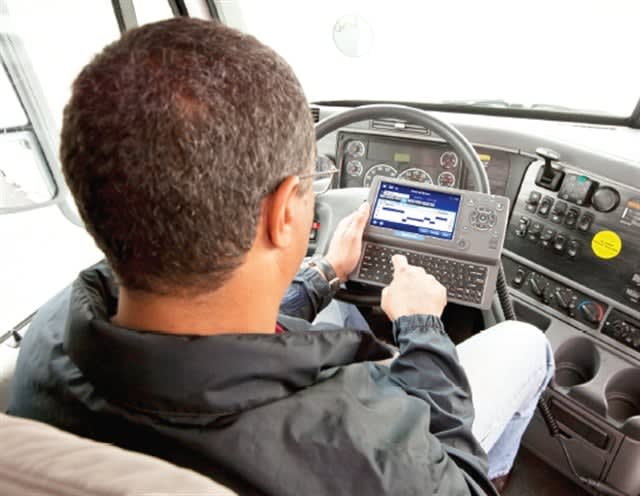
Mobile devices could become profit centers for carriers, according to Laura Lohrke, product manager for mobile, Omnitracs. During a session on how to increase driver productivity when outside the cab using mobile devices at the company’s user conference in Dallas Feb. 9, Lohrke reviewed projects the company is currently working on that will be available over the next year and a half.
She said that mobile devices can solve a number of challenges: locating a truck, determining delivery status, updating drivers when they are outside of the cab, capturing proof-of-delivery information and sending that data back to the office and tracking routes. She said mobile devices with the ability to capture POD information, such as signatures can reduce the need for back office staff to process paperwork brought in each day. The first step in in gaining these efficiencies is having the driver’s mobile device connected with the in-cab device.
Data captured by the driver on his handheld device is sent via a Bluetooth connection to the in-cab device and from there transmitted to the back office via the vehicle’s in-cab device.
The benefits of connecting the mobile device with the in-cab device means the carrier only needs a single data plan for the in-cab device (or just a limited data plan for the mobile device).
The combination allows for driver tracking both from the in-cab device when the driver is driving and via the mobile device when the driver is out of the vehicle. The driver can also receive updates on deliveries or other information when out-of-the cab. Plus many mobile devices, such as those from Motorola are able to capture signatures, scan barcodes, capture photos and run mobile workflow applications.
In Omnitracs’ case, these functions are supported on its MCP50, MCP110 and MCP200 in-cab devices using a small Bluetooth add-on that can communicate with any Android device.
And while Bluetooth range is limited to 100 feet, the mobile devices record the data captured and then automatically sync with the in-cab device once the driver is within 100 feet of the vehicle. The system also automatically logs the driver into the mobile device once he logs into his MCP unit.
Lohrke said this simplifies the driver’s workload because he doesn’t have to remember to log into the mobile device or download information from that device to the in-cab unit.
The company also has a customizable workflow application that allows fleets to design forms that guide drivers through their task at each stop.
These forms can also be used to gather information for their customers, such as the delivery locations look – which is an important element for dedicated or private fleets serving retail and food establishments.
The devices can also be used to keep track of overages, shortages and damages, if they occur. All of that information can be recorded on the mobile device and transmitted to the back office, freeing the driver from having to scan, fax or bring the form in.
Another key advantage is that getting this information to the back end system speeds up the order to payment process. The applications will also keep track of vehicle location and time spent at each stop and report exceptions when a driver spends too much time at one stop or is out of route.
The back office systems for capturing the data will include Omnitracs’ web portal and the Roadnet Anywhere planning application.
More Fleet Management

Geotab Links Fleet Card to Vehicle Data
The new card combines fuel discounts with telematics-based purchase controls. Geotab’s analysis also points to potential savings from choosing lower-priced fuel stops.
Read More →
How MFA Helps Protect Trucking Fleets
Multi-factor authentication adds protection when passwords are stolen. Here’s how it works and where fleets should start.
Read More →
How Better Freight Data Helps Trucking Teams Get Ahead of Disruption
Trucking and logistics teams have plenty of data. The problem is getting the right information in front of the right people soon enough to act. Better-connected data can help teams spot trouble earlier and make smarter decisions before small problems become big ones.
Read More →

Trimble: Taking Artificial Intelligence in Trucking Beyond Faster Tasks
At Insight 2026, Trimble executives argued that fleets may need to redesign workflows to get more from AI as it introduced new products and enhancements. AI’s value will depend on how fleets combine automation with their people's knowledge.
Read More →
Sponsored•September 28, 2026
Build a bulletproof fleet: Uniting ELDs and dash cams for total compliance
An ELD can prove compliance, but it cannot always prove what happened on the road. Discover how uniting accurate ELD data with AI-powered dash cam video can help your fleet strengthen compliance, defend against liability, protect drivers and reduce operational costs.
Read More →
Nominations Open for HDT Emerging Leaders
Heavy Duty Trucking is looking for accomplished trucking fleet professionals under 40 who are making an impact and helping lead the industry forward.
Read More →
Why Private Fleets Are Taking More Freight
Private fleets are putting their own trucks on demanding customers and high-cost lanes as companies seek greater control over service, costs, and capacity.
Read More →
Sponsored•September 16, 2026
Color Match Smarter: Tools That Restore & Perform
For fleet managers and collision repair professionals keeping heavy-duty trucks on the road, getting the color right the first time isn't just about appearance — it's about efficiency, turnaround time, and bottom-line results. Discover how today's digital color tools are transforming the repair process from guesswork to precision.
Read More →
FMCSA Pauses Biennial-Update Enforcement Amid Motus Transition
Carriers whose updates were due on or after June 1 have more time, while FMCSA works to stabilize its new registration system and warns of phishing sites impersonating its new carrier registration system, Motus.
Read More →
Sponsored•September 14, 2026
2026 Blueprint for Countering Smarter Supply Chain Theft
Cargo theft is no longer just the cost of doing business. It's a multi-billion-dollar criminal enterprise exploiting vulnerabilities across your fleet, drivers, and supply chain.
Read More →