





Related: Daimler's Daum Talks Future Trucks and Current Business at IAA Show
Mercedes-Benz Shows Autonomous Van Concept for Freight, Passengers
Mercedes-Benz Vans showcased a concept of an autonomous, all-electric van in two variants, one for freight and one for passengers.
September 21, 2018
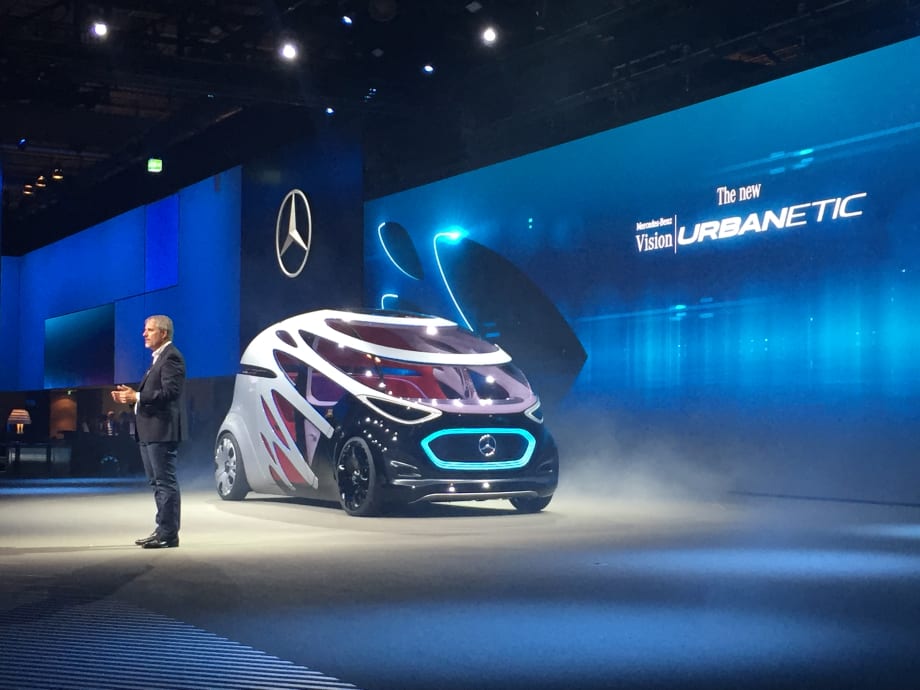
The passenger/rideshare version of the Vision Urbanetic concept.
Photo by Deborah Lockridge
2 min to read
Mercedes-Benz Vans unveiled a concept autonomous, all-electric van in two variants, one for freight and one for passengers at the IAA Commercial Vehicles Show in Hannover, Germany. The vehicle showcased the Vision Urbanetic autonomous driving platform — what the company calls a “revolutionary mobility concept” for urban areas.
The Vision Urbanetic mobility concept highlighted at the show is based on an autonomous, electrically powered driving platform that can carry different interchangeable bodies for people-moving or goods transportation.
Wilfried Porth, who heads up Mercedes-Benz Vans, told the crowd of assembled global journalists that innovative solutions are needed for the cities of the future, which will be larger and more densely populated. Quality of life issues, such as traffic, noise, and emissions, can be addressed with electrification and autonomous technologies, he noted. "Autonomous vans make transport and mobility solutions possible that we could hardly have imagined a few years ago, Porth said. "I'm convinced this will fundamentally change the rules of the game in our industry, both in passenger transport and freight transport.
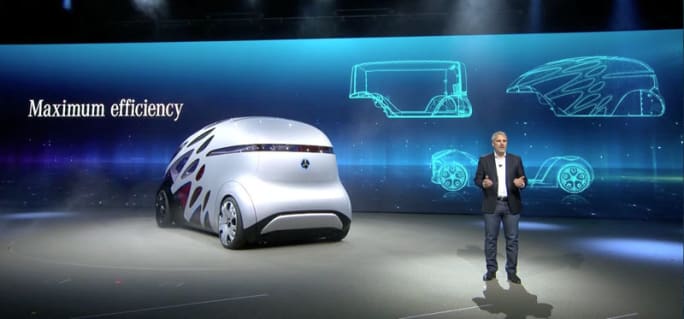
Slide shows the interchangeable cargo/passenger body concept of the Urbanetic as the people-moving version rotates on the stage in the foreground.
Screen capture from Mercedes-Benz video at IAA press conference
As a ridesharing vehicle, Vision Urbanetic could carry up to 12 passengers, while the cargo module can accommodate up to 10 Euro-pallets. It offers a load length of 3.70 meters in an overall vehicle length of 5.14 meters.
The vehicle on display at the show was the passenger-carrying version, a sleek futuristic pod. The cargo variant, shown on video, was a more boxy cargo pod.
Gordon Wagener, Mercedes-Benz design boss, used the term “holistic” in describing the Urbanetic concept, as well as bringing intelligence and emotion together. “Form follows function,” he noted.
The concept is also “part of a cloud-based system solution.” It incorporates an IT infrastructure that analyzes supply and demand, resulting in an autonomous fleet operating on routes planned flexibly and efficiently based on current transport needs.
“Vision Urbanetic is a mobility platform in the truest sense of the word,” said Volker Mornhinweg, head of Mercedes-Benz Vans, in a news release. “We have developed a vision that makes commercial sense for companies and that can make the city of the future more livable for its inhabitants.”
Daimler is working with customers to field-test various technology elements of the concept and is working with BASF and ViaVan. In a first step, BASF will introduce an on-demand ridesharing system at its Ludwigshafen facility. It features technology from ViaVan, a joint venture between Mercedes-Benz Vans and U.S. startup Via. Further projects are set to follow in the years ahead, including an electric, fully connected and autonomous shuttle on the factory site.
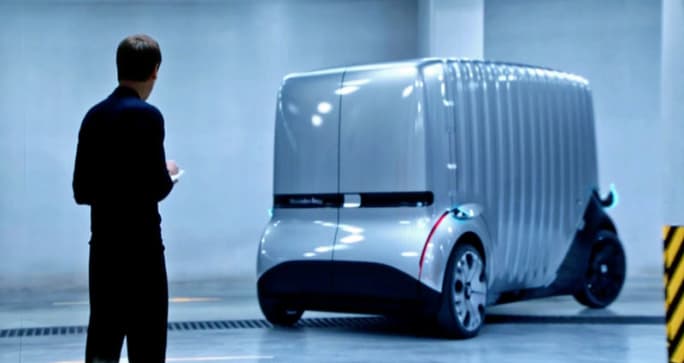
Using the same electrically driven, autonomous chassis with interchangeable passenger and cargo bodies, the Urbanetic concept could drop commuters off at work in the morning, spend the day delivering packages, then pick up commuters after work.
Screen capture from Mercedes-Benz video at IAA press conference
More Equipment

How Volvo Updated Its D13 for EPA 2027 [Watch]
Volvo’s updated D13 promises lower emissions without sacrificing performance or fuel economy. Take a closer look at what changed inside the engine in this HDT Spotlight video.
Read More →
Michelin Tire Improves Efficiency and Durability for Regional Fleets
The Michelin X Multi Energy D2 is a regional haul drive tire engineered to help fleets improve fuel efficiency, durability and traction in demanding stop-and-go operations.
Read More →
ZF Expands Commercial Vehicle Push in North America
ZF is expanding its North American commercial-vehicle presence with new transmission applications, electrification, trailer technology and autonomous-driving systems.
Read More →
Tesla Wants a Self-Driving Semi. Are Cameras Enough?
Could Tesla’s camera-only autonomous driving technology work on an 80,000-pound Semi? In this commentary, HDT's Deborah Lockridge takes a look at Tesla, Cybercab, and how autonomous trucks see the road.
Read More →
Kodiak: Driverless Long-Haul Truck Launch on Track for 2026
Kodiak AI says its driverless long-haul safety case is 93% complete and it remains on track to begin commercial operations by year-end 2026.
Read More →
What DOT’s Automated Vehicle Strategy Means for Trucking
The U.S. Department of Transportation issued a new automated-vehicle strategy that outlines plans for driverless-truck regulations, cross-state freight corridors, and federal safety standards.
Read More →
East Coast Port Launches $45M Electric Truck Push
The Port Authority of New York and New Jersey announced millions in incentives for zero-emission drayage trucks, yard tractors, and new charging hubs near the port.
Read More →
PlusAI Going Public to Fund Autonomous Truck Launch
A SPAC deal could provide PlusAI with up to $300 million as it works toward a 2027 commercial launch of factory-built autonomous trucks.
Read More →
NHTSA Moves to Rewrite Truck Fuel-Economy Rules
The National Highway Traffic Safety Administration says it lacks authority to regulate medium- and heavy-duty truck engines separately from complete vehicles, but the existing standards have not yet been eliminated.
Read More →
Detroit Opens Orders for EPA 2027 Engines
Detroit isn’t starting from scratch to meet EPA 2027 diesel emissions standards. Its Gen 6 DD13 and DD15 engines keep much of today’s platform while updating the fuel and aftertreatment systems.
Read More →