




Mercedes-Benz Begins 20-Country eActros Run in Europe
An 8,000-mile test run featuring two Mercedes-Benz eActros electric trucks has begun in Europe.

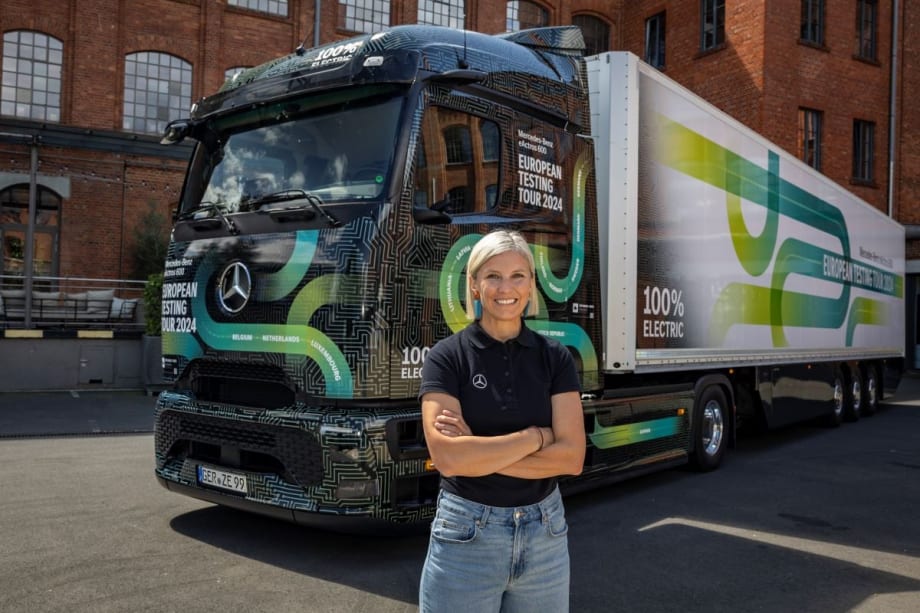
Karin Rådström, CEO Mercedes-Benz Trucks prepares to drive an eActros electric truck on its first leg of an ambitious new tour of Europe.
Photo: Mercedes-Benz Trucks
Two new eActros 600 prototype trucks have set off from Frankfurt am Main, Germany on an 8,000-mile tour of Europe. Mercedes-Benz Trucks is hailing the trip as the most extensive battery-electric truck test run in its history. Mercedes-Benz completed a similar European evaluation run last year.
The two battery-electric, long-haul, cabover trucks will travel through more than 20 countries on the test run. Each truck is hauling 40 tons of total towing weight in trailers behind them.
Mercedes-Benz CEO Behind the Wheel
Dubbed the “eActros 600 European Testing Tour 2024,” Mercedes-Benz said the goal of the drive is ambitious. The two electric flagship eActros 600s will drive to, and through northernmost and southernmost points in Continental Europe: The North Cape in Norway and Tarifa in Spain.
The tour started unofficially at Mercedes-Benz Trucks’ location in Wörth am Rhein and Daimler Truck AG’s headquarters in Leinfelden-Echterdingen. There, Karin Rådström, CEO Mercedes-Benz Trucks, took a turn at the steering wheel of one of the eActros trucks for the first few kilometers.
“I would like to thank our engineers who are embarking on the journey with the eActros 600,” Rådström said after her drive. “The vehicle technology for the transformation is ready. Battery-electric long-distance transport in Europe is possible. Now politics and the energy sector must work together in collaboration with OEMs to push forward the build-up of public charging infrastructure.”
Mercedes-Benz engineers expect the tour to give them valuable experience with electric trucks on a wide range of routes, climates and geographic conditions. One primary goal will be to study the energy consumption of the trucks on the test run.
Public Charging Only
Mercedes-Benz said the eActros’ feature high battery capacity of more than 600 kilowatt hours and a new, efficient electric drive axle developed in-house. These features give the trucks a range of 500 kilometers (310 miles) without intermediate charging.
The intention is to charge the batteries exclusively at public charging stations during the tour.
The trip will head through Germany, Denmark, Sweden, Norway, Finland, Estonia, Latvia, Lithuania, Poland, Czechia, Austria, Slovakia, Hungary, Croatia, Slovenia, Italy, Monaco, France, Spain, Portugal, Belgium, Netherlands and Luxembourg.
A New eActros Design
According to Mercedes-Benz Trucks, around 60% of long-distance journeys for its customers in Europe are shorter than 500 kilometers. This, the company said, means charging infrastructure at the depot and at the loading and unloading points is sufficient for most fleets.
For all other uses, continual expansion of public charging infrastructure is vital in order to make the electric truck viable for long-distance haulage across Europe.
In addition to CCS charging with up to 400 kW, the eActros 600 will later also enable megawatt charging (MCS).
In April this year, developers from Mercedes-Benz Trucks successfully charged for the first time a prototype of the eActros 600 at a charging station with an output of one megawatt at the in-house development and testing center in Wörth am Rhein.
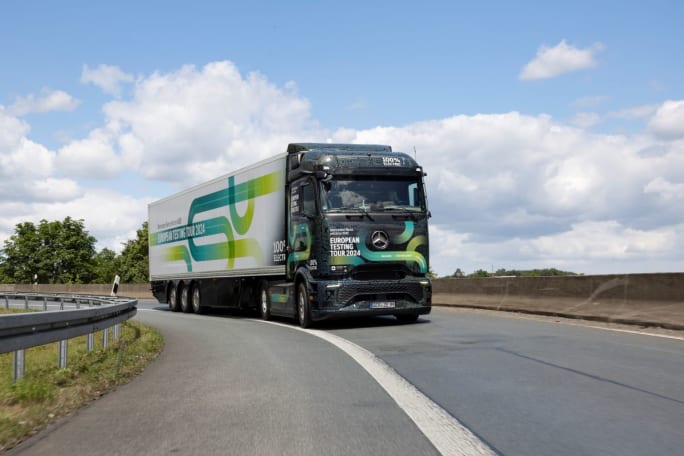
Mercedes-Benz engineers expect the eActros European tour to give them valuable experience with electric trucks in a wide range of routes, climates and geographic conditions.
Photo: Mercedes-Benz Trucks
Mercedes-Benz said that as soon as MCS technology becomes available and is standardized across manufacturers, it is planned to be retrofittable for these early models of the eActros 600.
According to the OEM, the eActros’ batteries can be charged from 20% to 80% percent in about 30 minutes at a suitable charging station with an output of around one megawatt.
Visually, the long-haul e-truck is characterized by a new design with clear lines and an aerodynamic shape.
Mercedes-Benz added that the eActros electric truck was designed to replace the majority of diesel trucks in the important long-haul transport segment in Europe.
Mercedes-Benz Trucks’ concept is to offer its customers electric fleet solutions consisting of vehicle technology, consulting, charging infrastructure and services.
More Fuel Smarts

How Volvo Updated Its D13 for EPA 2027 [Watch]
Volvo’s updated D13 promises lower emissions without sacrificing performance or fuel economy. Take a closer look at what changed inside the engine in this HDT Spotlight video.
Read More →
Diesel Price Spike Shortens Payback for Natural Gas Trucks, Report Says
Energy Vision estimates fleets could recover the higher purchase price of an RNG-fueled Class 8 tractor in 1.3 to 2.8 years under current fuel-price scenarios.
Read More →
Calstart Becomes Catalyst Mobility, Reflecting Broader Focus
Calstart is now Catalyst Mobility, reflecting the nonprofit’s growing national role in clean transportation, including zero-emission trucks, infrastructure and incentive programs.
Read More →

Record Diesel Prices Squeeze Trucking Fleets
Average U.S. diesel prices have climbed to nearly $6 a gallon, surpassing the 2022 record as tight refinery capacity and Middle East disruptions keep fuel costs elevated.
Read More →
How Fuel Delivery Shapes Engine Performance
Fuel delivery depends on more than what happens at the injector. For fleet, maintenance and technical professionals, looking at the full path from pump to injector can provide useful context for understanding engine performance.
Read More →
East Coast Port Launches $45M Electric Truck Push
The Port Authority of New York and New Jersey announced millions in incentives for zero-emission drayage trucks, yard tractors, and new charging hubs near the port.
Read More →
California Bill Could Shed Light on Electric Truck Prices
Why do battery-electric Class 8 trucks remain so expensive? A California bill headed to Gov. Gavin Newsom would give fleets and state agencies more visibility into what manufacturers charge.
Read More →
Detroit Opens Orders for EPA 2027 Engines
Detroit isn’t starting from scratch to meet EPA 2027 diesel emissions standards. Its Gen 6 DD13 and DD15 engines keep much of today’s platform while updating the fuel and aftertreatment systems.
Read More →
Zero-Emission Truck Corridor Planned for West Coast
California, Oregon, Washington, British Columbia and Baja California are coordinating plans for truck charging and hydrogen fueling from Canada to Mexico.
Read More →
A Closer Look at Kenworth’s Electric T880E Vocational Truck [Video]
Learn more about Kenworth's T880E battery-electric vocational truck at the Paccar Technical Center, including its range, applications, upfitting considerations, and PTO options, in this HDT Spotlight video.
Read More →