





The Rush to Battery-Electric Trucks: Putting the Cart Before the Horse
Lion Electric Delivers Class 5, Lion5 Model
While well-positioned as last- or middle-mile delivery, the Class 5/6 Lion5 boasts a range of up to 200 miles with 80% charging in just 1.5 hours.
May 4, 2023
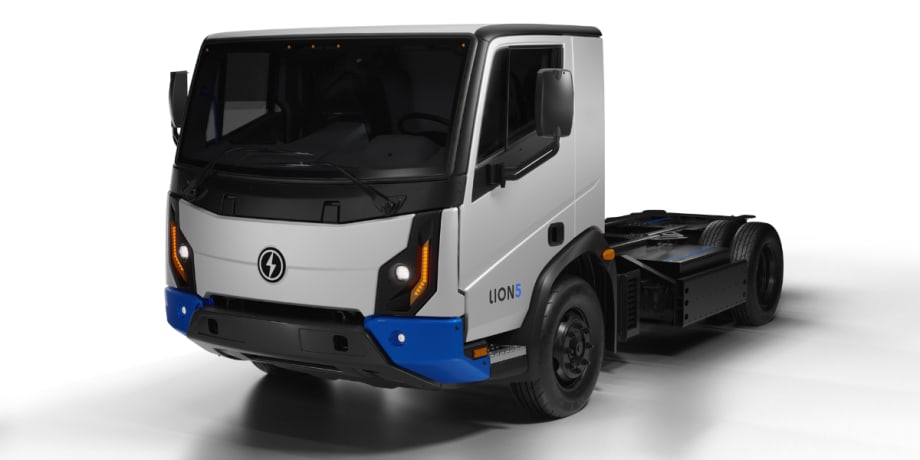
Class 5/6 Lion5 premiered at ACT Expo in Anaheim on May 3. It’s scheduled to go into production before the end of the year.
Photo: Lion Electric
3 min to read
Lion Electric revealed its new Class 5 offering, the Lion5, powered by the first LionBattery pack, Lion’s own in-house engineered and manufactured 800V battery pack.
The Lion5 has a maximum payload of 12,500 pounds and is scheduled for production before the end of 2023, company officials said during the Advanced Clean Transportation Expo in Anaheim, California, May 3.
Lion5 — Beyond Last-Mile Delivery
While it’s positioned for last-mile delivery, it will fit easily into many more applications with its GVWR Class 5-to-6 crossover capabilities.
In Class 5, it has a GVWR of 19,500 lbs., up through 26,000 lbs. in Class 6.
Whether requiring payload capacity, towing capability, or both, the Lion5 harnesses 315 hp and 2,360 lb.-ft of torque and can be equipped with a GCWR of up to 30,000 lbs. for towing small- to medium-sized trailers.
“The Lion5 is a perfect example of what we call a purpose-built electric truck,” said company founder and CEO, Marc Bedard. “It's designed to be easily integrated into truck fleets for last-mile and middle-mile delivery, and as many other uses as the operators see fit. This truck has a great total cost of ownership and we trust it will become the best friend of the drivers and mechanics.”
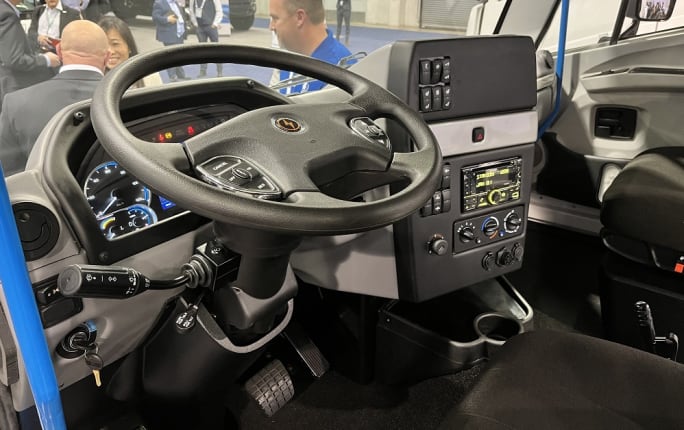
The spacious 96-inch-wide cab can be configured as a full cab or a cutaway for applications such as ambulances.
Photo: Jim Park
Upgraded Ride and Handling Performance
Drivers and passengers will appreciate the premium ride and handling performance derived from the Lion5’s low center of gravity and well-balanced front-to-back weight distribution.
It also has auto-leveling four-wheel independent suspension standard on certain models. For added safety and traction management, the Lion5 has electronic stability control, traction control, hill-start assist, and a limited-slip differential.
At 96 inches wide, the Lion5’s cab can be configured as a full-cab or a cutaway configuration enabling seamless pass-through between the cab and any suitable body upfit.
When it comes to exiting the vehicle, Lion engineered the steps to form into the cab for immediate visibility from the driver’s or passenger’s seat when their respective door is open. Adding to the safety and ease of entering and exiting, the adaptive independent suspension variants have a programmable feature that lowers the vehicle three inches when opening the door.
“That’s a key feature when the truck is spec’d as an ambulance allowing for much easier access and egress with patients,” said Bedard.
The Lion5 has been engineered to be upfit with any suitable body application. Bodybuilders have access to 4kW of low voltage and up to 32kW of high voltage when equipped with the optional ePTO interface. For additional flexibility, upfitters can choose from multiple LionBattery pack placement configurations, depending on build specification selections.
LionBattery Powers the Future for Lion Electric
First installed on the Lion5, the LionBattery is an 800v proprietary battery system comprised of a battery management system, a battery thermal management system, and battery modules and packs.
The LionBattery was designed to optimize performance, integration, and packaging throughout Lion’s complete portfolio of commercial trucks and buses. In the Lion5, it will deliver a range of up to 200 miles, while having the capability to be charged to 80% in 1.5 hours.
More Equipment

How Volvo Updated Its D13 for EPA 2027 [Watch]
Volvo’s updated D13 promises lower emissions without sacrificing performance or fuel economy. Take a closer look at what changed inside the engine in this HDT Spotlight video.
Read More →
Michelin Tire Improves Efficiency and Durability for Regional Fleets
The Michelin X Multi Energy D2 is a regional haul drive tire engineered to help fleets improve fuel efficiency, durability and traction in demanding stop-and-go operations.
Read More →
ZF Expands Commercial Vehicle Push in North America
ZF is expanding its North American commercial-vehicle presence with new transmission applications, electrification, trailer technology and autonomous-driving systems.
Read More →
Tesla Wants a Self-Driving Semi. Are Cameras Enough?
Could Tesla’s camera-only autonomous driving technology work on an 80,000-pound Semi? In this commentary, HDT's Deborah Lockridge takes a look at Tesla, Cybercab, and how autonomous trucks see the road.
Read More →
Kodiak: Driverless Long-Haul Truck Launch on Track for 2026
Kodiak AI says its driverless long-haul safety case is 93% complete and it remains on track to begin commercial operations by year-end 2026.
Read More →
What DOT’s Automated Vehicle Strategy Means for Trucking
The U.S. Department of Transportation issued a new automated-vehicle strategy that outlines plans for driverless-truck regulations, cross-state freight corridors, and federal safety standards.
Read More →
East Coast Port Launches $45M Electric Truck Push
The Port Authority of New York and New Jersey announced millions in incentives for zero-emission drayage trucks, yard tractors, and new charging hubs near the port.
Read More →
PlusAI Going Public to Fund Autonomous Truck Launch
A SPAC deal could provide PlusAI with up to $300 million as it works toward a 2027 commercial launch of factory-built autonomous trucks.
Read More →
NHTSA Moves to Rewrite Truck Fuel-Economy Rules
The National Highway Traffic Safety Administration says it lacks authority to regulate medium- and heavy-duty truck engines separately from complete vehicles, but the existing standards have not yet been eliminated.
Read More →
Detroit Opens Orders for EPA 2027 Engines
Detroit isn’t starting from scratch to meet EPA 2027 diesel emissions standards. Its Gen 6 DD13 and DD15 engines keep much of today’s platform while updating the fuel and aftertreatment systems.
Read More →