





From the Archives: Uber, Otto Talk About Plans to Transform Trucking
Levandowski Sentenced for Stealing Autonomous Vehicle Documents
Self-driving truck entrepreneur Anthony Levandowski has been sentenced to 18 months in prison for stealing trade secrets related to autonomous vehicles, in what the judge called “the "biggest trade secret crime I have ever seen."
August 5, 2020

Anthony Levandowski has been sentenced to 18 months in prison for stealing self-driving vehicle information from Google's Waymo.
Photo: HDT file photo from Pronto.ai
3 min to read
Self-driving truck entrepreneur Anthony Levandowski has been sentenced to 18 months in prison for stealing trade secrets related to autonomous vehicles, in what the judge called “the "biggest trade secret crime I have ever seen,” according to published reports.
Levandowski gained visibility in trucking after he co-founded a self-driving truck enterprise called Otto after leaving his job in Google's Waymo autonomous vehicle program. But he was accused of transferring more than 14,000 Google files to his personal laptop before leaving the company. Those documents included development schedules and product designs for its autonomous vehicle program. And within months, Uber had purchased Otto, leading Waymo to sue Uber, alleging the competitor had done so in order to get its hands on that confidential information.
In March, Levandowski pleaded guilty to stealing a confidential Google document shortly before leaving the company. In the agreement, Levandowski agreed to a maximum fine of $250,000 and a maximum prison term of 10 years.
Prosecutors sought a 27-month sentence. Levandowski and his attorneys had argued for 12 months of home confinement, saying that a prison term would be a “death sentence” given the COVID-19 pandemic and his prior history of respiratory illness. The judge said home confinement would be “a green light to every future brilliant engineer to steal trade secrets. Prison time is the answer to that.” However, the judge did rule that Levandowski could wait to begin his sentence until after the Covid-19 pandemic had peaked.
Levandowski also agreed to pay more than $756,000 in restitution to Waymo and a fine of $95,000. He filed for bankruptcy in March because he owes $179 million to Google's parent company, Alphabet, for his actions.
Levandowski’s Journey
At the American Trucking Associations Management Conference and Expo in 2016, Levandowski took the stage as part of a panel on truck platooning and autonomous trucks. There, he raised eyebrows, from his casual dress and orange sneakers to his visions of trucks being built with no cabs for drivers at all.
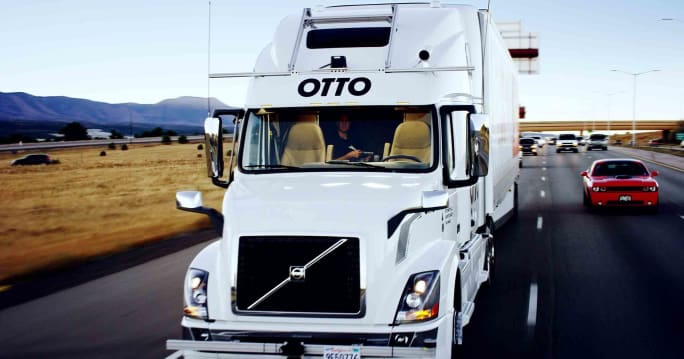
Levandowski got the attention of the trucking industry in 2016 when he founded self-driving truck company Otto after leaving Google.
Photo: HDT file photo from Otto
At the time he was heading up autonomous operations at Uber, which had purchased his self-driving truck startup Otto.
Earlier that year, we reported how Levandowski had left his job working at Google on its self-driving car to found Otto with two other former Google employees, Lior Ron and Don Burnette, and another robotics expert, Claire Delaunay.
Otto’s goal was to develop retrofittable autonomous-driving technology for on-highway commercial heavy trucks and conducted its first extended test on public highways in Nevada in May of 2016.
Levandowski was fired by Uber in 2017 when a lawsuit was filed against the company by Google’s autonomous vehicle arm Waymo, alleging that he had obtained autonomous technology trade secrets before resigning to found Otto and that Uber had bought Otto to get access to those confidential documents.
Uber and Waymo settled their lawsuit in early 2018, and later that year, Levandowski founded Pronto. This new venture, he said, aimed to take a more gradual approach to self-driving trucks and get retrofit autonomous technology to fleets in the near future.
But in August of 2019, the Department of Justice announced it was charging him with 33 counts of theft and attempted theft of trade secrets dating back to Levandowski’s time at Google, when he was an engineer working on that company’s Waymo autonomous vehicle project. Levandowski stepped aside at Pronto and Robbie Miller took over as CEO.
Meanwhile, Tech Crunch reports that Levandowski last month filed suit against Waymo and Uber as part of his bankruptcy proceedings. It focuses on Uber’s agreement to indemnify Levandowski against legal action when it bought his self-trucking company, Otto Trucking. It also includes new allegations concerning the settlement that Waymo and Uber reached over trade secret theft claims.
More Equipment

How Volvo Updated Its D13 for EPA 2027 [Watch]
Volvo’s updated D13 promises lower emissions without sacrificing performance or fuel economy. Take a closer look at what changed inside the engine in this HDT Spotlight video.
Read More →
Michelin Tire Improves Efficiency and Durability for Regional Fleets
The Michelin X Multi Energy D2 is a regional haul drive tire engineered to help fleets improve fuel efficiency, durability and traction in demanding stop-and-go operations.
Read More →
ZF Expands Commercial Vehicle Push in North America
ZF is expanding its North American commercial-vehicle presence with new transmission applications, electrification, trailer technology and autonomous-driving systems.
Read More →
Tesla Wants a Self-Driving Semi. Are Cameras Enough?
Could Tesla’s camera-only autonomous driving technology work on an 80,000-pound Semi? In this commentary, HDT's Deborah Lockridge takes a look at Tesla, Cybercab, and how autonomous trucks see the road.
Read More →
Kodiak: Driverless Long-Haul Truck Launch on Track for 2026
Kodiak AI says its driverless long-haul safety case is 93% complete and it remains on track to begin commercial operations by year-end 2026.
Read More →
What DOT’s Automated Vehicle Strategy Means for Trucking
The U.S. Department of Transportation issued a new automated-vehicle strategy that outlines plans for driverless-truck regulations, cross-state freight corridors, and federal safety standards.
Read More →
East Coast Port Launches $45M Electric Truck Push
The Port Authority of New York and New Jersey announced millions in incentives for zero-emission drayage trucks, yard tractors, and new charging hubs near the port.
Read More →
PlusAI Going Public to Fund Autonomous Truck Launch
A SPAC deal could provide PlusAI with up to $300 million as it works toward a 2027 commercial launch of factory-built autonomous trucks.
Read More →
NHTSA Moves to Rewrite Truck Fuel-Economy Rules
The National Highway Traffic Safety Administration says it lacks authority to regulate medium- and heavy-duty truck engines separately from complete vehicles, but the existing standards have not yet been eliminated.
Read More →
Detroit Opens Orders for EPA 2027 Engines
Detroit isn’t starting from scratch to meet EPA 2027 diesel emissions standards. Its Gen 6 DD13 and DD15 engines keep much of today’s platform while updating the fuel and aftertreatment systems.
Read More →