





Related: Is Displacement on Demand Coming to Heavy-Duty Diesel Engines?
Jacobs Diesel Engine Decompression System Can Save Fuel
Jacobs Vehicle Systems says its new Active Decompression Technology will allow stop-start functionality for diesel engines while eliminating start-up and shutdown vibrations.
November 29, 2018

Jacobs Vehicle Systems' new Active Decompression Technology enables a diesel engine stop-start system while eliminating engine-shake at both start-up and shutdown.
Photo: Jacobs Engine Systems
3 min to read
Jacobs Vehicle Systems has introduced Active Decompression Technology (ADT), which the company says enables heavy-duty commercial vehicles to benefit from an engine stop-start system and eliminating engine-shake at both start-up and shutdown. In addition to improving fuel economy and reducing emissions, ADT also improves cold engine starts, reduces loading and wear on engine components during start-up, and makes start-up faster, according to Jacobs.
Jacobs says the new ADT device incorporates valve actuation technologies proven over many millions of miles and can be cost-effectively added to many engine platforms.
Stop-start engine technology, which automatically switches off the engine when it would otherwise be idling, is widely adopted by automotive manufacturers, however, it is less common in heavy-duty commercial vehicles. This is largely due to the intrusive engine and cabin-shake experienced whenever a heavy-duty diesel engine starts or stops, and because of the cost of technologies needed to mitigate increased wear-and-tear on the starter motor, ring-gear, and battery. ADT significantly reduces these issues.
Extensive testing has shown that ADT reduces the magnitude of engine-shake during shutdown by 90%, which is when vibrations transmitted to the cabin are of greatest frequency and strength. This has the additional benefit of preventing disturbance to drivers sleeping in cabs overnight when there are automated engine starts and stops to maintain battery charge.
The ADT device is automatically activated by the engine control unit (ECU) whenever the engine shuts down or starts up, and works by keeping the engine valves open and the cylinders decompressed. When switching off the engine, it “coasts” to a smooth shutdown without causing the cab to shake. When starting up, the engine is kept in a decompressed state which decreases cranking torque by 40% and allows the engine to spin up to twice its normal speed for smoother starting, faster priming of the fuel system, and decreased wear on the starter gear, fly wheel and other components. This can also allow the use of smaller and lighter batteries, cables, and starter.
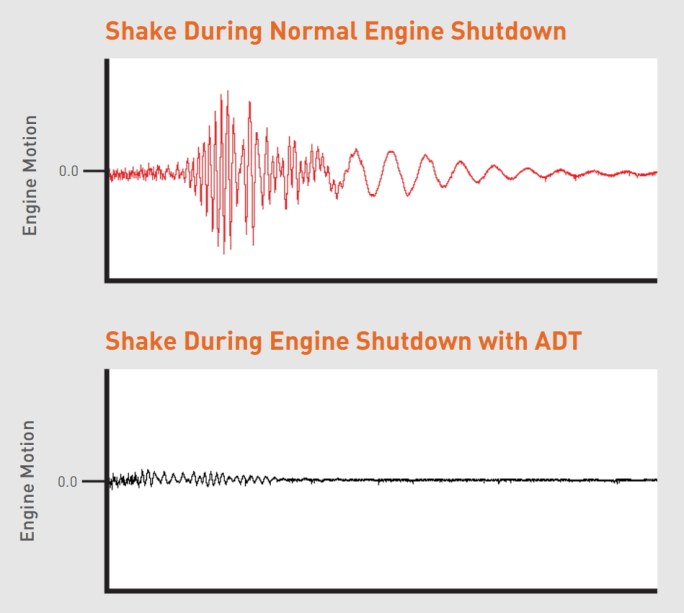
Jacobs says extensive testing has shown that ADT reduces the magnitude of engine-shake during shutdown by 90%, which is when vibrations transmitted to the cabin are of greatest frequency and strength.
Photo: Jacobs Engine Systems
By enabling the engine to be turned-over while decompressed, ADT also improves start-ups in cold temperatures by enabling the engine to reach its critical compression ignition speeds. When combined with supplemental air inlet heaters, ADT also enables the engine cylinders to be pre-warmed without the engine load from compression; especially useful when freezing temperatures have reduced battery levels. When high cranking speed is reached, the engine compression is reactivated and cylinder-fueling begins.
“ADT is another development of Jacobs’ well-proven valve actuation technologies to deliver another set of benefits,” said Steve Ernest, vice president of engineering and business development at Jacobs Vehicle Systems. “Some OEMs will be interested in ADT because it enhances vehicle refinement by eliminating engine-shake and cabin-shake. Other customers – particularly those whose vehicles endure heavy stop-start cycles - will welcome the reduced component load, fuel economy and emissions advantages.”
More Equipment

How Volvo Updated Its D13 for EPA 2027 [Watch]
Volvo’s updated D13 promises lower emissions without sacrificing performance or fuel economy. Take a closer look at what changed inside the engine in this HDT Spotlight video.
Read More →
Michelin Tire Improves Efficiency and Durability for Regional Fleets
The Michelin X Multi Energy D2 is a regional haul drive tire engineered to help fleets improve fuel efficiency, durability and traction in demanding stop-and-go operations.
Read More →
ZF Expands Commercial Vehicle Push in North America
ZF is expanding its North American commercial-vehicle presence with new transmission applications, electrification, trailer technology and autonomous-driving systems.
Read More →
Tesla Wants a Self-Driving Semi. Are Cameras Enough?
Could Tesla’s camera-only autonomous driving technology work on an 80,000-pound Semi? In this commentary, HDT's Deborah Lockridge takes a look at Tesla, Cybercab, and how autonomous trucks see the road.
Read More →
Kodiak: Driverless Long-Haul Truck Launch on Track for 2026
Kodiak AI says its driverless long-haul safety case is 93% complete and it remains on track to begin commercial operations by year-end 2026.
Read More →
What DOT’s Automated Vehicle Strategy Means for Trucking
The U.S. Department of Transportation issued a new automated-vehicle strategy that outlines plans for driverless-truck regulations, cross-state freight corridors, and federal safety standards.
Read More →
East Coast Port Launches $45M Electric Truck Push
The Port Authority of New York and New Jersey announced millions in incentives for zero-emission drayage trucks, yard tractors, and new charging hubs near the port.
Read More →
PlusAI Going Public to Fund Autonomous Truck Launch
A SPAC deal could provide PlusAI with up to $300 million as it works toward a 2027 commercial launch of factory-built autonomous trucks.
Read More →
NHTSA Moves to Rewrite Truck Fuel-Economy Rules
The National Highway Traffic Safety Administration says it lacks authority to regulate medium- and heavy-duty truck engines separately from complete vehicles, but the existing standards have not yet been eliminated.
Read More →
Detroit Opens Orders for EPA 2027 Engines
Detroit isn’t starting from scratch to meet EPA 2027 diesel emissions standards. Its Gen 6 DD13 and DD15 engines keep much of today’s platform while updating the fuel and aftertreatment systems.
Read More →