




Isuzu Breaks Ground on South Carolina Truck Plant
Isuzu’s new North American facility, situated on 200 acres in Greenville County, represents a $280 million investment.

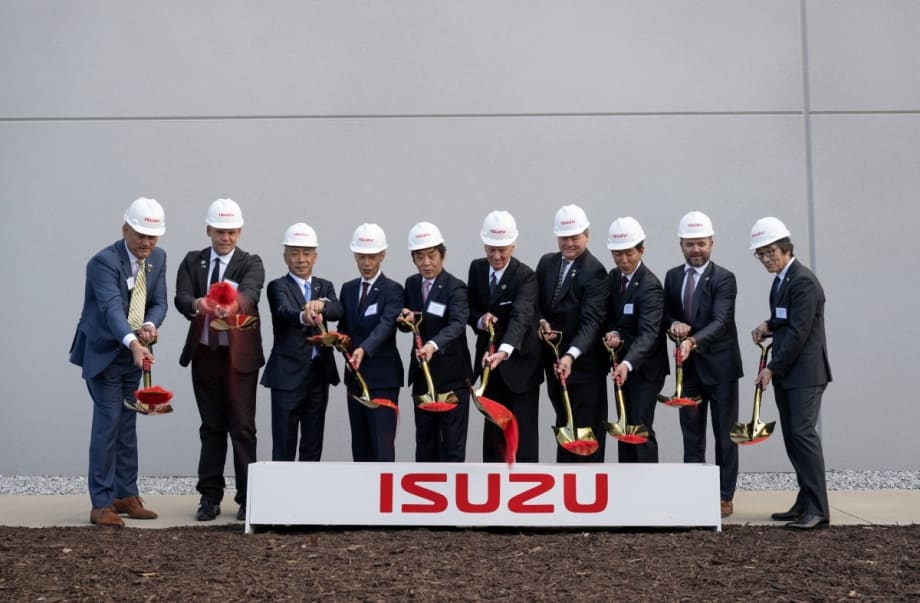
Isuzu leaders, state officials and community representatives participated in a symbolic turning of soil for the OEM's new truck plant in Greenville, South Carolina.
Photo: Isuzu North America
Isuzu North America held a groundbreaking ceremony today for its new 1,000,000-square-foot production facility in Piedmont, South Carolina. This event marks a major milestone in the company’s long-term commitment to the North American market, the OEM said.
Groundbreaking Ceremony
The groundbreaking ceremony was attended by numerous dignitaries. These included South Carolina Governor, Henry McMaster, Isuzu Motors Limited Chairman, Representative Director and CEO, Masanori Katayama, and the Japanese Ambassador to the United States, Shigeo Yamada.
Each delivered remarks highlighting the importance of this investment for both the State of South Carolina and Isuzu’s global operations.
As part of the program, Governor McMaster and Chairman Katayama participated in a ceremonial gift exchange, and Isuzu leaders, state officials and community representatives participated in a symbolic turning of soil.
To further commemorate the occasion, Yoshino cherry trees were planted on the site, symbolizing new beginnings and the enduring friendship between Japan and the United States.
These trees are the same variety famously gifted by Japan to the United States in 1912, which now bloom each spring around the Tidal Basin in Washington, D.C.
“This groundbreaking underscores our strong commitment to the North American market,” said Noboru Murakami, Chairman and CEO of Isuzu North America Corporation. “With this new plant, we are getting closer to our customers and the market, strengthening our ability to serve them, and investing in the future. Our new facility will create jobs, contribute to the local economy, and provide a foundation for long-term growth and success.”
Investing in South Carolina
Governor McMaster emphasized the significance of Isuzu’s investment in South Carolina. “Today’s groundbreaking represents more than the start of a construction project – it is a reflection of South Carolina’s reputation as a destination for world-class companies,” McMaster said. “Isuzu’s presence here will strengthen our economy, provide opportunities for our people, and further demonstrate the benefits of investing in our state.”
Isuzu’s facility, situated on 200 acres in Greenville County, represents a $280 million investment. The plant will serve as a cutting-edge production hub for Isuzu’s medium-duty truck lineup, including the N-Series Gas, N-Series Electric, and F-Series trucks.
The plant will have a production capacity of 50,000 units by 2030 and is expected to employ over 700 South Carolinians by 2028.
Commitment to U.S. Investment and Innovation
Isuzu’s U.S. investment strategy extends beyond this new facility, the company said.
The company is increasing its sourcing of parts from domestic suppliers and expanding its advanced automotive technology research and development initiatives in the U.S.
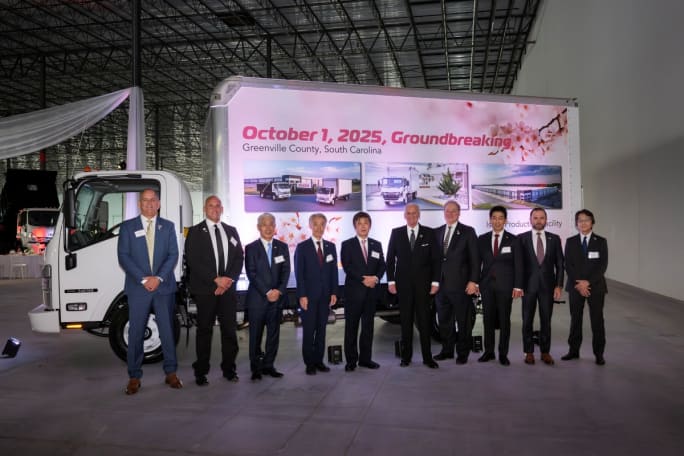
Isuzu North America executives and invited guests celebrate the OEM's new truck assembly plant in Piedmont, South Carolina.
Photo: Isuzu North America
Production operations at the Piedmont facility are scheduled to begin in 2027, consolidating all assembly and logistics operations under one roof.
The facility will streamline operations — spanning KD storage, parts management, vehicle production, and post-production installation (PIO)—while providing the flexibility to respond to evolving customer demands in the North American commercial vehicle market.
More Equipment

How Volvo Updated Its D13 for EPA 2027 [Watch]
Volvo’s updated D13 promises lower emissions without sacrificing performance or fuel economy. Take a closer look at what changed inside the engine in this HDT Spotlight video.
Read More →
Michelin Tire Improves Efficiency and Durability for Regional Fleets
The Michelin X Multi Energy D2 is a regional haul drive tire engineered to help fleets improve fuel efficiency, durability and traction in demanding stop-and-go operations.
Read More →
ZF Expands Commercial Vehicle Push in North America
ZF is expanding its North American commercial-vehicle presence with new transmission applications, electrification, trailer technology and autonomous-driving systems.
Read More →
Tesla Wants a Self-Driving Semi. Are Cameras Enough?
Could Tesla’s camera-only autonomous driving technology work on an 80,000-pound Semi? In this commentary, HDT's Deborah Lockridge takes a look at Tesla, Cybercab, and how autonomous trucks see the road.
Read More →
Kodiak: Driverless Long-Haul Truck Launch on Track for 2026
Kodiak AI says its driverless long-haul safety case is 93% complete and it remains on track to begin commercial operations by year-end 2026.
Read More →
What DOT’s Automated Vehicle Strategy Means for Trucking
The U.S. Department of Transportation issued a new automated-vehicle strategy that outlines plans for driverless-truck regulations, cross-state freight corridors, and federal safety standards.
Read More →
East Coast Port Launches $45M Electric Truck Push
The Port Authority of New York and New Jersey announced millions in incentives for zero-emission drayage trucks, yard tractors, and new charging hubs near the port.
Read More →
PlusAI Going Public to Fund Autonomous Truck Launch
A SPAC deal could provide PlusAI with up to $300 million as it works toward a 2027 commercial launch of factory-built autonomous trucks.
Read More →
NHTSA Moves to Rewrite Truck Fuel-Economy Rules
The National Highway Traffic Safety Administration says it lacks authority to regulate medium- and heavy-duty truck engines separately from complete vehicles, but the existing standards have not yet been eliminated.
Read More →
Detroit Opens Orders for EPA 2027 Engines
Detroit isn’t starting from scratch to meet EPA 2027 diesel emissions standards. Its Gen 6 DD13 and DD15 engines keep much of today’s platform while updating the fuel and aftertreatment systems.
Read More →