





More from Together for Safer Roads: Truck of the Future Project to Address Blind Zones in AI Pilot
Initiative to Develop 'Direct Vision' Ratings for Large-Vehicle Blind Spots
Currently, few commercial trucks available in the U.S. provide direct vision, the organization said, “despite estimates that one-quarter of the more than 500 pedestrian and bicyclist deaths each year that involve large trucks traveling at low speeds could be prevented by direct-vision cabs.”
June 13, 2022
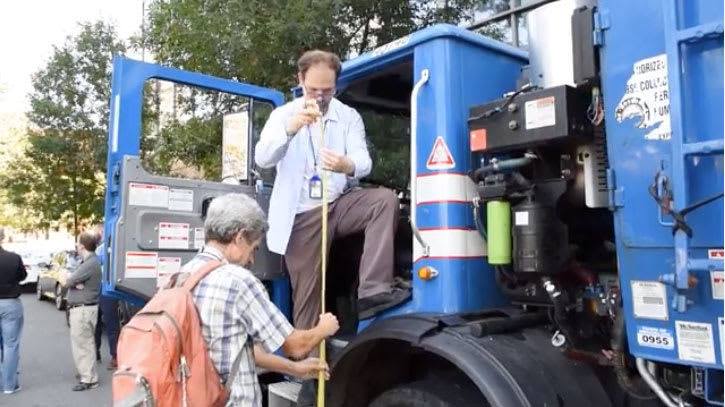
A 2018 demonstration of how the Volpe Center’s “View” app (Visibility in Elevated Wide vehicles), can measure blind zones on large vehicles.
Photo: Screen capture from Volpe video
5 min to read
Drivers of trucks, buses, and other large vehicles need to be able to see “vulnerable road users,” such as pedestrians, according to proponents of a new “direct-vision cab design” standard in the works.
Together for Safer Roads, through its Global Leadership Council for Fleet Safety, is partnering with the U.S. Department of Transportation’s Volpe Center and TSR members such as Republic Services to make direct-vision cab design a fleet industry standard in the U.S.
The initiative will give fleet managers and operators data and analysis on how safe — or dangerous — vehicles are in relation to driver blind zones, including developing a standard for rating the vehicles and a database of those ratings.
Direct-vision cabs reduce or completely eliminate driver blind zones, according to the announcement. Currently, the vast majority of commercial trucks available in the U.S. do not provide direct vision, the organization said, “despite estimates that one-quarter of the more than 500 pedestrian and bicyclist deaths each year that involve large trucks traveling at low speeds could be prevented by direct-vision cabs.”
A grant was awarded by The Santos Family Foundation to support TSR’s work to make direct-vision cabs the industry standard for commercial trucks.
Developing Direct Vision Ratings
TSR aims to make direct-vision cab design the standard by showcasing the benefits of a direct vision standard and self-certification process.
TSR plans to partner with fleet leaders to pilot the direct-vision rating standards and initiate the self-certification process to demonstrate truck safety. Its goal is for fleets to make the standards and certification an industry best practice, with supporting research shared across public and private sector fleets to prove the benefits of direct vision.
The standard and certification are built on research from the Volpe Center, whose mission it is to address the nation’s most pressing and complex transportation challenges. It will introduce new tools such as the Volpe Center’s “View” app (Visibility in Elevated Wide vehicles), a smartphone app that fleets can use to measure blind zones on their vehicles.
Together for Safer Roads and the Volpe Center are partnering to use the View app to assess commercial trucks and create a database of vision ratings for dozens, if not hundreds, of models.
View is a low-cost web application prototyped by students at the Olin College of Engineering, who were sponsored by the Santos Family Foundation and worked under guidance from Volpe Center experts. Data for View is gathered with a standard smartphone, a measuring pole, and a camera stand. The web application calculates a direct vision rating based on the visible space near the truck cab.
In 2018, the Volpe Center, Together for Safer Roads, and waste disposal company Republic Services convened a demonstration of the View system.
The Santos Family Foundation has also provided grants to the Volpe Center to develop and refine applications that facilitate direct vision assessment for truck and large passenger vehicle cabs.
As part of the standard and certification development process, TSR and the Volpe Center will distribute data and analysis to government regulators, car and truck makers, fleet managers, and drivers to promote the need for direct-vision cabs.
Although several vehicle manufacturers already sell direct-vision cab designs in Europe, few are available to fleets in the U.S. or other parts of the world. TSR intends to show manufacturers the untapped potential for direct vision trucks in the U.S. market and beyond, with work already under way through a public-private partnership that includes organizations such as:
The City of New York, which manages the largest sanitation department in the world and is committed to making direct vision trucks the standard.
TSR member Republic Services, one of the largest waste management companies in the U.S., which is conducting research around changing its procurement specifications to require direct-vision cabs.
The National Waste and Recycling Association, which is participating in TSR-led discussions around direct vision.
The New York City plan notes that “large trucks may be configured with cabs that allow the driver the greatest possible amount of direct vision and that minimize the need to rely on indirect vision through mirrors, cameras, and other devices. Truck cabs should be positioned as low to the ground as possible and include glazing that extends as far down on the front and sides as practical — e.g., fully glazed full-height entry doors similar to those on DSNY collectors. Trucks should be either cab-over-engine design whenever feasible, otherwise with a sloped conventional hood to minimize the front blind spot."
Protecting 'Vulnerable Road Users'
TSR's not the only organization concerned about large-vehicle blind spots that can hide pedestrians, cyclists, and other "vulnerable road users."
The National Transportation Safety Board has been recommending for years that the National Highway Traffic Safety Administration require both medium- and heavy-duty trucks to be “equipped with visibility enhancement systems to improve the ability of drivers of tractor-trailers to detect passenger vehicles and vulnerable road users, including pedestrians, cyclists, and motorcyclists.”
In 2019, the NTSB reported that data have shown that large vehicles pose a specific problem for bicycle safety, especially in urban areas where large vehicles operate near bicyclists and other vulnerable road users.
The NTSB examined data from 2014 through 2017 and found that 511 bicyclists were involved in crashes involving transit operations. Among them, 374 bicyclists, or 73%, collided with transit buses. Twenty-three bicyclists, or 6%, died in these crashes.
In 2013, the NTSB report, “Crashes Involving Single-Unit Trucks that Resulted in Injuries and Deaths,” concluded that onboard systems and equipment that compensate for blind spots and allow drivers of single-unit trucks to detect vulnerable road users could prevent fatalities and injuries that occur in crashes involving single-unit trucks. Such systems and equipment could include enhanced mirror systems or sensors that can alert drivers if there is another vehicle, bicyclist, or pedestrian in the blind spot after the driver activates the turn signal.
More Safety & Compliance

FMCSA Pauses Biennial-Update Enforcement Amid Motus Transition
Carriers whose updates were due on or after June 1 have more time, while FMCSA works to stabilize its new registration system and warns of phishing sites impersonating its new carrier registration system, Motus.
Read More →
ZF Expands Commercial Vehicle Push in North America
ZF is expanding its North American commercial-vehicle presence with new transmission applications, electrification, trailer technology and autonomous-driving systems.
Read More →
Truck Drivers Need More Than Another Alert
Fleets have more visibility into truck health, safety events, and driver activity than ever. The next challenge is turning all that information into useful guidance for the person who has to decide what to do next.
Read More →
Tesla Wants a Self-Driving Semi. Are Cameras Enough?
Could Tesla’s camera-only autonomous driving technology work on an 80,000-pound Semi? In this commentary, HDT's Deborah Lockridge takes a look at Tesla, Cybercab, and how autonomous trucks see the road.
Read More →
What DOT’s Automated Vehicle Strategy Means for Trucking
The U.S. Department of Transportation issued a new automated-vehicle strategy that outlines plans for driverless-truck regulations, cross-state freight corridors, and federal safety standards.
Read More →
NYC Expands Speed, Pedestrian Safety Tech Across Fleet
New York City is expanding intelligent speed assistance and pedestrian-alert systems across its municipal fleet, moving the technologies from pilot programs into vehicle procurement and retrofit requirements.
Read More →
FMCSA Removes 110 Truck Driver Training Schools from Certified ELDT List
Federal regulators also are targeting more than 160 additional training providers and launching a nationwide audit of third-party CDL skills testers as part of a broader crackdown on trucking fraud.
Read More →
Beyond DOT Compliance: What Makes a Trucking Fleet Truly Safe?
A trucking fleet can follow every rule and still make unsafe decisions. The real test comes when safety conflicts with freight, productivity, or cost.
Read More →
Hours of Service Pilot Programs: FMCSA Readies for 2027 Rollout
Two pilot programs could eventually reshape hours-of-service rules, giving truck drivers options to pause their 14-hour clock or use longer split sleeper rest periods.
Read More →
New Guide Offers Pet Safety Tips for Truck Drivers
Hundreds of thousands of pets travel in truck cabs. A new safety guide from Volvo Trucks and the Center for Pet Safety offers practical advice for truck drivers who bring dogs and cats along for the ride.
Read More →