




Infrastructure Reform Group Finds Twin 33s Boost Safety and Efficiency
The Americans for Modern Transportation coalition released a new study finding that twin 33-foot trailers would boost safety and efficiency with widespread adoption.
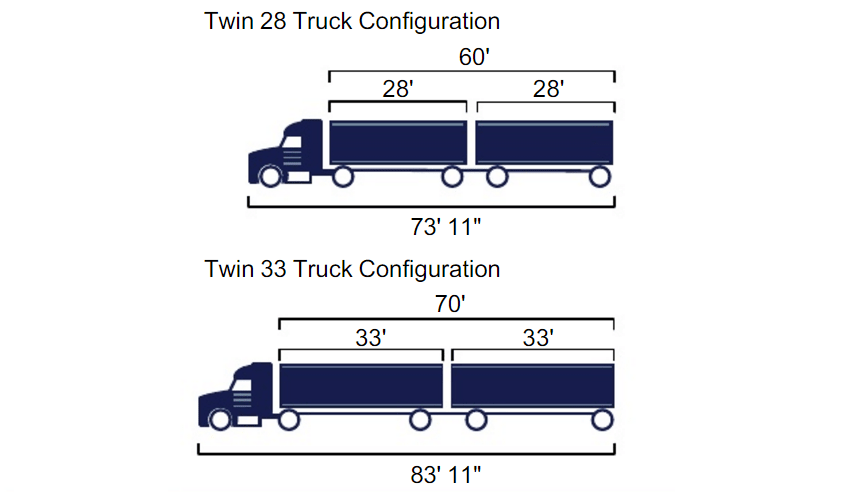
Image via report: Twin 33 Foot Truck Trailers: Making U.S. Freight Transport Safer and More Efficient
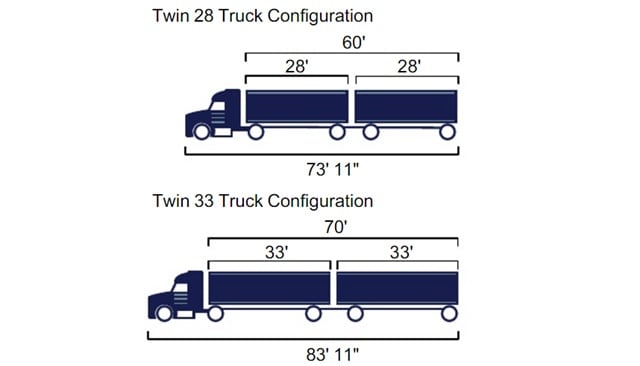
Image via report: Twin 33 Foot Truck Trailers: Making U.S. Freight Transport Safer and More Efficient
The Americans for Modern Transportation coalition released a new study finding that twin 33-foot trailers would boost safety and efficiency with widespread adoption.
The study, entitled Twin 33 Foot Truck Trailers: Making U.S. Freight Transport Safer and More Efficient, was conducted by Ronald Knipling, a 35-year traffic safety researcher. In it, Knipling found that twin 33s improved safety primarily through road stability and cutting down on the number of trucks on the road.
Because trailers often fill up before hitting the 80,000-pound limit, according to the study, by switching from twin 28-foot trailers to twin 33s, cargo volume could increase by 18.6% while still not needing to increase the maximum weight limit. This means that using twin 33s would require 15.7% fewer trucks and trailers to carry the same amount of cargo.
“Allowing widespread use of Twin 33 trailers is common sense policy. Not only are they more stable at highway speeds, the efficiency gains mean we have fewer trucks on the road,” said Knipling.
“Fewer trucks means fewer accidents, less wear and tear on our roads, and more focused enforcement by weigh stations for all types of trucks. It’s a win-win for drivers, consumers, businesses, and the economy.”
The study found that through a widespread adoption of Twin 33s, truck miles driven could have by reduced by as much as 3.1 billion miles and reduced the number of truck-involved accidents by 4,500 annually.
Fewer trucks on the road would also reduce fuel use, saving 255.2 million gallons of fuel and reducing carbon emissions by nearly 3 million tons. The effect of this reduction would be similar to taking 551,000 cars off of the road, according to the study.
Another positive change by switching to twin 33s was reduced congestion, again from needing fewer trucks on the road to move freight. The study estimated that Twin 33s could have decreased travel delay time by 53.2 million hours over the course of a year. Ultimately, all of the positives resulting from twin 33s could have saved around 2.6 billion in transportation costs.
The study also highlights other innovations in trucking safety and efficiency such as adaptive cruise control, electronic stability monitoring, video mirrors, collision warning systems and onboard safety monitoring.
“While the trucking industry continues to innovate, it’s been more than 25 years since we upgraded our transportation policies,” said Melissa Manson, AMT spokesperson. “Business and consumer trends demand a modern transportation system.”
More Fleet Management

Color Match Smarter: Tools That Restore & Perform
For fleet managers and collision repair professionals keeping heavy-duty trucks on the road, getting the color right the first time isn't just about appearance — it's about efficiency, turnaround time, and bottom-line results. Discover how today's digital color tools are transforming the repair process from guesswork to precision.
Read More →
FMCSA Pauses Biennial-Update Enforcement Amid Motus Transition
Carriers whose updates were due on or after June 1 have more time, while FMCSA works to stabilize its new registration system and warns of phishing sites impersonating its new carrier registration system, Motus.
Read More →
2026 Blueprint for Countering Smarter Supply Chain Theft
Cargo theft is no longer just the cost of doing business. It's a multi-billion-dollar criminal enterprise exploiting vulnerabilities across your fleet, drivers, and supply chain.
Read More →


How Telematics Improves Visibility, Control, and Performance in Refrigerated Fleets
Explore how telematics help refrigerated fleets improve visibility, uptime, efficiency, compliance, and cargo protection across connected cold chain operations.
Read More →
What the U.S.-Canada Trade War Means for Trucking
Escalating U.S.-Canada tariffs could disrupt cross-border freight, reduce truck volumes, raise costs, and create new uncertainty for carriers on both sides of the border.
Read More →
What Are Trucking’s Top Concerns for 2026?
The American Transportation Research Institute wants to know what's worrying trucking fleet managers, drivers, and other stakeholders in its annual Industry Issues survey.
Read More →
American Trucking Associations Looks for a New Leader
ATA President and CEO Chris Spear abruptly left his job at the association on August 21, at a pivotal time for the trucking industry.
Read More →
Public Wi-Fi Cybersecurity Risks: How Truck Drivers and Fleets Can Protect Their Data
Public Wi-Fi can expose truck drivers and fleets to credential theft, malware, and other cyber threats. Here’s how to reduce the risk on the road.
Read More →
For Nicky Cupp, Fleet Innovation Starts With Frustration
HDT Truck Fleet Innovator Nicky Cupp turns everyday pain points at Fraley & Schilling into opportunities for better technology and smarter processes.
Read More →
Adam Buttgenbach’s Approach to Electric Trucks: Start With Where They Fit
HDT Truck Fleet Innovator Adam Buttgenbach helped PepsiCo build one of North America’s largest EV fleets by focusing on where electric trucks make operational sense.
Read More →