




Smart Trailers Face a Huge Hurdle
Hyundai Translead: Composite Trailer Panels Offer Significant Improvements
Hyundai Translead said it has developed a new, composite material panel technology for trailers that offers significant weight savings and enhanced durability.
by Staff
January 12, 2021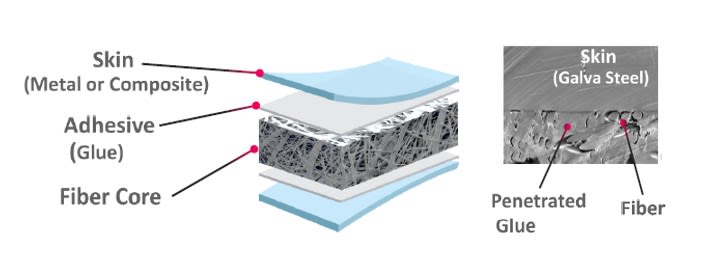
Hyundai Translead's new advanced fiber core composite panel was developed over the past three years in collaboration with LG Hausys, a manufacturer specializing in high performance materials including appliance and automotive components.
Image: Hyundai Translead
3 min to read
Hyundai Translead has introduced a new, lightweight polymer fiber core composite panel for trailers. The company said in a news release that this new composite fiber panel, along with improved panel designs, will result in lower total cost of ownership for fleet operators.
“Our new and enhanced design changes allow for significant weight savings while maintaining the same durability and strength,” said Y.J. Park, vice president, product engineering at Hyundai Translead, in the release. “We are very excited about both the additional weight savings and new composite panel technology.”
The company said recently launched design improvements in its dry and reefer trailer models offer weight savings to fleets, allowing them to load more freight with each truckload.
The new lightweight composite dry van trailer features a new rear header, standard side panel specification, and side rail redesigns, offering a significant weight reduction of 330 pounds per trailer, according to the news release.
An optimized high-strength steel upper coupler is fully hot-dipped galvanized for added corrosion protection. Harness routing in the rear door header, along with convenient replacement of the side composite panels, allow for ease of maintenance. Roll forming has been adopted to improve and reduce components used in the rear header and impact guard.
Hyundai Translead said it has made multiple enhancements to its refrigerated trailers since 2019, resulting in significant weight savings of 680 pounds per trailer. The 2021 models feature reduced weight, improved durability, and greater thermal efficiency. Enhanced designs have increased durability and strength for flat and duct floors with floor ratings of 20,000 pounds. Reinforced polypropylene used in the new floor design provides significant weight savings, increases flexural strength by 30%, and prevents deterioration, according to the company.
Moreover, the company said, the lightweight refrigerated trailer offers improved thermal efficiency. Design changes on the front structure, upper coupler, and front interior connection combine to reduce moisture intrusion.
The new advanced fiber core composite panel was developed over the past three years in collaboration with LG Hausys, a manufacturer specializing in high-performance materials, including appliance and automotive components.
The new fiber core composite panel consists of a galvanized steel skin and fiber core, creating a product that is durable, lighter in weight, and has reduced thermal transmittance. A stronger polymer fiber core allows for a thinner outer composite layer, allowing significant weight reduction. Available on dry van trailers, the panel offers customers a weight savings of 155 pounds per trailer in addition to the 330-pound weight savings offered by the standard conventional composite panel.
Fibers in the core layer of the panel are mechanically bonded for improved strength and endurance. Additionally, the adhesive is anchored to the open cell for a longer lasting bond. The enhanced peel strength keeps water intrusion at bay, preventing costly damage such as delamination and cracks. Tested in extreme temperatures, the fiber core composite panel can withstand harsh conditions and weather, according to the news release.
The panel is designed with enhanced insulation, preventing moisture build-up and providing a safe environment for all types of cargo. Engineered to reduce heat transfer, the innovative panel’s fiber core reduces thermal transmittance up to 25%, says the company.
Thermal transmittance can cause condensation to accumulate inside the trailer due to the temperature difference of the exterior and interior atmosphere. Designed with enhanced insulation, the fiber core composite panel prevents moisture buildup and provides a safe environment for all types of freight.
More Equipment

How Volvo Updated Its D13 for EPA 2027 [Watch]
Volvo’s updated D13 promises lower emissions without sacrificing performance or fuel economy. Take a closer look at what changed inside the engine in this HDT Spotlight video.
Read More →
Michelin Tire Improves Efficiency and Durability for Regional Fleets
The Michelin X Multi Energy D2 is a regional haul drive tire engineered to help fleets improve fuel efficiency, durability and traction in demanding stop-and-go operations.
Read More →
ZF Expands Commercial Vehicle Push in North America
ZF is expanding its North American commercial-vehicle presence with new transmission applications, electrification, trailer technology and autonomous-driving systems.
Read More →
Tesla Wants a Self-Driving Semi. Are Cameras Enough?
Could Tesla’s camera-only autonomous driving technology work on an 80,000-pound Semi? In this commentary, HDT's Deborah Lockridge takes a look at Tesla, Cybercab, and how autonomous trucks see the road.
Read More →
Kodiak: Driverless Long-Haul Truck Launch on Track for 2026
Kodiak AI says its driverless long-haul safety case is 93% complete and it remains on track to begin commercial operations by year-end 2026.
Read More →
What DOT’s Automated Vehicle Strategy Means for Trucking
The U.S. Department of Transportation issued a new automated-vehicle strategy that outlines plans for driverless-truck regulations, cross-state freight corridors, and federal safety standards.
Read More →
East Coast Port Launches $45M Electric Truck Push
The Port Authority of New York and New Jersey announced millions in incentives for zero-emission drayage trucks, yard tractors, and new charging hubs near the port.
Read More →
PlusAI Going Public to Fund Autonomous Truck Launch
A SPAC deal could provide PlusAI with up to $300 million as it works toward a 2027 commercial launch of factory-built autonomous trucks.
Read More →
NHTSA Moves to Rewrite Truck Fuel-Economy Rules
The National Highway Traffic Safety Administration says it lacks authority to regulate medium- and heavy-duty truck engines separately from complete vehicles, but the existing standards have not yet been eliminated.
Read More →
Detroit Opens Orders for EPA 2027 Engines
Detroit isn’t starting from scratch to meet EPA 2027 diesel emissions standards. Its Gen 6 DD13 and DD15 engines keep much of today’s platform while updating the fuel and aftertreatment systems.
Read More →