




Gasoline Bucks Trend of Dropping Diesel, Oil Prices
Diesel fuel prices continue to drop as crude oil futures continue to reflect a worldwide glut. Gasoline prices, however, jumped nearly 30 cents a gallon in California.
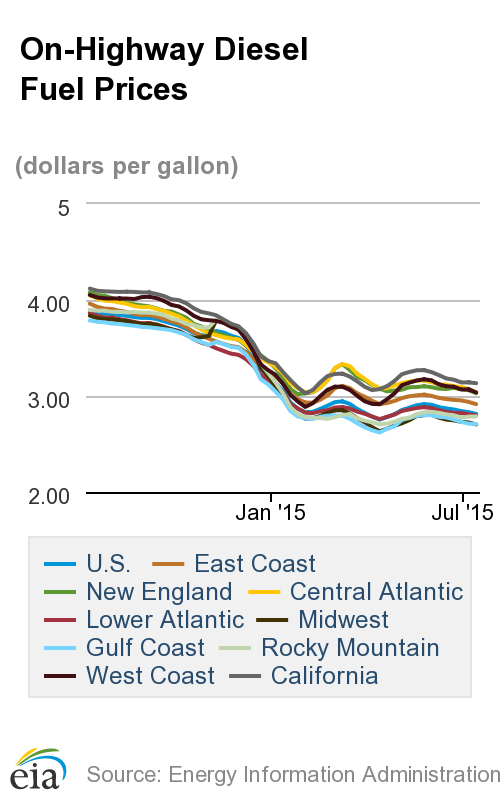
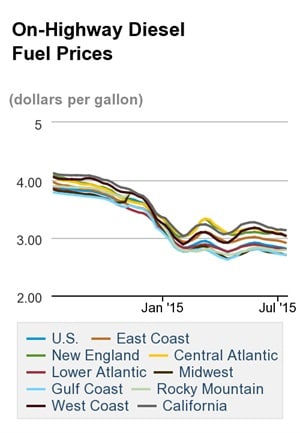
Diesel fuel prices continue to drop as crude oil futures continue to reflect a worldwide glut. Gasoline prices, however, jumped nearly 30 cents a gallon in California.
Weekly figures released Monday by the U.S. Department of Energy show the national average retail price of a gallon of diesel at $2.814, down 1.8 cents from a week ago and down $1.08 from a year ago.
For regular gasoline, however, the average price was up 4.1 cents per gallon from last week to $2.834. That's still down 80.1 cents from a year ago.
Diesel prices were down in all regions except for the Rocky Mountain region, where they were up 0.2 cents per gallon. The highest diesel prices were in California, at $3.133. The New England and Central Atlantic regions were also over $3 a gallon. The lowest average price was reported in the Midwest at $2.704, followed closely by the Gulf Coast at $2.708.
Gasoline prices were highest on the West Coast at $3.589 per gallon, jumping 29.2 cents from last week.
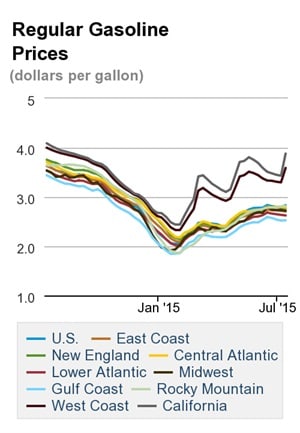
Drivers in California could see prices top $4 a gallon, reports the Associated Press, noting that a shortage in oil and other components used to make California's unique blend of gasoline.
Even without California, the West Coast saw an average gasoline price of $3.589. The lowest gasoline prices were reported in the Gulf Coast region at $2.527, up 0.8 cents from the previous week.
Negotiations ongoing with Iran over a nuclear deal have been depressing crude oil futures because a deal would mean the country would re-enter an oil market that is already in a glut. U.S. light crude, also known as West Texas Intermediate, closed down 54 cents Monday, or 1%, at $52.20 a barrel, CNBC reports.
Bank of America Merrill Lynch, CNBS reports, said U.S. crude prices "could soon drop well below our $50 per barrel target" for the third quarter of the year.
A weaker dollar also is contributing to lower crude oil futures prices. And the Wall Street Journal reports that news that production has recently increased in Saudi Arabia and North Dakota, despite the global glut, also pushed prices lower. In fact, Saudi Arabia produced a record high output of crude oil in June.
More Fuel Smarts

How Volvo Updated Its D13 for EPA 2027 [Watch]
Volvo’s updated D13 promises lower emissions without sacrificing performance or fuel economy. Take a closer look at what changed inside the engine in this HDT Spotlight video.
Read More →
Diesel Price Spike Shortens Payback for Natural Gas Trucks, Report Says
Energy Vision estimates fleets could recover the higher purchase price of an RNG-fueled Class 8 tractor in 1.3 to 2.8 years under current fuel-price scenarios.
Read More →
Calstart Becomes Catalyst Mobility, Reflecting Broader Focus
Calstart is now Catalyst Mobility, reflecting the nonprofit’s growing national role in clean transportation, including zero-emission trucks, infrastructure and incentive programs.
Read More →

Record Diesel Prices Squeeze Trucking Fleets
Average U.S. diesel prices have climbed to nearly $6 a gallon, surpassing the 2022 record as tight refinery capacity and Middle East disruptions keep fuel costs elevated.
Read More →
How Fuel Delivery Shapes Engine Performance
Fuel delivery depends on more than what happens at the injector. For fleet, maintenance and technical professionals, looking at the full path from pump to injector can provide useful context for understanding engine performance.
Read More →
East Coast Port Launches $45M Electric Truck Push
The Port Authority of New York and New Jersey announced millions in incentives for zero-emission drayage trucks, yard tractors, and new charging hubs near the port.
Read More →
California Bill Could Shed Light on Electric Truck Prices
Why do battery-electric Class 8 trucks remain so expensive? A California bill headed to Gov. Gavin Newsom would give fleets and state agencies more visibility into what manufacturers charge.
Read More →
Detroit Opens Orders for EPA 2027 Engines
Detroit isn’t starting from scratch to meet EPA 2027 diesel emissions standards. Its Gen 6 DD13 and DD15 engines keep much of today’s platform while updating the fuel and aftertreatment systems.
Read More →
Zero-Emission Truck Corridor Planned for West Coast
California, Oregon, Washington, British Columbia and Baja California are coordinating plans for truck charging and hydrogen fueling from Canada to Mexico.
Read More →
A Closer Look at Kenworth’s Electric T880E Vocational Truck [Video]
Learn more about Kenworth's T880E battery-electric vocational truck at the Paccar Technical Center, including its range, applications, upfitting considerations, and PTO options, in this HDT Spotlight video.
Read More →