Fourth of July Holiday Heightens Risk of Freight Theft
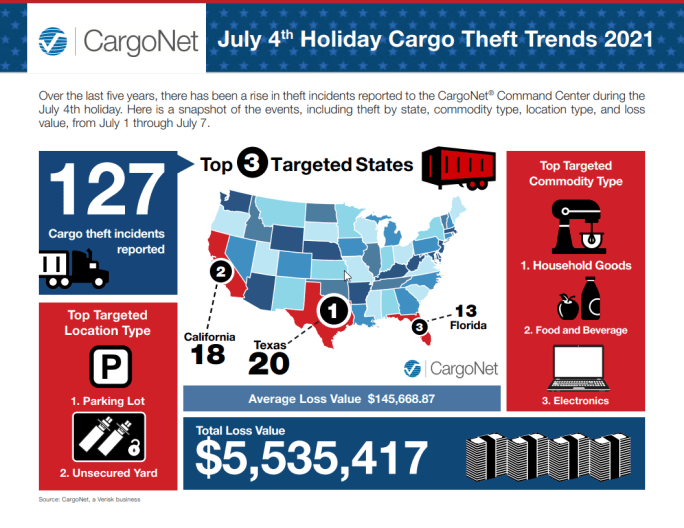
Activity for the Fourth of July weekend in 2020 was at its highest since 2016 and increased by 123% over the previous year, according to a CargoNet analysis.
Theft activity for the Fourth of July weekend in 2020 was at its highest since 2016.
File Photo: Doleco
2 min to read
An average of 25 freight thefts were recorded between July 1 and July 7 for the previous five years, CargoNet reported based on a review of theft data.
The average stolen shipment was worth $145,699 per event, according to CargoNet data.
Ad Loading...
Activity for the Fourth of July weekend in 2020 was at its highest since 2016 and increased by 123% over the previous year. Forty-two percent of theft events occurred on a Friday or Saturday in this analysis.
Graphic: CargoNet
In previous years, household goods and food and beverage items were the most commonly targeted commodities. This would include items like appliances, toys, alcoholic beverages and seafood.
“The COVID-19 pandemic has caused shortages and price inflation of specific goods and we think the items most affected — like computer electronics — are the items most at-risk this holiday,” CargoNet officials said in a press release. “Cargo thieves will seek to exploit extended business closures this upcoming holiday to steal more cargo.”
Ad Loading...
California, Texas, Florida and Illinois recorded the most thefts in the company’s analysis period.
Crime Trends
Computer Electronics Departing Warehouses in California
CargoNet is tracking an ongoing theft risk to shipments of computer electronics departing warehouses in California. CargoNet has recorded over 50 thefts of electronics shipments in the state since September 2020 and thefts have increased 89% when compared to the previous year. On average, each full truckload theft event was worth $595,928 and each partial truckload $197,157.
Full Truckload Cargo Theft Activity in Ohio, Indiana, Tennessee, North Carolina, and Texas
0 CargoNet has noticed a recent spike in full truckload cargo thefts in Ohio, Indiana, Tennessee, North Carolina, and Texas. Preliminary investigations indicate that one or more sophisticated cargo theft groups may be stalking truck stops along major interstates and surveilling shipper's warehouses with the intent to follow and steal once the shipment is left unattended.
“Supply chain professionals can step up security by arranging for same-day delivery of short-haul shipments, embedding covert tracking devices, and by using high-security locks to prevent trailer burglaries,” CargoNet officials advises. “Drivers should adhere to the "red-zone" rule and avoid stopping within 250 miles of pickup. Drivers should also be on the lookout for any vehicles that appear to be following them and avoid leaving trucks and trailers unattended for long periods of time.
Noteworthy thefts from previous July 4th holidays
$2,000,000 of perfume from Hillsborough Township, New Jersey
$444,000 in power cables from Long Beach, California
$439,895 in medical supplies from Davenport, Florida
$352,000 of computer electronics from San Francisco, CA
Volvo’s updated D13 promises lower emissions without sacrificing performance or fuel economy. Take a closer look at what changed inside the engine in this HDT Spotlight video.
The Michelin X Multi Energy D2 is a regional haul drive tire engineered to help fleets improve fuel efficiency, durability and traction in demanding stop-and-go operations.
ZF is expanding its North American commercial-vehicle presence with new transmission applications, electrification, trailer technology and autonomous-driving systems.
Could Tesla’s camera-only autonomous driving technology work on an 80,000-pound Semi? In this commentary, HDT's Deborah Lockridge takes a look at Tesla, Cybercab, and how autonomous trucks see the road.
The U.S. Department of Transportation issued a new automated-vehicle strategy that outlines plans for driverless-truck regulations, cross-state freight corridors, and federal safety standards.
The Port Authority of New York and New Jersey announced millions in incentives for zero-emission drayage trucks, yard tractors, and new charging hubs near the port.
The National Highway Traffic Safety Administration says it lacks authority to regulate medium- and heavy-duty truck engines separately from complete vehicles, but the existing standards have not yet been eliminated.
Detroit isn’t starting from scratch to meet EPA 2027 diesel emissions standards. Its Gen 6 DD13 and DD15 engines keep much of today’s platform while updating the fuel and aftertreatment systems.