





More on TuSimple: TuSimple, Developer Building Autonomous-Truck Terminal
FMCSA Looks into TuSimple Accident
Was an incident where a TuSimple truck made contact with a concrete medium divider simply a human error, or something that speaks to a potential larger issue with autonomous technology?
August 3, 2022
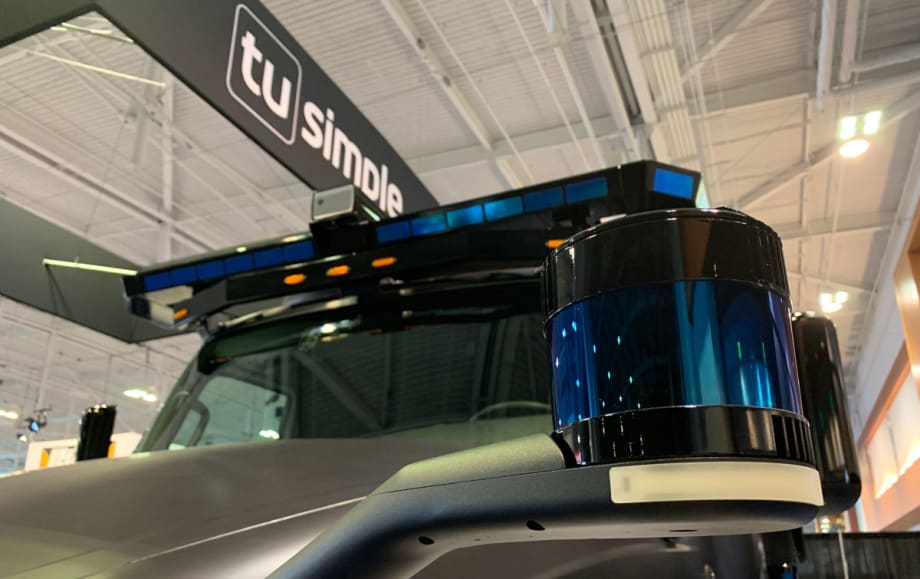
A TuSimple truck on display at the American Trucking Associations' 2021 annual management conference.
Photo: Deborah Lockridge
3 min to read
Was an incident where a TuSimple truck made contact with a concrete medium divider simply a human error, or something that speaks to a potential larger issue with the company or with self-driving trucks in general? That’s the question about an April incident which has attracted the attention of the Federal Motor Carrier Safety Administration.
According to the Wall Street Journal, FMCSA has launched what it described in a May 26 letter to TuSimple as a “safety compliance investigation.” The letter referenced the accident.
The April 6 incident in Tucson, Arizona, happened as the truck was being operated on the highway, within its mapped “operational design domain,” according to TuSimple’s self-report to the National Highway Traffic Safety Administration. “The driver and test engineer attempted to engage the automated driving system. However, the ADS was not functional at that moment due to the computer unit not having been initialized and should not have been attempted to be activated.”
As the Wall Street Journal described it based on what it said was an “internal TuSimple report on the mishap,” the truck “abruptly veered left because a person in the cab hadn’t properly rebooted the autonomous driving system before engaging it, causing it to execute an outdated command…. The left-turn command was 2 1/2 minutes old — an eternity in autonomous driving — and should have been erased from the system but wasn’t, the internal account said.”
TuSimple’s report explained that the safety driver took control of the steering and was able to prevent a crash, but not before the left front truck tire and left front quarter panel came into contact with the concrete barrier. The contact resulted in a scuff to the left tire and damage to the radar unit extending from the left quarter panel, noted the report.
“In short, this was a failed attempt to engage the system as a result of human error,” TuSimple said.
Was Autonomous-Truck Crash Simply Human Error?
However, the Wall Street Journal reported, researchers at Carnegie Mellon University said blaming the entire accident on human error is misleading. “Common safeguards would have prevented the crash had they been in place, said the researchers, … For example, a safety driver — a person who sits in the truck to backstop the artificial intelligence — should never be able to engage a self-driving system that isn’t properly functioning, they said. The truck also shouldn’t respond to commands that are even a couple hundredths of a second old, they said. And the system should never permit an autonomously-driven truck to turn so sharply while traveling at 65 mph.”
In a recent blog post on its website, TuSimple said that in response to the incident, “we immediately grounded our entire autonomous fleet and launched an independent review to determine the cause of the incident. With learnings from this review in hand, we upgraded all of our systems with new automated system checks to prevent this kind of human error from ever happening again and we reported the incident to NHTSA and the Arizona Department of Transportation….
“Because of our self-reporting of the incident, the Federal Motor Carrier Safety Administration (FMCSA) formally requested information, and we welcomed their team along with staff from NHTSA to visit our site in Tucson to discuss what occurred and the solutions we put in place to safeguard against human errors. Currently, we are helping FMCSA and NHTSA with the review process.”
TuSimple noted in its blog that there are more than 500,000 crashes involving large trucks each year, according to NHTSA data. “In comparison, in seven years and 7.2 million miles of autonomous vehicle testing, this is the first on the road incident for which we’ve been responsible. While our safety record is many times better than traditional manually-driven trucks, we take our responsibility to find and resolve all safety issues very seriously.”
The incident appears to be getting media attention due to someone anonymous who claims to be a whistleblower within TuSimple, according to this video, where dash-cam footage of the incident is shared:
More Safety & Compliance

FMCSA Pauses Biennial-Update Enforcement Amid Motus Transition
Carriers whose updates were due on or after June 1 have more time, while FMCSA works to stabilize its new registration system and warns of phishing sites impersonating its new carrier registration system, Motus.
Read More →
ZF Expands Commercial Vehicle Push in North America
ZF is expanding its North American commercial-vehicle presence with new transmission applications, electrification, trailer technology and autonomous-driving systems.
Read More →
Truck Drivers Need More Than Another Alert
Fleets have more visibility into truck health, safety events, and driver activity than ever. The next challenge is turning all that information into useful guidance for the person who has to decide what to do next.
Read More →
Tesla Wants a Self-Driving Semi. Are Cameras Enough?
Could Tesla’s camera-only autonomous driving technology work on an 80,000-pound Semi? In this commentary, HDT's Deborah Lockridge takes a look at Tesla, Cybercab, and how autonomous trucks see the road.
Read More →
What DOT’s Automated Vehicle Strategy Means for Trucking
The U.S. Department of Transportation issued a new automated-vehicle strategy that outlines plans for driverless-truck regulations, cross-state freight corridors, and federal safety standards.
Read More →
NYC Expands Speed, Pedestrian Safety Tech Across Fleet
New York City is expanding intelligent speed assistance and pedestrian-alert systems across its municipal fleet, moving the technologies from pilot programs into vehicle procurement and retrofit requirements.
Read More →
FMCSA Removes 110 Truck Driver Training Schools from Certified ELDT List
Federal regulators also are targeting more than 160 additional training providers and launching a nationwide audit of third-party CDL skills testers as part of a broader crackdown on trucking fraud.
Read More →
Beyond DOT Compliance: What Makes a Trucking Fleet Truly Safe?
A trucking fleet can follow every rule and still make unsafe decisions. The real test comes when safety conflicts with freight, productivity, or cost.
Read More →
Hours of Service Pilot Programs: FMCSA Readies for 2027 Rollout
Two pilot programs could eventually reshape hours-of-service rules, giving truck drivers options to pause their 14-hour clock or use longer split sleeper rest periods.
Read More →
New Guide Offers Pet Safety Tips for Truck Drivers
Hundreds of thousands of pets travel in truck cabs. A new safety guide from Volvo Trucks and the Center for Pet Safety offers practical advice for truck drivers who bring dogs and cats along for the ride.
Read More →