FMCSA: Data Shows Little Effect from 2020 Hours of Service Changes
A report on the impact of 2020 hours-of-service modifications indicates that, so far, the frequency and severity of HOS violations have not been reduced, nor has there been a significant effect on crash or fatality rates.
David Cullen・[Former] Business/Washington Contributing Editor
The electronic logging device mandate is one factor muddying the analysis of the effect of 2019's HOS changes.
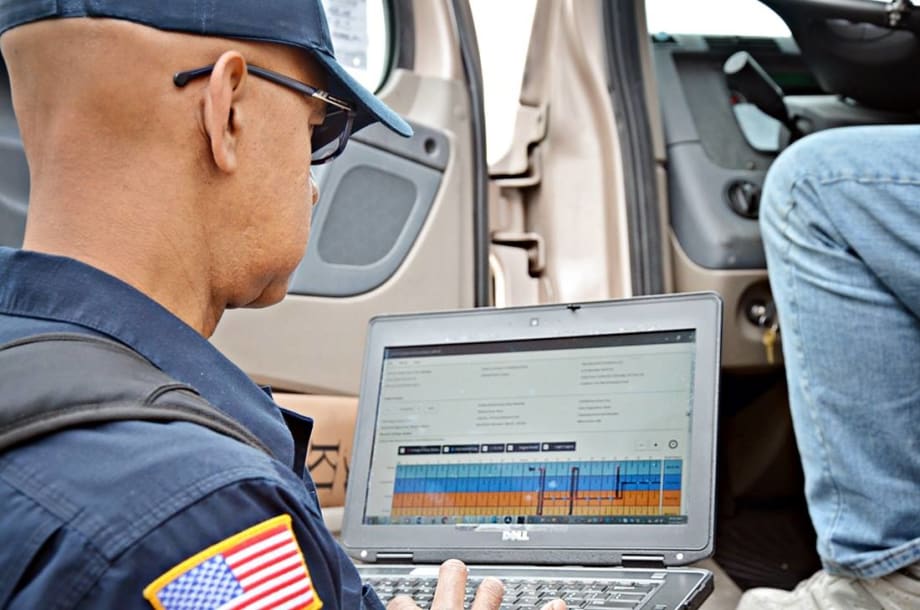
Photo: FMCSA (File)
4 min to read
To paraphrase Shakespeare, one might wonder if the changes that the Federal Motor Carrier Safety Administration made to the hours of service rule in 2020 amount to much ado about not much.
A public report on the impact of those modifications indicates that, so far, the frequency and severity of HOS violations have not been reduced, nor has there been a significant effect on crash or fatality rates, since the liberalized hours-of-service rules kicked in on Sept. 29, 2020.
Ad Loading...
The mandatory “Effects of Hours-of-Service Regulations Report to Congress” that FMCSA has sent to Congress “analyzes the real-world effects of the new hours-of-service regulations” by comparing safety data from the years prior to the most recent HOS amendments to determine any correlations.
Congress has required that the agency annually submit its analysis of “safety data, including but not limited to, the number of crashes, crash type, number of fatalities categorized by occupant type, number of serious injuries, the rate of involvement that large-trucks have [in] accidents, and the time of day and on what type of roadway the accident occurred.”
What the Hours-of-Service Report Found
However, the devil in the details is that the results are inconclusive — but only due to some mitigating factors unrelated to the rule changes.
Ad Loading...
But first, let’s dive into the specifics of the correlation study. The analysis compared two time periods, bracketing the change to HOS regulations that became effective on Sept. 29, 2020. Studied were the “pre-change period” for inspection and crash data of 01/01/2018 to 09/30/2020 and a “post-change period” for inspection and crash data of 10/01/2020 to 09/30/2021.
During the pre- and post-change periods, FMCSA examined the following correlations:
HOS inspection and violation data (all 49 CFR Part 395 HOS violations, including electronic logging device violations).
Large truck and bus crash trends.
Large truck and bus crash and fatality rates per 100 million vehicle miles traveled (VMT).
Relationships between HOS out-of-service (OOS) rates and large truck and bus crash and fatality rates.
The effect of the HOS changes on inspection and violations and crash and severity results varies more than might be expected. While HOS violations rose markedly, both crash and fatality rates rolled essentially flat.
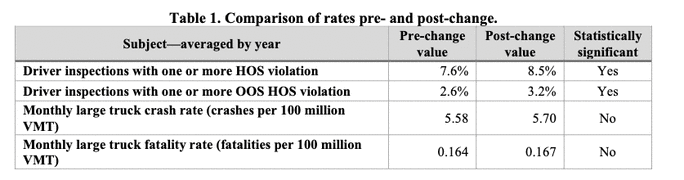
There was an increase in hours-of-service violations following the liberalization of HOS rules.
Source: FMCSA
Specifically, inspections of drivers resulting in one or more HOS violations increased from 7.6% pre-change to 8.5% post change. Driver inspections resulting in one or more OOS HOS violations rose from 2.6% to 3.2% The agency stated that both these comparison results are “statistically significant.”
Ad Loading...
On the other hand, FMCSA found that the monthly truck crash rate moved but slightly, moving from 5.58 to 5.70, and the monthly large truck fatality rate barely quivered, going from 0.164 to 0.167.
Why So Little Evidence of Cause and Effect?
In general, the 2020 revisions did not diminish HOS violation rates, according to FMCSA.
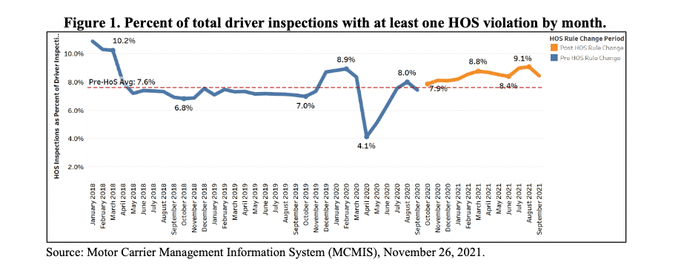
“The percentage of driver inspections with at least one HOS violation or at least one OOS HOS violation was significantly higher during the post-change period,” it said.
The data do not show a significant difference in crash or fatality rates, the agency said, “although it is important to note that initial trends may have been confounded” by outside pressures.
The percentage of driver inspections with at least one HOS violation was significantly higher after the new rules went into effect.
Source: FMCSA
FMCSA listed these impacts as:
Ad Loading...
The COVID-19 pandemic’s general effects on industry operations.
FMCSA’s emergency declaration that provided HOS regulatory relief for motor vehicle operations providing direct assistance in support of COVID-19 relief efforts.
In addition, there are “numerous confounding factors that influence crash rates, so this comparison does not specifically identify the effect of the HOS rule changes.”
There was not a significant difference in most crash-related metrics between the pre- and post-rule change periods. However, the data could be muddied by the COVID-19 pandemic’s effects on industry operations.
Source: FMCSA
Agency’s Alternative Approach
In the report’s conclusion, the agency offered an alternative approach to understanding the impact of the HOS changes” analyzing the safety outcomes of those who took advantage of the new provisions and waivers. However, there is very limited data to support an in-depth analysis of the safety outcomes of carriers that took advantage of the new HOS provisions in comparison to those that did not.
FMCSA stressed that “the pre- and post-rule change macro trend analysis is limited in its reach given the scale of the HOS rule changes and other confounding factors. Subsequent annual analysis will include more data points and additional data breakouts.”
The agency stated that it will work on “follow-on analyses drilling down into specific HOS violations or violation groups to attempt to correlate those with crash trends and will present any results in future annual reports.”
What Was in the Revised Hours of Service Rules
The current HOS final rule became effective on Sept. 29, 2020. It revised four provisions of HOS regulations:
30-minute break requirement. Requires a break of at least 30 consecutive minutes of non-driving time after eight cumulative hours of driving, but allows non-driving, on-duty time to count toward the required break.
Sleeper berth provision. Modifies the sleeper berth exception to allow a driver to meet the 10-hour minimum off-duty requirement by spending at least seven hours in the berth plus at least two hours inside or outside the berth, provided that the two periods total at least 10 hours.
Short-haul exception. Expanded from 100 air-miles to 150 air-miles for CDL holders and allows a 14-hour work shift for drivers utilizing the exception.
Adverse driving conditions exception. Expands the driving window during adverse driving conditions by two hours.
After three decades in trucking, Harold Perry shares what he's learned about driver safety, mentorship, and helping the next generation build confidence behind the wheel.
Carriers whose updates were due on or after June 1 have more time, while FMCSA works to stabilize its new registration system and warns of phishing sites impersonating its new carrier registration system, Motus.
ZF is expanding its North American commercial-vehicle presence with new transmission applications, electrification, trailer technology and autonomous-driving systems.
Fleets have more visibility into truck health, safety events, and driver activity than ever. The next challenge is turning all that information into useful guidance for the person who has to decide what to do next.
Could Tesla’s camera-only autonomous driving technology work on an 80,000-pound Semi? In this commentary, HDT's Deborah Lockridge takes a look at Tesla, Cybercab, and how autonomous trucks see the road.
The U.S. Department of Transportation issued a new automated-vehicle strategy that outlines plans for driverless-truck regulations, cross-state freight corridors, and federal safety standards.
New York City is expanding intelligent speed assistance and pedestrian-alert systems across its municipal fleet, moving the technologies from pilot programs into vehicle procurement and retrofit requirements.
Federal regulators also are targeting more than 160 additional training providers and launching a nationwide audit of third-party CDL skills testers as part of a broader crackdown on trucking fraud.
Two pilot programs could eventually reshape hours-of-service rules, giving truck drivers options to pause their 14-hour clock or use longer split sleeper rest periods.