




FMCSA Chief: Safety Benefits when Agency Partners with Trucking
The acting chief of the Federal Motor Carrier Safety Administration committed the agency to working even more closely with trucking’s stakeholders to further improve highway safety.

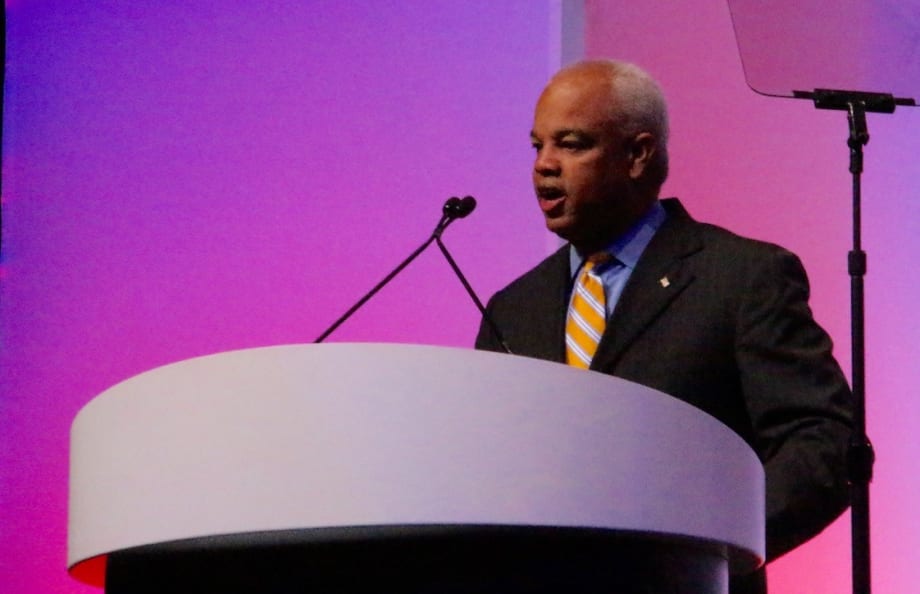
FMCSA's Darling addressing annual ATA meeting in Philadelphia on Oct. 18. Photo: Evan Lockridge
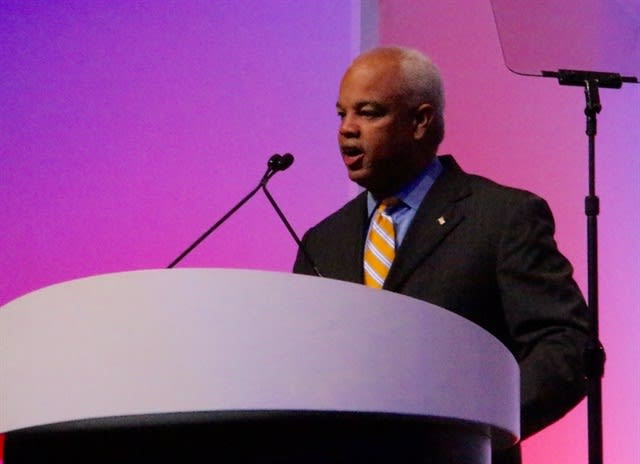
FMCSA's Darling addressing annual ATA meeting in Philadelphia on Oct. 18. Photo: Evan Lockridge
PHILADELPHIA — The acting chief of the Federal Motor Carrier Safety Administration committed the agency to working even more closely with trucking’s stakeholders to improve highway safety in his address here on Oct. 18 to the American Trucking Associations' Management Conference & Exhibition.
FMCSA Chief Counsel T.F. Scott Darling III stated that “there are 1,100 FMCSA employees making a difference [to improve safety], but we need partnerships [with trucking interests] to accomplish more. That’s why next year we will continue to push for partnerships” to help advance rulemakings.
Darling, who has headed the agency for over a year, was officially nominated to fill the vacant appointment of FMSCA Administrator by President Obama in August.
Darling remarked that the agency “depends on truck drivers and their companies to deliver goods and we need them to operate safely.” He said that FMCSA and trucking “must do all we can to take unsafe drivers and carriers off the road.”
As an example of the benefit of partnering, Darling said the industry “stepped up” when FMCSA “asked for help to reach drivers for data for our study of the effects of the hours-of-service restart provisions.”
He said that effort yielded data from more than 220 drivers as well as from trucking companies. “All the data points are being examined and we plan to submit our report to the [DOT] Office of the Inspector General in the coming months.”
Darling also said that, thanks to stakeholders “participating fully in the process,” the agency is completing a rulemaking on entry-level driver training despite “a compressed timeline” and said that is scheduled to be published by the end of the year.
The FMCSA chief reported as well that a new online unified-registration system for motor carriers is being developed that will save fleets both time and money.
As for the highly anticipated final rule that will mandate the use of electronic logging devices, Darling said it is “to be published soon.” He said that once it’s in effect, it “will save [an estimated] 20 lives and prevent more than 400 injuries a year and will improve [hours-of-service] compliance.”
Darling added that the White House’s Office of Management and Budget is reviewing the proposed Safety Fitness Determination rule and that FMSCA will be seeking public comment on it as well.
He also advised that the agency’s “militray skills training waiver” program that “removes the skills portion of CDL training” for qualifying military veterans has just been expanded to all 50 states.
More Safety & Compliance
A Camera Isn't a Safety Program. Here's What Brokers Are Screening for Now
Footage alone may not be enough to pass broker vetting processes. Here's what counts as a defensible safety program now.
Read More →
Marijuana and Trucking’s Drug-Testing Dilemma
Marijuana is getting stronger, laws are changing, and drug tests still can’t reliably establish impairment. What does that mean for truck drivers and the fleets that employ them?
Read More →
PrePass, Kodiak Connect Driverless Trucks to Roadside Enforcement
The system will allow enforcement agencies to verify Enhanced Inspection information and decide whether Kodiak’s autonomous trucks can bypass roadside screening sites.
Read More →

From One Generation to the Next: How Mentorship Builds Safer Truck Drivers
After three decades in trucking, Harold Perry shares what he's learned about driver safety, mentorship, and helping the next generation build confidence behind the wheel.
Read More →
FMCSA Pauses Biennial-Update Enforcement Amid Motus Transition
Carriers whose updates were due on or after June 1 have more time, while FMCSA works to stabilize its new registration system and warns of phishing sites impersonating its new carrier registration system, Motus.
Read More →
ZF Expands Commercial Vehicle Push in North America
ZF is expanding its North American commercial-vehicle presence with new transmission applications, electrification, trailer technology and autonomous-driving systems.
Read More →
Truck Drivers Need More Than Another Alert
Fleets have more visibility into truck health, safety events, and driver activity than ever. The next challenge is turning all that information into useful guidance for the person who has to decide what to do next.
Read More →
Tesla Wants a Self-Driving Semi. Are Cameras Enough?
Could Tesla’s camera-only autonomous driving technology work on an 80,000-pound Semi? In this commentary, HDT's Deborah Lockridge takes a look at Tesla, Cybercab, and how autonomous trucks see the road.
Read More →
What DOT’s Automated Vehicle Strategy Means for Trucking
The U.S. Department of Transportation issued a new automated-vehicle strategy that outlines plans for driverless-truck regulations, cross-state freight corridors, and federal safety standards.
Read More →
NYC Expands Speed, Pedestrian Safety Tech Across Fleet
New York City is expanding intelligent speed assistance and pedestrian-alert systems across its municipal fleet, moving the technologies from pilot programs into vehicle procurement and retrofit requirements.
Read More →