




Related: Houston Flood Damages City Vehicles
Flooding Takes Toll on Carolina Fleets
The governors of South Carolina and North Carolina have issued executive orders that suspend hours-of-service requirements as well as certain truck size and weight limits for loads deemed necessary to help speed emergency relief in their states.
by Staff
October 5, 2015
Photo of North Carolina highway crews digging trenches to drain a flooded road courtesy of NCDOT.
3 min to read
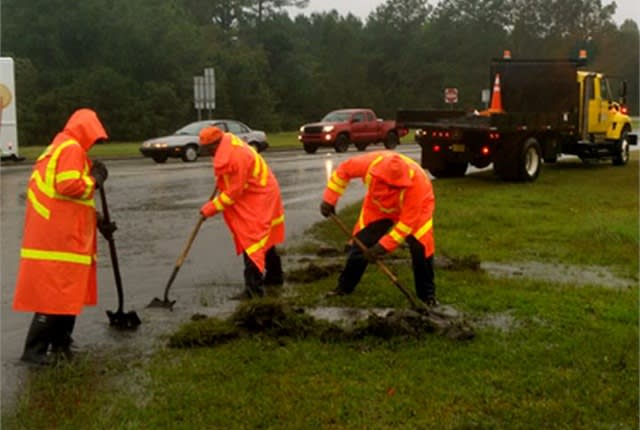
Photo of North Carolina highway crews digging trenches to drain a flooded road courtesy of NCDOT.
In response to the catastrophic flooding in the Carolinas, the governors of South Carolina and North Carolina have issued executive orders that suspend federal hours-of-service requirements for truck drivers as well as certain truck size and weight limits for loads deemed necessary to help speed emergency relief in their states. In addition, President Obama has declared a state of emergency exists in South Carolina.
Gov. Pat McCrory signed North Carolina’s order on Oct. 1 “for vehicles transporting equipment and supplies for the restoration of utility services, carrying essentials, and for equipment for any debris removal” and for “vehicles used to transport livestock and poultry and carrying livestock and poultry feed in the emergency area.”
Gov. Nikki Haley signed South Carolina’s order on Oct. 2 “to ensure the delivery of equipment, materials, services, supplies, food, fuel timber, debris and other items in response to flooding operations throughout South Carolina.”
Heavy rains caused flooding in North Carolina and South Carolina over the weekend, leading to numerous road closures and state DOT workers responding around the clock. In South Carolina, the National Guard helped state highway managers evaluated river conditions and the state Department of Public Safety offered assistance maintaining traffic control at several interstates.
A highway worker with the South Carolina Department of Transportation died when flood waters swept his truck away during heavy rains in the Southeast on Oct. 4.
Timothy Wayne Gibson, 45, was overseeing work on Garners Gerry Road in Columbia when rushing flood waters overturned his maintenance truck. He likely died as a result of drowning, according to Richland County Coroner Gary Watts. Gibson was assigned to the Richland Maintenance Unit. He had worked for SCDOT since February of 2013, according to the agency.
Trucking companies said they weren’t hit as hard as they feared, according to the Charlotte Observer. Some terminals were closed due to flooding, it reported, and carriers dealt with road closures by rescheduling pickups and deliveries. Although many smaller roads were closed because of flooding or structural damage, major arteries were open, with the exception of part of Interstate 95 in South Carolina.
On Monday, SCDOT opened an I-126 bridge leading in and out of downtown Columbia and I-20 around Columbia. Interstates that remained closed Monday included a 70-mile section of I-95 from I-26 to I-20 and I-26 in the Columbia/Lexington area at the Saluda River.
North Carolina Department of Transportation road crews also worked around the clock over the weekend to address flooding, responding to areas to dig trenches to drain water from swamped roadways. Stretches of four primary roads — N.C. 210 at North Topsail; N.C. 133, near N.C. 87, in Brunswick County; N.C 12 at Ocracoke; and N.C. 12 in Kitty Hawk — remained closed Monday.
City fleet maintenance workers were also busy this weekend dealing with flooding-related issues. The Fayetteville (N.C.) Public Works Commission's fleet maintenance unit "worked to insure any PWC or city service vehicles critical for emergency response and storm restoration are ready," spokeswoman Carolyn Justice-Hinson told the Observer.
Flooding also disrupted rail service in North Carolina, forcing Amtrak, CSXT, and Norfolk Southern to cancel some service.
More Fleet Management

Why Private Fleets Are Taking More Freight
Private fleets are putting their own trucks on demanding customers and high-cost lanes as companies seek greater control over service, costs, and capacity.
Read More →
Sponsored•September 16, 2026
Color Match Smarter: Tools That Restore & Perform
For fleet managers and collision repair professionals keeping heavy-duty trucks on the road, getting the color right the first time isn't just about appearance — it's about efficiency, turnaround time, and bottom-line results. Discover how today's digital color tools are transforming the repair process from guesswork to precision.
Read More →
FMCSA Pauses Biennial-Update Enforcement Amid Motus Transition
Carriers whose updates were due on or after June 1 have more time, while FMCSA works to stabilize its new registration system and warns of phishing sites impersonating its new carrier registration system, Motus.
Read More →


Sponsored•September 14, 2026
2026 Blueprint for Countering Smarter Supply Chain Theft
Cargo theft is no longer just the cost of doing business. It's a multi-billion-dollar criminal enterprise exploiting vulnerabilities across your fleet, drivers, and supply chain.
Read More →
Sponsored•September 1, 2026
How Telematics Improves Visibility, Control, and Performance in Refrigerated Fleets
Explore how telematics help refrigerated fleets improve visibility, uptime, efficiency, compliance, and cargo protection across connected cold chain operations.
Read More →
What the U.S.-Canada Trade War Means for Trucking
Escalating U.S.-Canada tariffs could disrupt cross-border freight, reduce truck volumes, raise costs, and create new uncertainty for carriers on both sides of the border.
Read More →
What Are Trucking’s Top Concerns for 2026?
The American Transportation Research Institute wants to know what's worrying trucking fleet managers, drivers, and other stakeholders in its annual Industry Issues survey.
Read More →
American Trucking Associations Looks for a New Leader
ATA President and CEO Chris Spear abruptly left his job at the association on August 21, at a pivotal time for the trucking industry.
Read More →
Public Wi-Fi Cybersecurity Risks: How Truck Drivers and Fleets Can Protect Their Data
Public Wi-Fi can expose truck drivers and fleets to credential theft, malware, and other cyber threats. Here’s how to reduce the risk on the road.
Read More →
For Nicky Cupp, Fleet Innovation Starts With Frustration
HDT Truck Fleet Innovator Nicky Cupp turns everyday pain points at Fraley & Schilling into opportunities for better technology and smarter processes.
Read More →