




Fleet Advantage Launches Quarterly “All-In Costs” Index
Fleet Advantage has released its inaugural quarterly index resource “designed to compare all-in costs of older model year Class 8 trucks and calculate the savings of new model replacements.”

Image: Fleet Advantage
Image: Fleet Advantage
Fleet Advantage, a provider of equipment financing and cost management to private fleets, has released its inaugural quarterly index resource “designed to compare all-in costs of older model year Class 8 trucks and calculate the savings of new model replacements.”
Using insight from the company’s ATLAAS program (Advanced Truck Lifecycle Administrative Analytics Software), Fleet Advantage said the data index will help “industry professionals make decisions regarding equipment replacement timing.”
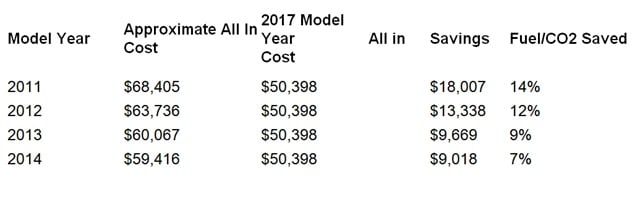
Taking into account all-in operating costs of fuel, finance, maintenance and repair, and tires, the index calculates that companies would save approximately $18,081 per truck in the first 12 months of operation by upgrading from a 2011 model-year vehicle to a 2017 model and reduce their CO2 emissions by 14%.
The calculations assume an operation running 100,000 miles per year and a previous 3-month average diesel price of $2.08.
“The industry now has concrete data available that can impact the bottom line in ways never before achievable,” said John Rickette, Fleet Advantage’s vice president of Transaction Management. “By leveraging the latest in business intelligence and analytics software linked to every vehicle in a fleet, we can offer insights that drive profitability throughout the operation.”
Fleet Advantage said the data index equips fleet operators with financial and valuation insights required to determine when each truck has become “economically obsolete” and the proper timing for when to replace it with a new, more efficient and less costly model.
The proprietary ATLAAS software and its data index were developed out of Fleet Advantage’s lifecycle business model, which the company said “helps truck fleet operators save millions in savings by replacing older vehicles and shifting their current lifecycle practices to a data-driven model.”
Below is the comparison obtained for day cabs:
And here is the comparison for sleepers:
More Fuel Smarts

How Volvo Updated Its D13 for EPA 2027 [Watch]
Volvo’s updated D13 promises lower emissions without sacrificing performance or fuel economy. Take a closer look at what changed inside the engine in this HDT Spotlight video.
Read More →
Diesel Price Spike Shortens Payback for Natural Gas Trucks, Report Says
Energy Vision estimates fleets could recover the higher purchase price of an RNG-fueled Class 8 tractor in 1.3 to 2.8 years under current fuel-price scenarios.
Read More →
Calstart Becomes Catalyst Mobility, Reflecting Broader Focus
Calstart is now Catalyst Mobility, reflecting the nonprofit’s growing national role in clean transportation, including zero-emission trucks, infrastructure and incentive programs.
Read More →

Record Diesel Prices Squeeze Trucking Fleets
Average U.S. diesel prices have climbed to nearly $6 a gallon, surpassing the 2022 record as tight refinery capacity and Middle East disruptions keep fuel costs elevated.
Read More →
How Fuel Delivery Shapes Engine Performance
Fuel delivery depends on more than what happens at the injector. For fleet, maintenance and technical professionals, looking at the full path from pump to injector can provide useful context for understanding engine performance.
Read More →
East Coast Port Launches $45M Electric Truck Push
The Port Authority of New York and New Jersey announced millions in incentives for zero-emission drayage trucks, yard tractors, and new charging hubs near the port.
Read More →
California Bill Could Shed Light on Electric Truck Prices
Why do battery-electric Class 8 trucks remain so expensive? A California bill headed to Gov. Gavin Newsom would give fleets and state agencies more visibility into what manufacturers charge.
Read More →
Detroit Opens Orders for EPA 2027 Engines
Detroit isn’t starting from scratch to meet EPA 2027 diesel emissions standards. Its Gen 6 DD13 and DD15 engines keep much of today’s platform while updating the fuel and aftertreatment systems.
Read More →
Zero-Emission Truck Corridor Planned for West Coast
California, Oregon, Washington, British Columbia and Baja California are coordinating plans for truck charging and hydrogen fueling from Canada to Mexico.
Read More →
A Closer Look at Kenworth’s Electric T880E Vocational Truck [Video]
Learn more about Kenworth's T880E battery-electric vocational truck at the Paccar Technical Center, including its range, applications, upfitting considerations, and PTO options, in this HDT Spotlight video.
Read More →