




Find Test Data in Choosing Economy Options, Report Says
Truck fleets should seek test data on fuel-saving products so they can intelligently decide what to use in their own operations, says Determining Efficiency, the latest “confidence report” from the North American Council for Freight Efficiency and the Carbon War Room.

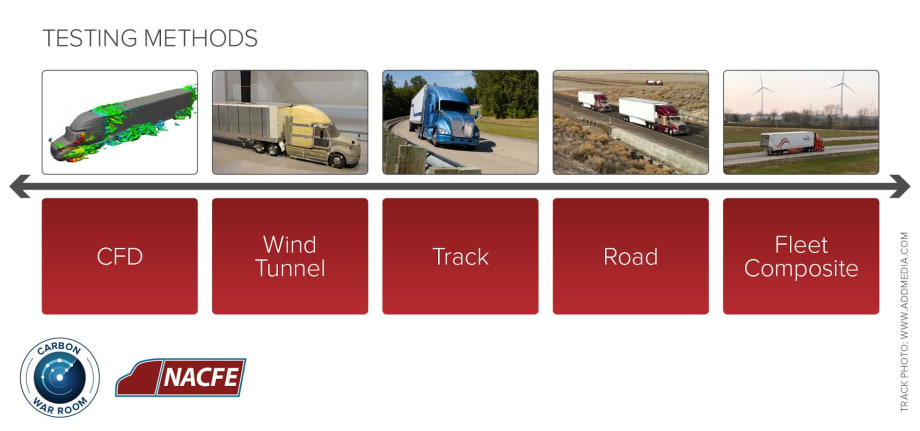
Fleet managers should understand the types of tests, and know how one was run and how it relates to their everyday operations.
Fleet managers should understand the types of tests, and know how one was run and how it relates to their everyday operations.
Truck fleets should seek test data on fuel-saving products so they can intelligently decide what to use in their own operations, says the latest “confidence report” from the North American Council for Freight Efficiency and the Carbon War Room.
There are many fuel-economy technologies available, but no one can employ all of them, says the report. It was announced Thursday by email and in a call-in conference for the trade press.
Owners of small fleets, especially, should seek information from testing that’s already been done rather than try to do their own, it contends.
"Fleets must carefully analyze the range of options and compare them against their own duty cycles and operations to determine which technologies offer the fastest paybacks and prioritize those for adoption,” says the report’s executive summary, available here.
Fleet managers need to gather and understand data on their own operations and fuel use, and should find data from testing of the various devices, the summary stated.
And accuracy is important.
“Some will say, ‘That thing will get you 28% better economy,’ when in fact that test was run on a track at a certain set speed,” said Mike Roeth, NACFE’s executive director and trucking operations lead for the Carbon War Room. “You don’t run that way in your operation.”
Truck builders should also use objectively gathered data, because “fleets say they just don’t trust the manufacturers,” he commented. “So manufacturers could be more diligent in using this information.”
Manufacturers might seek specific information from a test, such as a drag coefficient, which fleets won’t find useful. Fleet managers should understand such nuances and know how a given test was run and how it relates to their everyday operations.
“We don’t need a lot more testing,” he said. “We really need a lot more sharing of information that’s out there.”
Roeth said NACFE, informally called Trucking Efficiency, wants to be the repository and disseminator of testing information. It maintains data, as well as its own confidence reports and a special cost-payback calculator, at www.truckingefficiency.org.
More Fuel Smarts

California Bill Could Shed Light on Electric Truck Prices
Why do battery-electric Class 8 trucks remain so expensive? A California bill headed to Gov. Gavin Newsom would give fleets and state agencies more visibility into what manufacturers charge.
Read More →
Detroit Opens Orders for EPA 2027 Engines
Detroit isn’t starting from scratch to meet EPA 2027 diesel emissions standards. Its Gen 6 DD13 and DD15 engines keep much of today’s platform while updating the fuel and aftertreatment systems.
Read More →
Zero-Emission Truck Corridor Planned for West Coast
California, Oregon, Washington, British Columbia and Baja California are coordinating plans for truck charging and hydrogen fueling from Canada to Mexico.
Read More →
A Closer Look at Kenworth’s Electric T880E Vocational Truck [Video]
Learn more about Kenworth's T880E battery-electric vocational truck at the Paccar Technical Center, including its range, applications, upfitting considerations, and PTO options, in this HDT Spotlight video.
Read More →
Kenworth T880E Brings EV Power to Vocational Trucks
A closer look at the Kenworth T880E’s range, charging, powertrain and upfit options — and where fleets are showing the most interest.
Read More →
Jennie Abarca Is Proving Electric Trucks Can Do the Job
HDT Truck Fleet Innovator Jennie Abarca is building confidence in fleet electrification one load at a time while openly sharing the challenges she encounters along the way as a small-fleet owner.
Read More →
Cummins Adjusts 2027 Engine Rollout After EPA Proposal
The engine maker will gradually introduce its new Model Year 2027 diesel engines while continuing to offer current models during the transition, citing the EPA's proposed emissions rule changes.
Read More →
EPA Proposal Could Ease 2027 Truck Costs and Buying Uncertainty
The proposal doesn't change the tougher NOx standard, but it would revise key implementation requirements that manufacturers say have driven up costs and complicated fleet purchasing decisions.
Read More →
Cummins, Paccar Ease DEF Derates After EPA Guidance
Updated diesel engine software gives truck operators more time to address emissions-system issues while staying compliant with EPA emissions standards.
Read More →
Maintenance in the Messy Middle Part 3: Biodiesel
Biodiesel can reduce emissions, improve fuel-system lubricity and use existing diesel infrastructure. But NACFE’s Messy Middle maintenance report says fleets must actively manage storage, cold-weather operation, filters and oil drain intervals to avoid problems.
Read More →