




ELD Mandate On the Way, Says FMCSA Official
The Federal Motor Carrier Safety Administration will publish its final rule mandating the use of electronic logging devices some time this year, according to Joe DeLorenzo, director of FMCSA’s office of enforcement and compliance.


Joe DeLorenzo, FMCSA director, office of enforement & compliance, presented a regularoy update during Omnitracs' Outlook user conference in Dallas on Feb. 10. Photo: Jim Beach

Joe DeLorenzo, FMCSA director, office of enforement & compliance, presented a regularoy update during Omnitracs' Outlook user conference in Dallas on Feb. 10. Photo: Jim Beach
The Federal Motor Carrier Safety Administration will publish its final rule mandating the use of electronic logging devices some time this year, according to Joe DeLorenzo, director of FMCSA’s office of enforcement and compliance.
Speaking at the Omnitracs Outlook user conference in Dallas Feb. 10, DeLorenzo said that when he’s talking about ELDs, he’s talking about the upcoming rule. “There are no ELDs right now,” he said. Rather current regulations refer to automated onboard recording devices (49 CFR 395.15).
The reasons for the ELD mandate are pretty straight forward, he said. FMCSA believes the devices will improve safety and will improve the recording of drivers’ hours and cut down on citations that result from simple paperwork errors driver may make.
The ELD rule will also provide uniformity. “Right now, there are a lot of devices out there,” he said. “We’ll get to a point with this rule where we will have uniformity” across the industry. A key point for carriers, he said is to “know the difference between the devices you are using now and make sure your drivers are well versed in how to use them.”
On the topic of how crashes and accountability and how that is recorded in the agency’s SMS, he noted, “it’s a difficult topic.” He noted that a recent study tried to address how the agency handles accountability. It’s a difficult situation because while they found that police accident reports could be useful in determining accountability, “we don’t get police accident reports on all crashes.” Plus, when they compared police accident reports with the fatal accident reporting system (FARS), they found there was a fair amount of data mismatch. “There were data quality issues. When we compared the two, they weren’t matching.” He said they were “looking for help,” on the subject, trying to find data sources that could be of value in determining crash accountability.
As for requesting that inaccurate data be corrected on a carriers CSA reports via the DataQs method, he advised carriers “take the time to file a good one” and make sure to file all the appropriate information – anything the carrier has that will substantiate their information.
He also talked about the changes to the 34-hour restart provision in drivers’ hours of service rules that went into effect at the end of December. Certain aspects of the rule 34-hour rule that require two 1 a.m. to 5 a.m. periods during the 34 hours had been suspended until Sept. 30 pending another study on the issue. He noted that the 34-hour restart was to provide flexibility to the industry and that the rule that is important for fleets is the 60/70 hour rule, he said “I’ve never seen a study get off the ground as quickly as this one.”
He also talked about the recent change regarding driver vehicle inspection reports. Carriers are no longer required to file DVIRs if no defects are found. However, that does not mean drivers are not required to perform those inspections. And he said, the revision “does not change the fact that you have to keep them on file for a period of time.”
The biggest rules coming up, of course will be the final ELD rule and a proposed rule on Safety Fitness Determination. He advised carriers to check out the agency's CSA website to learn more about CSA, check company safety records, order driver records and to request data reviews.
More Drivers
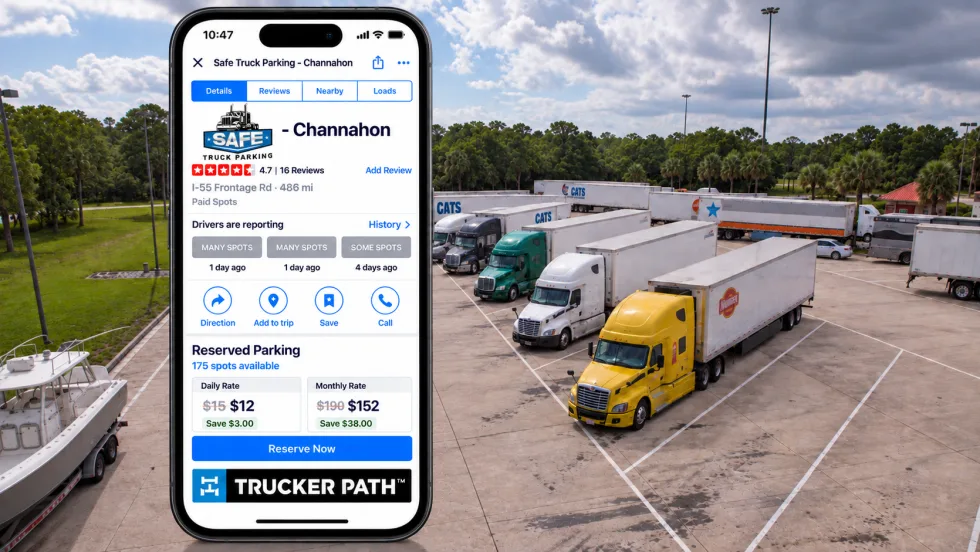
Trucker Path Expands Reserved Parking Network
Trucker Path has added close to 6,000 more truck parking spaces to its Trucker Path Reserved Parking Network with the addition of Safe Truck Parking.
Read More →
EEOC Sues Texas Trucking Company Over Driver Age Limits
The agency says Trancasa USA rejected applicants over 65 and applied tougher driving-record standards to those over 60.
Read More →
Nussbaum, Roehl Announce Second Driver Pay Increase This Year
This year has seen a swath of major truck driver pay increases as freight capacity has tightened.
Read More →
From One Generation to the Next: How Mentorship Builds Safer Truck Drivers
After three decades in trucking, Harold Perry shares what he's learned about driver safety, mentorship, and helping the next generation build confidence behind the wheel.
Read More →
Truck Drivers Need More Than Another Alert
Fleets have more visibility into truck health, safety events, and driver activity than ever. The next challenge is turning all that information into useful guidance for the person who has to decide what to do next.
Read More →
FMCSA Removes 110 Truck Driver Training Schools from Certified ELDT List
Federal regulators also are targeting more than 160 additional training providers and launching a nationwide audit of third-party CDL skills testers as part of a broader crackdown on trucking fraud.
Read More →
Hours of Service Pilot Programs: FMCSA Readies for 2027 Rollout
Two pilot programs could eventually reshape hours-of-service rules, giving truck drivers options to pause their 14-hour clock or use longer split sleeper rest periods.
Read More →
Medical Cards, English Proficiency Reshape Roadcheck Violations
Medical-card violations jumped to the top of the driver out-of-service list during CVSA’s 2026 International Roadcheck, while English-language proficiency violations appeared among the leading violations for the first time.
Read More →
Driver Trust Can Make or Break the Success of Fleet Safety Technology
New Teletrac Navman research suggests that onboarding, transparency about driver data, and positive feedback can play a significant role in how commercial drivers respond to safety and coaching technology.
Read More →
EEOC Sues KLLM Over Alleged Sex Discrimination in Driver Training
KLLM is facing a federal sex-discrimination lawsuit over policies the EEOC alleges put female truck driver trainees at a disadvantage.
Read More →