




Economic Watch: More Traffic Congestion, Better Economy
If trucking is the lifeblood of the nation’s economy, then surprisingly, there is no reason for alarm if the arteries carrying those trucks seem a little clogged. Traffic information services provider Inrix reports traffic congestion rose nationally more than 9% in May, signaling the continued strengthening of the national economy.
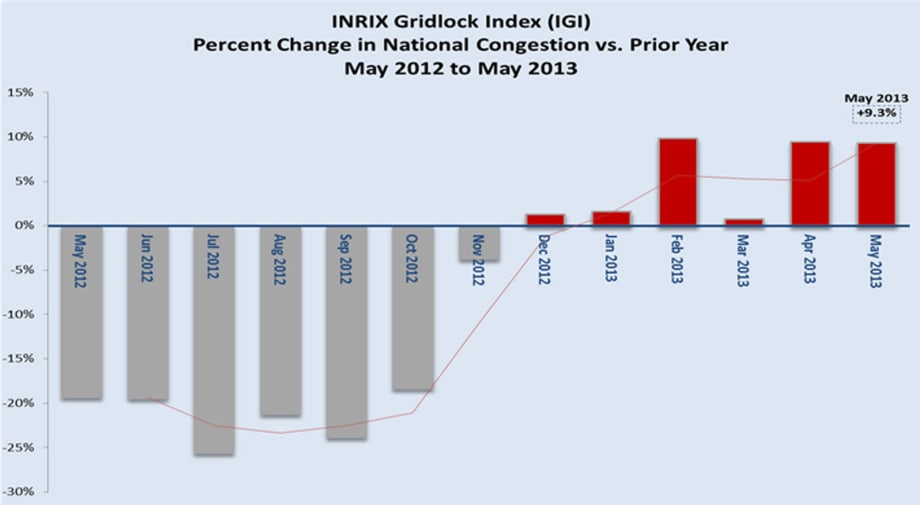
If trucking is the lifeblood of the nation’s economy, then surprisingly, there is no reason for alarm if the arteries carrying those trucks seem a little clogged.
A new report form the traffic information services provider Inrix shows traffic congestion rose nationally more than 9% in May, it says signaling the continued strengthening of the national economy as retail sales increased 0.6% month-over-month in the U.S., led by a 1.8% jump in auto sales, the biggest increase since November.
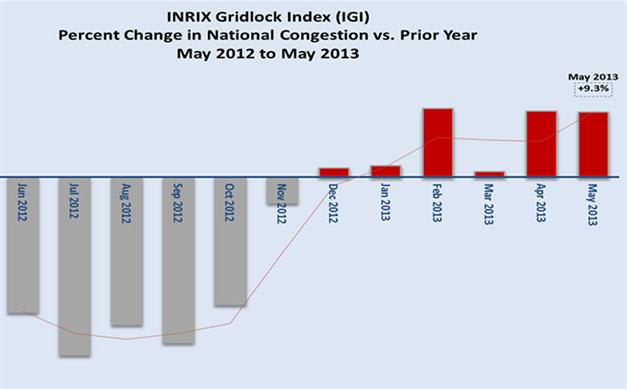
The Inrix Gridlock Index shows traffic congestion increased 9.3% from May 2012 to May 2013 to reach a composite IGI score of 7.2. This means the average trip took drivers in the 100 most populated metro areas just over 7% longer due to increased traffic.
Metropolitan areas in the Western U.S. experienced the largest year-over-year increases, 15.7%, followed by the Northeast at 11.2% and Midwest metro areas at 9.1%. The Southern region continued to display the most modest increase in traffic levels at just 2.4%.
"The overall rise in traffic in the first five months of the year is indicative of increased confidence in the direction of the economy," says Bryan Mistele, CEO of Inrix. "Renewed consumer spending, especially on new vehicles, means more shoppers at stores, more cars on the road and more traffic on our streets."
The rise in traffic levels continued to be uneven not only across regions, but also within regions as well, according to Inrix. For example, in April 2013, traffic congestion in Midwestern metro areas in April 2013 increased more than any other region on a year-over-year basis. However, the Midwest was only the third most important contributor to the rise in traffic congestion nationwide in May 2013.
Inrix sites the monthly Creighton University Mid-America Business Condition Index, a leading economic indicator for a nine-state region, as reflectinbg this decline in its May report. The Creighton Index, which measures the strength of the Midwest economy on a scale from 0-100, shows a decline to 56.2 in May from 56.8 in April, with components of the Creighton Index including employment, wholesale prices, confidence, new orders and production each lower than their April readings.
Inrix says the rise in national traffic congestion recorded by IGI is also aligned with the Federal Reserve's announcement on June 19 that economic activity has been expanding at a moderate pace with officials saying the economy is expected to grow at an annual rate of 2.3% to 2.6% percent in 2013, slightly below the top end of the 2.3% to 2.8% growth previously forecast, and that the unemployment rate in 2013 is expected to fall to a range of 7.2% to 7.3%, which is below the 7.3% to 7.5% previously forecast.
The IGI draws data from the INRIX Traffic Data Archive, a historical traffic information database comprised of data collected from hundreds of public and private sources, including a crowd-sourced network of millions of vehicles and mobile devices.
More Drivers

Nussbaum, Roehl Announce Second Driver Pay Increase This Year
This year has seen a swath of major truck driver pay increases as freight capacity has tightened.
Read More →
From One Generation to the Next: How Mentorship Builds Safer Truck Drivers
After three decades in trucking, Harold Perry shares what he's learned about driver safety, mentorship, and helping the next generation build confidence behind the wheel.
Read More →
Truck Drivers Need More Than Another Alert
Fleets have more visibility into truck health, safety events, and driver activity than ever. The next challenge is turning all that information into useful guidance for the person who has to decide what to do next.
Read More →
FMCSA Removes 110 Truck Driver Training Schools from Certified ELDT List
Federal regulators also are targeting more than 160 additional training providers and launching a nationwide audit of third-party CDL skills testers as part of a broader crackdown on trucking fraud.
Read More →
Hours of Service Pilot Programs: FMCSA Readies for 2027 Rollout
Two pilot programs could eventually reshape hours-of-service rules, giving truck drivers options to pause their 14-hour clock or use longer split sleeper rest periods.
Read More →
Medical Cards, English Proficiency Reshape Roadcheck Violations
Medical-card violations jumped to the top of the driver out-of-service list during CVSA’s 2026 International Roadcheck, while English-language proficiency violations appeared among the leading violations for the first time.
Read More →
Driver Trust Can Make or Break the Success of Fleet Safety Technology
New Teletrac Navman research suggests that onboarding, transparency about driver data, and positive feedback can play a significant role in how commercial drivers respond to safety and coaching technology.
Read More →
EEOC Sues KLLM Over Alleged Sex Discrimination in Driver Training
KLLM is facing a federal sex-discrimination lawsuit over policies the EEOC alleges put female truck driver trainees at a disadvantage.
Read More →
FMCSA Moves to Codify English Language Requirements for Commercial Drivers
By changing regulations on English-language proficiency requirements for commercial drivers, rather than relying on a guidance memo, the FMCSA said future administrations won't be able to walk back the Trump administration's stricter enforcement with just a memo.
Read More →
Drivers Put Western Star Trucks to the Test at Star Nation Experience
Watch to get an inside look at the Western Star trucks, technology, and community behind the Star Nation Experience 2026!
Read More →