




Eaton: 48-volt Power Will Drive Cuts in Vehicle Emissions
Eaton’s Vehicle Group has developed a suite of 48-volt technologies to assist on- and off-highway commercial vehicle customers in transitioning from traditional 12- and 24-volt vehicle systems.

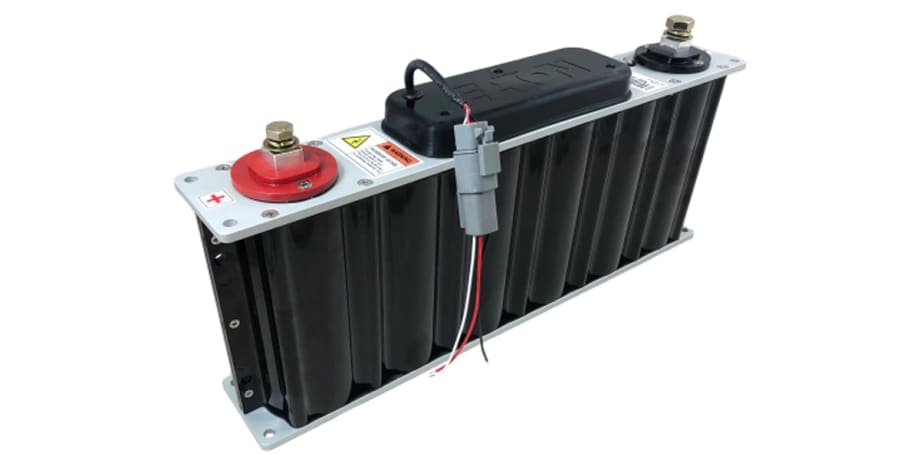
Supercapacitors can quickly charge and discharge at higher rates than lithium-ion batteries, but they don’t retain high energy levels or require a liquid cooling system.
Photo: Eaton
Tightening diesel emissions regulations are putting additional strain on engine and vehicle manufacturers to meet reductions targets with traditional 12- and 24-volt electrical architecture. Eaton say the answer lies with 48-volt components that will help reduce emissions and improve fuel economy and performance.
Eaton’s Vehicle Group has developed suite of 48-volt technologies such as cooling fans, HVAC compressors, pumps, and electric heating for aftertreatment systems to assist on- and off-highway commercial vehicle customers in transitioning from traditional 12- and 24-volt vehicle systems.
Electrifying the cooling fan provides additional benefits, as it could be reduced in size and strategically placed within the engine bay, allowing for aerodynamic design flexibility to increase fuel economy and reduce emissions.
“Forty-eight-volt power will also be used to power systems such as HVAC and the engine cooling fan, which are traditionally run by the engine,” said Ben Karrer, manager of technology development for Eaton’s Vehicle Group, in a press release. “Today’s systems are not intelligent — you can’t control when they’re on or off or adjust the levels. Converting those components to electric alternatives allows you to intelligently control them and eliminate mechanical loads.”
Many vehicle systems are powered directly from mechanical power generated by the engine, which runs 12-volt systems such as air conditioning and pumps. Eaton is developing 48-volt systems that include motor generators and inverters that generate 48-volt DC power for the vehicle. Eaton also produces 48-volt DC/DC converters that step power down from 48-volt vehicle architectures to power 12- and 24-volt systems.
Eaton is also developing power electronics for 48-volt electric catalyst heating, which provides heat directly to the vehicle’s aftertreatment system. This active heating helps catalyst components reach efficient operating temperatures faster upon engine start and maintains those temperatures during low-load operation. This will be an essential strategy for reducing emissions to the levels required by future regulations.
“This development comes as global vehicle manufacturers are making decisions to adopt new technologies to meet emissions regulations,” Karrer said. “Of the options available, 48-volt architectures are becoming more popular because they can decrease both CO2 and NOx simultaneously, which helps both our customers and the environment.”
48-Volt Batteries, Supercapacitors
Eaton’s Vehicle Group is also developing a range of 48-volt energy storage solutions, including lead-acid batteries and supercapacitors. Eaton says lead-acid batteries are inexpensive compared to lithium-ion packs and offer a safe and more efficient solution. Supercapacitors can quickly charge and discharge at higher rates than lithium-ion batteries, but they don’t retain high energy levels or require a liquid cooling system. Supercapacitors also have longer lifespans than lead-acid or lithium-ion batteries.
“We’re integrating various energy storage technologies into a larger storage pack including controls, fusing, and contactors,” Karrer said. “Eaton’s Electrical Components Group is our partner for supercapacitors, and we will be working with most commercial vehicle battery manufacturers for lead-acid batteries.”
This suite of technologies is an example of how Eaton is working to achieve its 2030 Sustainability Targets, which include reducing the carbon emissions from our operations by half and lowering product and supply chain emissions.
More Equipment

Used-Truck Remarketing Math Is Changing
Used-truck value is no longer just a concern at trade-in. Decisions made throughout a truck’s first life can influence what it’s worth years later.
Read More →
How Volvo Updated Its D13 for EPA 2027 [Watch]
Volvo’s updated D13 promises lower emissions without sacrificing performance or fuel economy. Take a closer look at what changed inside the engine in this HDT Spotlight video.
Read More →
Michelin Tire Improves Efficiency and Durability for Regional Fleets
The Michelin X Multi Energy D2 is a regional haul drive tire engineered to help fleets improve fuel efficiency, durability and traction in demanding stop-and-go operations.
Read More →
ZF Expands Commercial Vehicle Push in North America
ZF is expanding its North American commercial-vehicle presence with new transmission applications, electrification, trailer technology and autonomous-driving systems.
Read More →
Tesla Wants a Self-Driving Semi. Are Cameras Enough?
Could Tesla’s camera-only autonomous driving technology work on an 80,000-pound Semi? In this commentary, HDT's Deborah Lockridge takes a look at Tesla, Cybercab, and how autonomous trucks see the road.
Read More →
Kodiak: Driverless Long-Haul Truck Launch on Track for 2026
Kodiak AI says its driverless long-haul safety case is 93% complete and it remains on track to begin commercial operations by year-end 2026.
Read More →
What DOT’s Automated Vehicle Strategy Means for Trucking
The U.S. Department of Transportation issued a new automated-vehicle strategy that outlines plans for driverless-truck regulations, cross-state freight corridors, and federal safety standards.
Read More →
East Coast Port Launches $45M Electric Truck Push
The Port Authority of New York and New Jersey announced millions in incentives for zero-emission drayage trucks, yard tractors, and new charging hubs near the port.
Read More →
PlusAI Going Public to Fund Autonomous Truck Launch
A SPAC deal could provide PlusAI with up to $300 million as it works toward a 2027 commercial launch of factory-built autonomous trucks.
Read More →
NHTSA Moves to Rewrite Truck Fuel-Economy Rules
The National Highway Traffic Safety Administration says it lacks authority to regulate medium- and heavy-duty truck engines separately from complete vehicles, but the existing standards have not yet been eliminated.
Read More →