




Driver Charged With Vehicular Homicide in Fatal I-75 Crash
The truck driver involved in a June 25 nine-vehicle crash on I-75 near Chattanooga, Tenn., that killed six people, has been charged with six counts of vehicular homicide, among other charges.
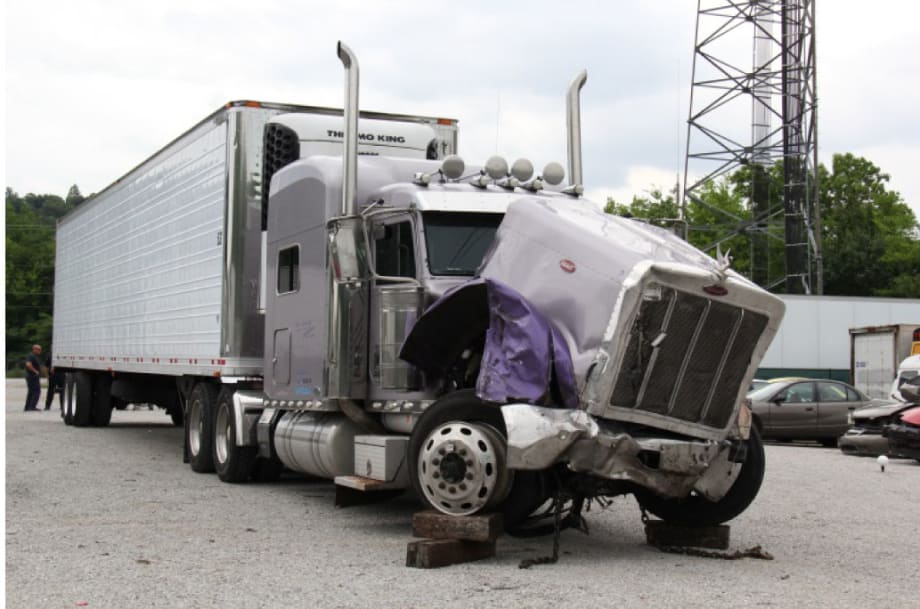
The NTSB preliminary report shows the damage to Brewer's vehicle following the crash.
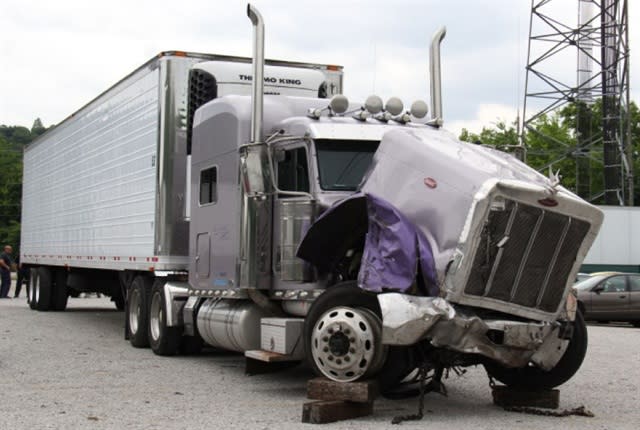
The NTSB preliminary report shows the damage to Brewer's vehicle following the crash.
The truck driver involved in a June 25 nine-vehicle crash on I-75 near Chattanooga, Tenn., that killed six people, has been charged with six counts of vehicular homicide, among other charges.
The move comes shortly after the National Transportation Safety Board released its preliminary report into the crash, which found mechanical breakdowns, another minor crash on the trip, and major hours of service violations.
A lawsuit has also been filed against the driver and the carrier.
In addition to the vehicular homicide charges, Benjamin Scott Brewer, 39, was also charged with four counts of reckless aggravated assault; one count of driving under the influence of narcotics; one count of speeding (77 mph in a 55-mph zone), and one false report of duty status, according to the Chattanooga Times Free Press.
On the evening of June 25, eight vehicles were stopped on I-75 northbound because of construction when Brewer's tractor-trailer plowed into them from behind. Six people, two of them children, were killed, and others were injured.
The NTSB usually sends five investigators to crash sites, but sent 11 to Chattanooga due to the scope of this incident, according to the paper.
In its preliminary report, the board found that Brewer began his trip on Monday, June 22, reporting for duty in London, Ky. He was supposed to pick up a load in Kentucky and deliver it to Florida. When he picked up the load, however, he found the truck's air compressor couldn't build up enough air to properly operate the brake system. After he got that fixed, the truck had problems with the fuel delivery system so it went back to the shop.
After that was repaired, no more mechanical issues were reported in route to Florida, but after being on duty for about 45 hours, he sideswiped another vehicle in Wildwood, Fla. There were not injuries, but he was cited with reckless driving for causing the crash, and the damage to the truck resulted in another delay for repairs.
The driver arrived at his final destination in Florida on Wednesday, June 24 – after being on duty for about 50 consecutive hours – and logged himself off duty at 4:30 p.m.
Twelve hours later he was on the road for his return trip to London, Kentucky, and at 7:10 p.m. was involved in the fatal crash – over his 14-hour daily on duty limit.
Other aspects of the investigation are ongoing, including a review of electronic control modules, security video from local businesses near the crash, cell phone records, motor carrier operations, and toxicology testing.
Two weeks ago, the Federal Motor Carrier Safety Administration declared Brewer an imminent hazard to public safety and ordered him off the road.
That order noted that although Brewer reported being off duty June 15-25, the vehicle tracking system used by his employer, along with other records, showed he had been on-duty and driving on June 22, 23, and 24.
It was also found that Brewer omitted a past citation and crash from his employment application, which required him to list all accidents and convictions occurring in the past three years. On May 25, Brewer also tested positive for controlled substances following a court-ordered controlled substances test.
A crash survivor has filed a $10 million lawsuit against both Brewer and the carrier that owned the truck, Cool Runnings Express Inc., and the company's owners, Billy Sizemore and Cretty Sizemore, according to published reports. It apparently was Brewer's first run for the company.
According to the Times Free Press, Cool Runnings Express operates six trucks and employs nine drivers, hauling refrigerated freight.
During the last 24 months, the paper notes, the company's trucks failed three of eight vehicle inspections and two of 14 driver inspections. On three occasions since 2013, trucks were put out of service during roadside inspection issues because of brake problems. In addition, the paper reports two instances of out of service violations for hours of service in 2014.
More Safety & Compliance

FMCSA Pauses Biennial-Update Enforcement Amid Motus Transition
Carriers whose updates were due on or after June 1 have more time, while FMCSA works to stabilize its new registration system and warns of phishing sites impersonating its new carrier registration system, Motus.
Read More →
ZF Expands Commercial Vehicle Push in North America
ZF is expanding its North American commercial-vehicle presence with new transmission applications, electrification, trailer technology and autonomous-driving systems.
Read More →
Truck Drivers Need More Than Another Alert
Fleets have more visibility into truck health, safety events, and driver activity than ever. The next challenge is turning all that information into useful guidance for the person who has to decide what to do next.
Read More →
Tesla Wants a Self-Driving Semi. Are Cameras Enough?
Could Tesla’s camera-only autonomous driving technology work on an 80,000-pound Semi? In this commentary, HDT's Deborah Lockridge takes a look at Tesla, Cybercab, and how autonomous trucks see the road.
Read More →
What DOT’s Automated Vehicle Strategy Means for Trucking
The U.S. Department of Transportation issued a new automated-vehicle strategy that outlines plans for driverless-truck regulations, cross-state freight corridors, and federal safety standards.
Read More →
NYC Expands Speed, Pedestrian Safety Tech Across Fleet
New York City is expanding intelligent speed assistance and pedestrian-alert systems across its municipal fleet, moving the technologies from pilot programs into vehicle procurement and retrofit requirements.
Read More →
FMCSA Removes 110 Truck Driver Training Schools from Certified ELDT List
Federal regulators also are targeting more than 160 additional training providers and launching a nationwide audit of third-party CDL skills testers as part of a broader crackdown on trucking fraud.
Read More →
Beyond DOT Compliance: What Makes a Trucking Fleet Truly Safe?
A trucking fleet can follow every rule and still make unsafe decisions. The real test comes when safety conflicts with freight, productivity, or cost.
Read More →
Hours of Service Pilot Programs: FMCSA Readies for 2027 Rollout
Two pilot programs could eventually reshape hours-of-service rules, giving truck drivers options to pause their 14-hour clock or use longer split sleeper rest periods.
Read More →
New Guide Offers Pet Safety Tips for Truck Drivers
Hundreds of thousands of pets travel in truck cabs. A new safety guide from Volvo Trucks and the Center for Pet Safety offers practical advice for truck drivers who bring dogs and cats along for the ride.
Read More →