




DOT Wants Your Ideas on Streamlining Regulations
Now’s your chance to tell the U.S. Department of Transportation about regulations that should be changed or eliminated at DOT agencies such as the Federal Motor Carrier Safety Administration.

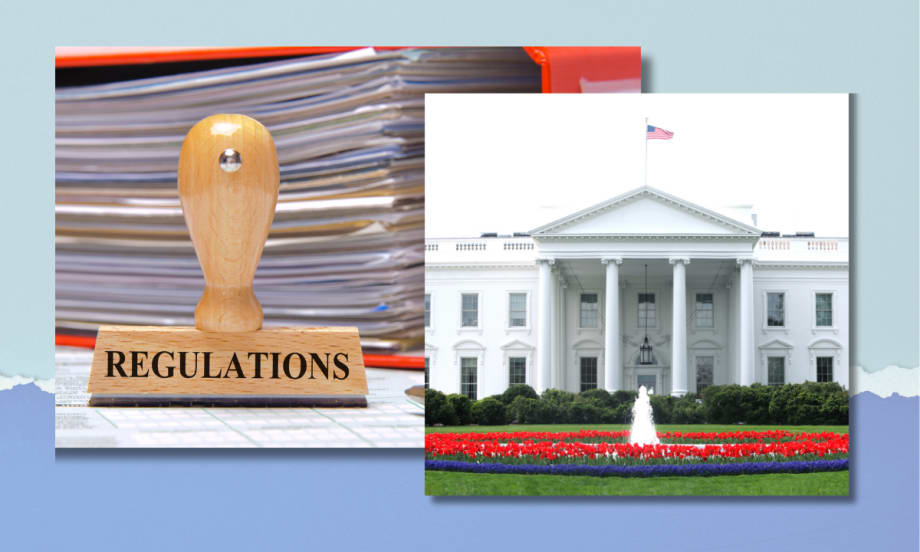
The U.S. Department of Transportation is looking at regulations to eliminate or streamline to comply with Trump administration executive orders.
Image: HDT Graphic
Now’s your chance to tell the U.S. Department of Transportation about regulations that should be changed or eliminated at DOT agencies such as the Federal Motor Carrier Safety Administration or the National Highway Traffic Safety Administration.
On April 3, the DOT published a notice in the Federal Register, “Ensuring Lawful Regulation; Reducing Regulation and Controlling Regulatory Costs,” asking for comments and information to help it identify existing regulations, guidance, paperwork requirements, and other regulatory obligations that can be modified or repealed.
DOT's goal is to create a method for identifying existing DOT regulations, guidance, or reporting requirements that are inconsistent with law or Trump administration policy, including regulations, guidance, or reporting requirements that are obsolete, unnecessary, unjustified, or simply no longer make sense.
The department issued the notice as part of its implementation of President Trump’s executive orders, including:
Executive Order 14219, “Ensuring Lawful Governance and Implementation of the President's ‘Department of Government Efficiency’ Deregulatory Agenda,” issued on February 19, 2025.
Executive Order 14192, “Unleashing Prosperity through Deregulation,” issued on January 31, 2025. This requires that if an agency wants to propose a new regulation, it must identify at least 10 existing regulations to be repealed.
Written comments and information are requested on or before May 5, 2025.
What Information is the DOT Looking For?
The DOT offered a list of 12 questions to help guide commenters. It asked that comments provide supporting data or other information such as cost information, as well as specific suggestions regarding repeal, replacement, or modification.
Below is an edited and paraphrased version of those questions; see the full DOT notice in the federal register for more details.
Are there any regulations or guidance that fall within the seven categories outlined in Executive Order 14219? Those include regulations that exceed the scope of the power given to the federal government in the Constitution; that are “based on unlawful delegations of legislative power” or “on anything other than the best reading of the underlying statutory authority or prohibition;” regulations that “implicate matters of social, political, or economic significance that are not authorized by clear statutory authority;” regulations that impose significant costs on private parties that are not outweighed by public benefits; regulations that unjustifiably impede technological innovation, infrastructure development, disaster response, inflation reduction, research and development, economic development, energy production, land use, and foreign policy objectives; and regulations that impose undue burdens on small business and impede private enterprise and entrepreneurship.
How can DOT best promote meaningful regulatory cost reduction while achieving its regulatory objectives? How can it best identify regulations, guidance, or reporting requirements that might be modified, streamlined, or repealed?
How can DOT best obtain and consider accurate, objective information and data about the costs, burdens, and benefits of existing regulations, guidance, and reporting requirements?
Are there regulations, guidance, or reporting requirements that simply make no sense or have become unnecessary, ineffective, or ill-advised? Or that can be repealed without impairing DOT's ability to comply with its statutory obligations?
Are there regulations, guidance, or reporting requirements that have become outdated? How can they be modernized?
Are there regulations, guidance, or reporting requirements that are still necessary, but have not worked as well as expected?
Are there regulations, guidance, or reporting requirements that unnecessarily obstruct or impose significant costs on the siting, permitting, or delivery of transportation projects?
Does DOT currently collect information that it does not need or use effectively?
Are there regulations, guidance, or reporting requirements, or regulatory processes that are unnecessarily complicated or could be streamlined?
Are there regulations, guidance, or reporting requirements that have been overtaken by technological developments? Can new technologies be used to streamline or rescind them?
Does the methodology and data used in analyses supporting DOT's regulations meet the requirements of the Information Quality Act? https://obamawhitehouse.archives.gov/omb/inforeg_agency_info_quality_links/
Are there any DOT regulations, guidance, or reporting requirements that are inconsistent with Executive Orders 14151, 14154, 14168, 14213, and other executive orders issued by the president?
Comments can be submitted through the Federal eRulemaking Portal: https://www.regulations.gov. Follow the instructions for submitting comments.
In addition, DOT has created an email in-box at Transportation.RegulatoryInfo@dot.gov, which interested parties can use to identify to DOT — on a continuing basis — existing regulations, guidance, reporting requirements, and other regulatory obligations that they believe can be modified or repealed, consistent with law.
More Safety & Compliance

FMCSA Pauses Biennial-Update Enforcement Amid Motus Transition
Carriers whose updates were due on or after June 1 have more time, while FMCSA works to stabilize its new registration system and warns of phishing sites impersonating its new carrier registration system, Motus.
Read More →
ZF Expands Commercial Vehicle Push in North America
ZF is expanding its North American commercial-vehicle presence with new transmission applications, electrification, trailer technology and autonomous-driving systems.
Read More →
Truck Drivers Need More Than Another Alert
Fleets have more visibility into truck health, safety events, and driver activity than ever. The next challenge is turning all that information into useful guidance for the person who has to decide what to do next.
Read More →
Tesla Wants a Self-Driving Semi. Are Cameras Enough?
Could Tesla’s camera-only autonomous driving technology work on an 80,000-pound Semi? In this commentary, HDT's Deborah Lockridge takes a look at Tesla, Cybercab, and how autonomous trucks see the road.
Read More →
What DOT’s Automated Vehicle Strategy Means for Trucking
The U.S. Department of Transportation issued a new automated-vehicle strategy that outlines plans for driverless-truck regulations, cross-state freight corridors, and federal safety standards.
Read More →
NYC Expands Speed, Pedestrian Safety Tech Across Fleet
New York City is expanding intelligent speed assistance and pedestrian-alert systems across its municipal fleet, moving the technologies from pilot programs into vehicle procurement and retrofit requirements.
Read More →
FMCSA Removes 110 Truck Driver Training Schools from Certified ELDT List
Federal regulators also are targeting more than 160 additional training providers and launching a nationwide audit of third-party CDL skills testers as part of a broader crackdown on trucking fraud.
Read More →
Beyond DOT Compliance: What Makes a Trucking Fleet Truly Safe?
A trucking fleet can follow every rule and still make unsafe decisions. The real test comes when safety conflicts with freight, productivity, or cost.
Read More →
Hours of Service Pilot Programs: FMCSA Readies for 2027 Rollout
Two pilot programs could eventually reshape hours-of-service rules, giving truck drivers options to pause their 14-hour clock or use longer split sleeper rest periods.
Read More →
New Guide Offers Pet Safety Tips for Truck Drivers
Hundreds of thousands of pets travel in truck cabs. A new safety guide from Volvo Trucks and the Center for Pet Safety offers practical advice for truck drivers who bring dogs and cats along for the ride.
Read More →