





More on CDLs: FMCSA Targets CDL Mills as Transportation Secretary Questions Truck Driver Shortage Narrative
DOT Targets Pennsylvania for Non-Domiciled CDLs
Pennsylvania is the U.S. Department of Transportation's latest target in its effort to restrict commercial drivers licenses for non citizens.
November 24, 2025
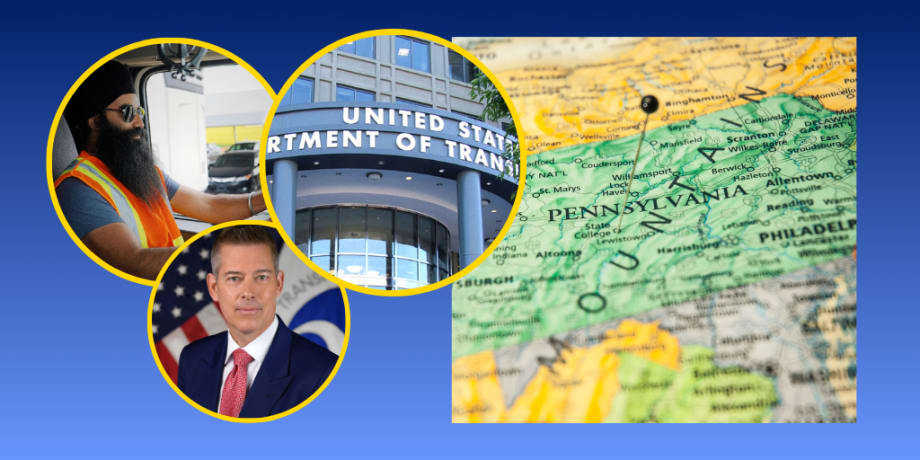
In September, the U.S. Department of Transportation announced an emergency interim final rule to strengthen federal oversight of how states issue non-domiciled commercial driver’s licenses.
HDT Graphic
3 min to read
The U.S. Transportation Department is threatening to withhold $75 million in federal-aid highway funding from Pennsylvania and decertify its CDL program unless the state complies with its orders regarding non-domiciled commercial drivers licenses.
The Federal Motor Carrier Safety Administration said in an audit of the PennDOT CDL program, it found evidence of procedural and programming errors, including:
Issuing non-domiciled CDLs with an expiration date that extended well beyond the driver’s authorized stay in the United States
Failing to require any proof of lawful presence before issuing a CDL
DOT is demanding that Pennsylvania take the following corrective measures to avoid funding being withheld:
Immediately pause the issuance of all new, renewed, transferred, or upgraded non-domiciled CDLs or commercial learner’s permits (CLPs).
Conduct a comprehensive internal audit to identify every non-domiciled license that was issued in violation of federal regulations and the policies, practices, and procedures that allowed for the issuance of non-compliant licenses.
Void or rescind all unexpired, noncompliant licenses and remove unqualified drivers from the road.
Accused Terrorist with Non-Domiciled CDL: Pennsylvania Relied on Federal Database
The Department of Transportation is tying non-domiciled CDLs to cases of illegal immigrants involved in crimes or fatal crashes.
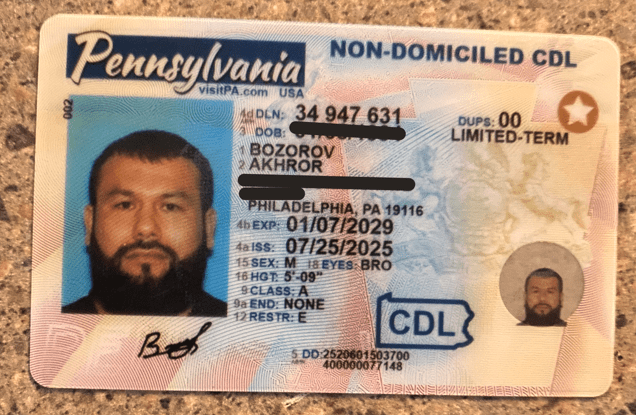
Transportation Secretary Sean Duffy pointed to the arrest of Akhror Bozorov, an immigrant wanted in his origin country of Uzbekistan for belonging to a terrorist organization, who had a non-domiciled CDL from Pennsylvania.
Photo: Department of Homeland Security
In a news release announcing the Pennsylvania crackdown, Transportation Secretary Sean Duffy pointed to the arrest of Akhror Bozorov, an immigrant wanted in his origin country of Uzbekistan for belonging to a terrorist organization, who had a non-domiciled CDL from Pennsylvania. He illegally entered the United States in February 2023, according to the Department of Homeland Security, after Uzbekistan issued an arrest warrant for Bozorov in 2022.
However, Pennsylvania Gov. Josh Shapiro explained that part of the state's process for non-citizens to obtain a CDL involves checking the federal database, SAVE, to confirm legal residency in the country. As reported by WGAL, Bozorov was listed as authorized for a CDL in the federal database several months ago when he received the license.
What is a Non-Domiciled CDL and Why Are They a Problem?
A non-domiciled CDL is issued to someone who is legally allowed to work in the U.S. but doesn’t permanently live in the state issuing the license — often foreign nationals working under temporary U.S. work authorization.
These licenses came under scrutiny following a fatal crash in Florida in August when an immigrant tried to make an illegal U-turn in a tractor-trailer.
In September, the U.S. Department of Transportation announced an emergency interim final rule to strengthen federal oversight of how states issue non-domiciled commercial driver’s licenses.
This followed a nationwide audit of non-domiciled CDLs that the agency said showed systemic non-compliance across several states.
That emergency rule created a much stricter set of rules for non-citizens to obtain a non-domiciled CDL, including having an employment-based visa and undergoing a mandatory federal immigration status check using the SAVE system (the same system Shapiro said Pennsylvania used when issuing a CDL to Bozorov.)
How is FMCSA Responding to the Court Order Staying the Non-Domiciled CDL Rule?
The DOT's emergency rule on non-domiciled CDLs has been challenged in court, and in November, the U.S. Court of Appeals for the D.C. Circuit temporarily stayed the rule pending further judicial review.
In response, the FMCSA allowed states to continue to issue non-domiciled CDLs in accordance with the prior rules and guidance, according to the nonprofit Eno Center for Transportation — except for “states that are subject to a correction action plan” which includes the state of California, among others.
"Despite this stay, FMCSA has continued to pursue corrective actions in states they consider out of compliance with their CDL regulations, and they’ve indicated does not affect the corrective action plans," Rebecca Higgins wrote for the Eno Center for Transportation.
More Drivers

Truck Drivers Need More Than Another Alert
Fleets have more visibility into truck health, safety events, and driver activity than ever. The next challenge is turning all that information into useful guidance for the person who has to decide what to do next.
Read More →
FMCSA Removes 110 Truck Driver Training Schools from Certified ELDT List
Federal regulators also are targeting more than 160 additional training providers and launching a nationwide audit of third-party CDL skills testers as part of a broader crackdown on trucking fraud.
Read More →
Hours of Service Pilot Programs: FMCSA Readies for 2027 Rollout
Two pilot programs could eventually reshape hours-of-service rules, giving truck drivers options to pause their 14-hour clock or use longer split sleeper rest periods.
Read More →
Medical Cards, English Proficiency Reshape Roadcheck Violations
Medical-card violations jumped to the top of the driver out-of-service list during CVSA’s 2026 International Roadcheck, while English-language proficiency violations appeared among the leading violations for the first time.
Read More →
Driver Trust Can Make or Break the Success of Fleet Safety Technology
New Teletrac Navman research suggests that onboarding, transparency about driver data, and positive feedback can play a significant role in how commercial drivers respond to safety and coaching technology.
Read More →
EEOC Sues KLLM Over Alleged Sex Discrimination in Driver Training
KLLM is facing a federal sex-discrimination lawsuit over policies the EEOC alleges put female truck driver trainees at a disadvantage.
Read More →
FMCSA Moves to Codify English Language Requirements for Commercial Drivers
By changing regulations on English-language proficiency requirements for commercial drivers, rather than relying on a guidance memo, the FMCSA said future administrations won't be able to walk back the Trump administration's stricter enforcement with just a memo.
Read More →
Drivers Put Western Star Trucks to the Test at Star Nation Experience
Watch to get an inside look at the Western Star trucks, technology, and community behind the Star Nation Experience 2026!
Read More →
Trump Administration Looks to Put More Veterans Behind the Wheel
The Freedom Haulers program pulls together existing and expanded programs at several federal agencies to recruit veterans to drive commercial heavy-duty trucks and cut the red tape for them to get a CDL, training, and employment.
Read More →
Putting Mack’s Command Steer to the Test
A test drive of Mack’s Command Steer active steering system evaluates how it can make truck driving easier and less tiring.
Read More →