




DOT Freight Index Rises to Best Level on Record
The amount of freight carried by the nation’s for-hire transportation industry rose 1.2% in November from October, rebounding from a one-month decline to reach its highest all-time level, according to a new U.S. Department of Transportation report.
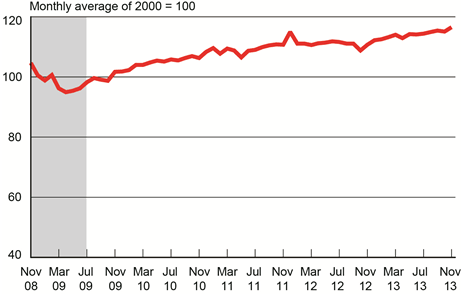
Five Years: Freight Transportation Services Index, November 2008-November 2013. Credit: U.S. DOT
The amount of freight carried by the nation’s for-hire transportation industry rose 1.2% in November from October, rebounding from a one-month decline to reach its highest all-time level, according to a new U.S. Department of Transportation report.

Five Years: Freight Transportation Services Index, November 2008-November 2013.
U.S. DOT
The November 2013 Freight Transportation Services Index level of 116.5 was 22.8% above the April 2009 low during the most recent recession and exceeds the previous high of 115.4 in September 2013. Records go back to 2000.
The October index was revised upward to 115.1 from 114.3 in last month’s release. Monthly numbers for May through September were also revised up from last month’s release.
The 1.2% increase in November freight transportation after a small dip in October was a return to the growth that has characterized the second half of 2013, says the DOT. “The November rise was a result of increases in all modes except pipeline. Growth in tonnage intensive industries such as heavy construction and oil and gas fracking produced an increase in truck tonnage. Both trucking and rail benefitted from growing auto production.”
The Freight TSI remained above its 2012 range for the 11th month in a row. Beginning with January, every month in 2013 has exceeded the high point of 2012, 112.2 reached in December. After dipping to 94.9 in April 2009, the index rose 22.8% in the succeeding 55 months.
Year to date freight shipments measured by the index were up 3.8% higher in November compared to the end of 2012.
Freight shipments are up 11.3% in the five years from the recession level of November 2008 and are up 9.6% in the 10 years from November 2003.
Compared to the same month a year ago, November 2013 freight shipments were up 5.2% from November 2012.
The freight transportation index consists of for-hire trucking, railroad (including rail based intermodal shipments such as containers on flat cars), inland waterway, pipeline transportation and air freight.
More Drivers

Truck Drivers Need More Than Another Alert
Fleets have more visibility into truck health, safety events, and driver activity than ever. The next challenge is turning all that information into useful guidance for the person who has to decide what to do next.
Read More →
FMCSA Removes 110 Truck Driver Training Schools from Certified ELDT List
Federal regulators also are targeting more than 160 additional training providers and launching a nationwide audit of third-party CDL skills testers as part of a broader crackdown on trucking fraud.
Read More →
Hours of Service Pilot Programs: FMCSA Readies for 2027 Rollout
Two pilot programs could eventually reshape hours-of-service rules, giving truck drivers options to pause their 14-hour clock or use longer split sleeper rest periods.
Read More →
Medical Cards, English Proficiency Reshape Roadcheck Violations
Medical-card violations jumped to the top of the driver out-of-service list during CVSA’s 2026 International Roadcheck, while English-language proficiency violations appeared among the leading violations for the first time.
Read More →
Driver Trust Can Make or Break the Success of Fleet Safety Technology
New Teletrac Navman research suggests that onboarding, transparency about driver data, and positive feedback can play a significant role in how commercial drivers respond to safety and coaching technology.
Read More →
EEOC Sues KLLM Over Alleged Sex Discrimination in Driver Training
KLLM is facing a federal sex-discrimination lawsuit over policies the EEOC alleges put female truck driver trainees at a disadvantage.
Read More →
FMCSA Moves to Codify English Language Requirements for Commercial Drivers
By changing regulations on English-language proficiency requirements for commercial drivers, rather than relying on a guidance memo, the FMCSA said future administrations won't be able to walk back the Trump administration's stricter enforcement with just a memo.
Read More →
Drivers Put Western Star Trucks to the Test at Star Nation Experience
Watch to get an inside look at the Western Star trucks, technology, and community behind the Star Nation Experience 2026!
Read More →
Trump Administration Looks to Put More Veterans Behind the Wheel
The Freedom Haulers program pulls together existing and expanded programs at several federal agencies to recruit veterans to drive commercial heavy-duty trucks and cut the red tape for them to get a CDL, training, and employment.
Read More →
Putting Mack’s Command Steer to the Test
A test drive of Mack’s Command Steer active steering system evaluates how it can make truck driving easier and less tiring.
Read More →