




DOE Initiatives Aim to Accelerate Lithium-Battery, Clean-Hydrogen Technologies
The U.S. Department of Energy announced initiatives designed to address potential challenges to zero-emissions vehicles – battery materials and technologies, and affordable clean hydrogen.

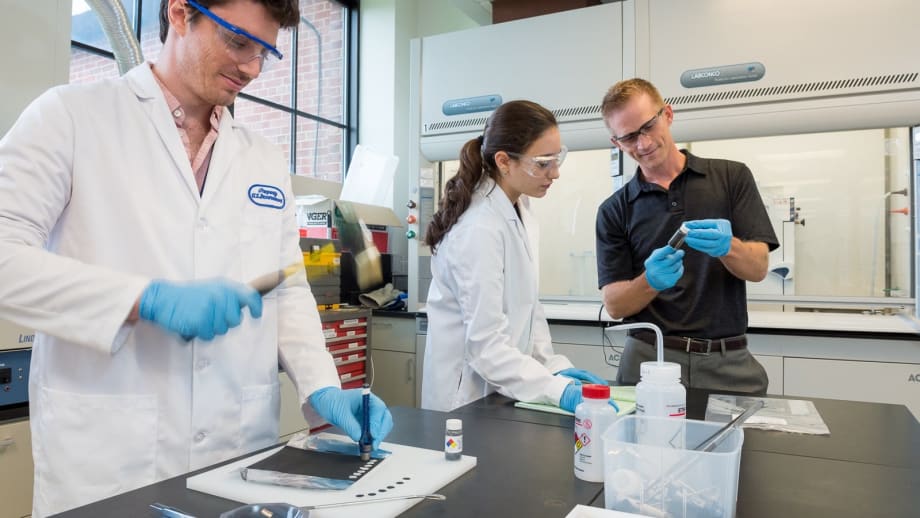
The DOE wants to accelerate research and development of U.S. battery materials and technologies.
Photo: Argonne National Lab
The U.S. Department of Energy this week announced initiatives designed to address potential challenges to zero-emissions vehicles – battery materials and technologies, and affordable clean hydrogen.
Bringing Battery Research and Production to the U.S.
The department announced immediate policy actions designed to scale up a domestic manufacturing supply chain for batteries, based on recommendations from the Biden administration’s 100-day review of advanced batteries.
Advanced, lithium-based batteries will be vital for electric vehicles and stationary grid storage, explained the DOE. Today, the U.S. relies heavily on importing advanced battery components from abroad, exposing the nation to supply chain vulnerabilities that threaten to disrupt the availability and cost of these technologies. The battery supply chain assessment found that the U.S. has less than a 10% global market share for manufacturing capacity across all major battery components and cell fabrication.
“We’re going to need a significant increase in battery production to supercharge America’s clean energy future, which means we urgently need to build up our capacity to research, develop, manufacture, and market batteries right here at home,” said Secretary of Energy Jennifer M. Granholm in a DOE news release. “Strengthening our domestic supply chain will accelerate our efforts to decarbonize the economy—helping to power electric vehicles and boost grid storage and resiliency.”
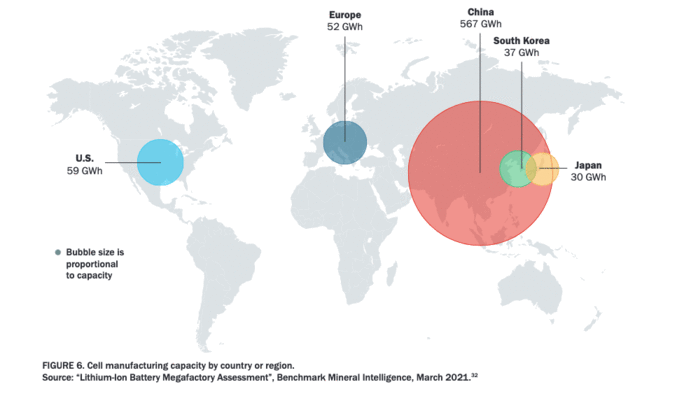
The U.S. has less than a 10% global market share for manufacturing capacity across all major battery components and cell fabrication.
Source: Federal Consortium for Advanced Batteries
The new DOE actions announced include:
A new policy for federally funded grants, cooperative agreements, and research and development contracts will require that all innovations—including those relating to advanced batteries—developed with taxpayer dollars through DOE Science and Energy Programs be substantially manufactured in the United States.
A national blueprint to develop a domestic advanced battery supply chain between now and 2030, released by the Federal Consortium for Advanced Batteries. The National Blueprint for Lithium Batteries 2021-2030 lays out five critical goals and key actions to guide federal agency collaboration.
Providing financing to the advanced battery supply chain for electric vehicles. The DOE’s Loan Programs Office published guidance and released a factsheet to clarify the uses of the Advanced Technology Vehicles Manufacturing Loan Program, which can make loans to manufacturers of advanced technology vehicle battery cells and packs for re-equipping, expanding or establishing such manufacturing facilities in the United States.
Procuring stationary battery storage in support of the Biden administration’s goal for 100% clean electricity by 2035. The DOE’s Federal Energy Management Program is kicking off a federal government-wide project to deploy battery storage at federal sites.
Clean Hydrogen 'Earthshot'
The DOE’s new Energy Earthshots Initiative is designed to accelerate breakthroughs of more abundant, affordable, and reliable clean energy solutions within the decade. The first Energy Earthshot—Hydrogen Shot—seeks to reduce the cost of clean hydrogen by 80% to $1 per kilogram in one decade.
Industries are beginning to implement clean hydrogen to reduce emissions, but there are still many hurdles to deploying it at scale, noted the DOE in its announcement. Currently, hydrogen from renewable energy costs about $5 per kilogram. The department’s goal is to unlock a five-fold increase in demand by increasing clean hydrogen production from sources such as renewables, nuclear, and thermal conversion.
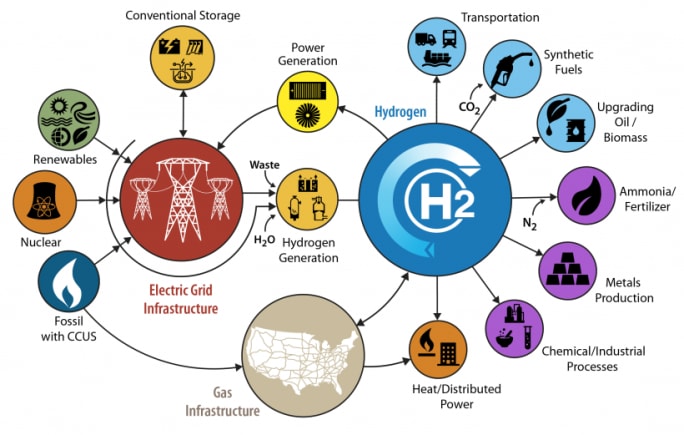
The DOE's H2@Scale H2@Scale is a concept that explores the potential for wide-scale hydrogen production and use in the United States.
Source: Department of Energy
The Hydrogen Shot establishes a framework and foundation for clean hydrogen deployment in the American Jobs Plan, which includes support for demonstration projects.
As part of the launch, DOE’s Hydrogen Program issued a Request for Information on viable hydrogen demonstrations.
“The Energy Earthshots are an all-hands-on-deck call for innovation, collaboration and acceleration of our clean energy economy by tackling the toughest remaining barriers to quickly deploy emerging clean energy technologies at scale,” said Secretary Granholm. “First up: Hydrogen Shot, which sets an ambitious yet achievable cost target to accelerate innovations and spur demand of clean hydrogen. Clean hydrogen is a game changer. It will help decarbonize high-polluting heavy-duty and industrial sectors, while delivering good-paying clean energy jobs and realizing a net-zero economy by 2050.”
More Fuel Smarts

How Volvo Updated Its D13 for EPA 2027 [Watch]
Volvo’s updated D13 promises lower emissions without sacrificing performance or fuel economy. Take a closer look at what changed inside the engine in this HDT Spotlight video.
Read More →
Diesel Price Spike Shortens Payback for Natural Gas Trucks, Report Says
Energy Vision estimates fleets could recover the higher purchase price of an RNG-fueled Class 8 tractor in 1.3 to 2.8 years under current fuel-price scenarios.
Read More →
Calstart Becomes Catalyst Mobility, Reflecting Broader Focus
Calstart is now Catalyst Mobility, reflecting the nonprofit’s growing national role in clean transportation, including zero-emission trucks, infrastructure and incentive programs.
Read More →

Record Diesel Prices Squeeze Trucking Fleets
Average U.S. diesel prices have climbed to nearly $6 a gallon, surpassing the 2022 record as tight refinery capacity and Middle East disruptions keep fuel costs elevated.
Read More →
How Fuel Delivery Shapes Engine Performance
Fuel delivery depends on more than what happens at the injector. For fleet, maintenance and technical professionals, looking at the full path from pump to injector can provide useful context for understanding engine performance.
Read More →
East Coast Port Launches $45M Electric Truck Push
The Port Authority of New York and New Jersey announced millions in incentives for zero-emission drayage trucks, yard tractors, and new charging hubs near the port.
Read More →
California Bill Could Shed Light on Electric Truck Prices
Why do battery-electric Class 8 trucks remain so expensive? A California bill headed to Gov. Gavin Newsom would give fleets and state agencies more visibility into what manufacturers charge.
Read More →
Detroit Opens Orders for EPA 2027 Engines
Detroit isn’t starting from scratch to meet EPA 2027 diesel emissions standards. Its Gen 6 DD13 and DD15 engines keep much of today’s platform while updating the fuel and aftertreatment systems.
Read More →
Zero-Emission Truck Corridor Planned for West Coast
California, Oregon, Washington, British Columbia and Baja California are coordinating plans for truck charging and hydrogen fueling from Canada to Mexico.
Read More →
A Closer Look at Kenworth’s Electric T880E Vocational Truck [Video]
Learn more about Kenworth's T880E battery-electric vocational truck at the Paccar Technical Center, including its range, applications, upfitting considerations, and PTO options, in this HDT Spotlight video.
Read More →