




Diesel Prices Drop as Oil Hits 6-Year Lows
Amidst some of the lowest crude oil prices since 2009, the average price of a gallon of on-highway diesel fuel continued its more than 2-month streak of price drops.
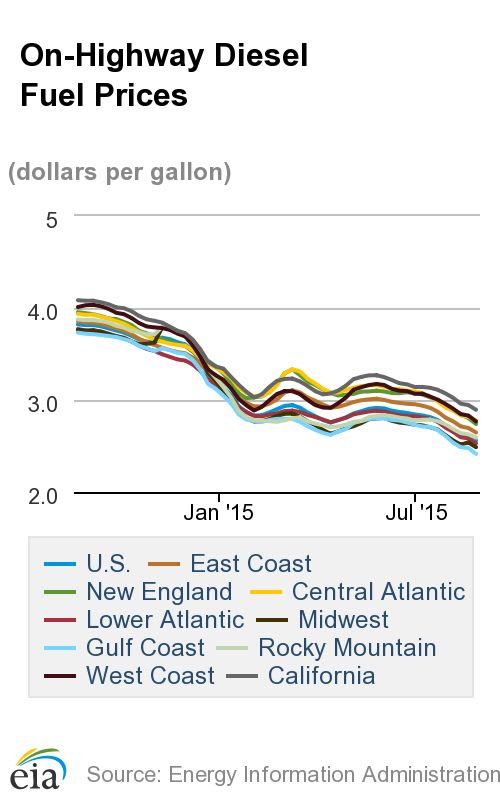
Amidst some of the lowest crude oil prices since 2009, the average price of a gallon of on-highway diesel fuel continued its more than 2-month streak of price drops, according to the latest numbers from the U.S. Energy Department.
The average price dropped for the 13th straight week, sliding 5.4 cents nationally to an average price of $2.561 per gallon. Prices are significantly lower than this period last year, down $1.26 per gallon.
Regional prices were down across the board, with the largest drops coming to the West Coast and New England, where prices fell by 6.4 cents. The smallest decrease occurred in the Rocky Mountain region, falling 3.5 cents.
The price of a gallon of regular gasoline was down 7.9 cents for the week, largely erasing the 8.7-cent increase the week prior. Last week’s increase was mostly due to the partial shutdown of a BP refinery in Indiana, which spiked gas prices in the Midwest.
This week’s largest drop by region occurred on the West Coast with an 8-cent price decrease, and the smallest decrease was found in the Rocky Mountain region at 1.5 cents.
Prices could see even further drops, as crude oil prices dove to six-year lows. West Texas Intermediate crude futures ended the day under $39 a barrel Monday on the New York Mercantile Exchange, at $38.24. Similarly, Brent Crude oil traded at six-year lows coming in at $42.69 per barrel, according to a MarketWatch report.
Oil supply continues to outstrip demand globally, causing prices to precipitously decline throughout much of 2015. Total global liquids inventories have grown by 2.3 million barrels per day through the first seven months of 2015. By comparison, the price of barrel of crude oil was trading at or near $100 a year ago this month.
More Fuel Smarts

A Closer Look at Kenworth’s Electric T880E Vocational Truck
Learn more about Kenworth's T880E battery-electric vocational truck at the Paccar Technical Center, including its range, applications, upfitting considerations, and PTO options.
Read More →
Kenworth T880E Brings EV Power to Vocational Trucks
A closer look at the Kenworth T880E’s range, charging, powertrain and upfit options — and where fleets are showing the most interest.
Read More →
Jennie Abarca Is Proving Electric Trucks Can Do the Job
HDT Truck Fleet Innovator Jennie Abarca is building confidence in fleet electrification one load at a time while openly sharing the challenges she encounters along the way as a small-fleet owner.
Read More →
Cummins Adjusts 2027 Engine Rollout After EPA Proposal
The engine maker will gradually introduce its new Model Year 2027 diesel engines while continuing to offer current models during the transition, citing the EPA's proposed emissions rule changes.
Read More →
EPA Proposal Could Ease 2027 Truck Costs and Buying Uncertainty
The proposal doesn't change the tougher NOx standard, but it would revise key implementation requirements that manufacturers say have driven up costs and complicated fleet purchasing decisions.
Read More →
Cummins, Paccar Ease DEF Derates After EPA Guidance
Updated diesel engine software gives truck operators more time to address emissions-system issues while staying compliant with EPA emissions standards.
Read More →
Maintenance in the Messy Middle Part 3: Biodiesel
Biodiesel can reduce emissions, improve fuel-system lubricity and use existing diesel infrastructure. But NACFE’s Messy Middle maintenance report says fleets must actively manage storage, cold-weather operation, filters and oil drain intervals to avoid problems.
Read More →
Enhance Fleet Performance with High-Efficiency Auxiliary Power Units
Drive sustainable cost savings while increasing driver comfort during short- and long-haul logistics operations.
Read More →
Maintenance in the ‘Messy Middle’ Part 2: Renewable Diesel Fuel
NACFE's latest Messy Middle Powertrain Service & Maintenance report says renewable diesel gives fleets an opportunity to reduce carbon emissions without changing trucks, fueling infrastructure or maintenance practices. But technicians still need to understand several important operational differences.
Read More →
The Diesel Engine Enters NACFE’s ‘Messy Middle’
NACFE’s new Messy Middle Powertrain Service & Maintenance report says keeping modern diesel engines running now depends as much on software, diagnostics and data as traditional mechanical service.
Read More →