




DHL Begins Class 8 Electric Truck Operations in North America
DHL said it will begin operating Class 8 electric delivery trucks in several states and that early results show reductions in energy costs and improved driver satisfaction.

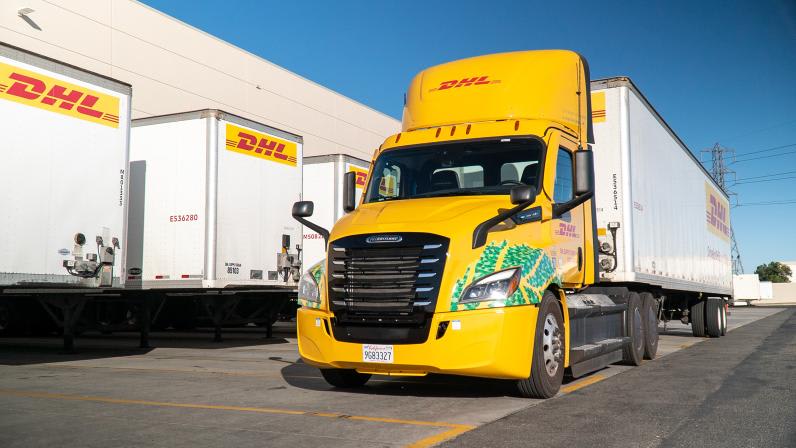
DHL currently has two trucks in operation in California and will soon take delivery of an additional 11 units for use in other states.
Photo: DHL
DHL Supply Chain is deploying its first Class 8 electric trucks in North America, calling it a significant milestone in its commitment to clean and efficient trucking operations.
DHL currently has two trucks in operation in California and in the coming weeks will take delivery of 11 more, to be deployed across Ohio, North Carolina, Pennsylvania, and California.
DHL: BEV Trucks Offer Operational Advantages
DHL said its electric trucks offer advantages including the following:
Zero tailpipe emissions: Electric vehicles are considered zero-emission technology, which means they do not produce any tailpipe carbon dioxide or nitrogen oxide emissions. Each EV that replaces a diesel truck saves, on average, 100 tons of CO2 annually.
Energy conservation: A six-month DHL Supply Chain pilot of a Class 8 EV truck revealed that the truck consumed on average 50% less energy for the same job compared to its diesel counterpart.
Extended range: The EV trucks get up to 250 miles on a single charge, covering the needs of many regional haul routes.
Right-sized charging: Equipped with fast-charging technology and remote monitoring capabilities, the EV trucks enable turnaround times that are aligned with DHL's operational requirements.
Powerful performance: The EV trucks deliver superior horsepower and torque compared to their diesel counterparts, according to DHL
Improved driver satisfaction: During the pilot, drivers shared a preference for the BEV truck over diesel due to its ‘quietness’ and low to no vibrations, leading to less fatigue.
"Our commitment to sustainability extends beyond reducing our environmental impact," said Jim Monkmeyer, president of transportation, DHL Supply Chain.
"We see electric trucks as a strategic investment that offers numerous advantages for our company and the communities we serve. From improved efficiency and a better driving experience, to reduced air and noise pollution, electric trucks are the future of transportation."
Fueling Green Innovation
DHL said it has been an early adopter of EV technology, having deployed more than 30,000 light- to-heavy duty EVs worldwide.
By being an early adopter, the company said, DHL Supply Chain has been able to pilot and learn how best to implement green technologies to enhance productivity and improve operational efficiencies.
In 2023 it added 30 new electric yard trucks, totaling 60 vehicles currently in operation in North America. The company has also continued phasing out propane-powered material handling equipment such as forklifts, replacing them with electric ones.
“We’re building a comprehensive ecosystem around green technologies to support seamless operation, including right-sized charging infrastructure at our facilities and a dedicated team of experts driving continuous improvement," Monkmeyer said.
"This is not just a truck. It's a system, a symbol of our commitment to creating a cleaner, more efficient, and more sustainable transportation landscape."
DHL's Global Sustainability
The addition of electric trucks to its North America fleet follows the announcement of DHL Supply Chain’s global Green Transport Policy aimed at reducing carbon emissions in line with DHL Group’s Sustainability Roadmap. As an initial move, DHL Supply Chain will transition around 2,000 vehicles globally from conventional combustion engines to greener alternatives, including hydrotreated vegetable oil, biogas, electric, or hydrogen.
Over the next three years, DHL Supply Chain's commitment to an additional investment of 200 million euros in fossil fuel alternatives promises to reduce nearly 300,000 tons of CO2 emissions. These savings are equivalent to offsetting the CO2 emissions produced by 2,200 trucks, each driving a daily distance of 500 kilometers over one year.
The new policy is starting with investments in 17 countries with the highest emissions footprint.
More Fuel Smarts

New California Law Could Shed Light on Electric Truck Prices
Why do battery-electric Class 8 trucks remain so expensive? A California bill signed by Gov. Gavin Newsom would give fleets and state agencies more visibility into what manufacturers charge.
Read More →
How Volvo Updated Its D13 for EPA 2027 [Watch]
Volvo’s updated D13 promises lower emissions without sacrificing performance or fuel economy. Take a closer look at what changed inside the engine in this HDT Spotlight video.
Read More →
Diesel Price Spike Shortens Payback for Natural Gas Trucks, Report Says
Energy Vision estimates fleets could recover the higher purchase price of an RNG-fueled Class 8 tractor in 1.3 to 2.8 years under current fuel-price scenarios.
Read More →

Calstart Becomes Catalyst Mobility, Reflecting Broader Focus
Calstart is now Catalyst Mobility, reflecting the nonprofit’s growing national role in clean transportation, including zero-emission trucks, infrastructure and incentive programs.
Read More →
Record Diesel Prices Squeeze Trucking Fleets
Average U.S. diesel prices have climbed to nearly $6 a gallon, surpassing the 2022 record as tight refinery capacity and Middle East disruptions keep fuel costs elevated.
Read More →
How Fuel Delivery Shapes Engine Performance
Fuel delivery depends on more than what happens at the injector. For fleet, maintenance and technical professionals, looking at the full path from pump to injector can provide useful context for understanding engine performance.
Read More →
East Coast Port Launches $45M Electric Truck Push
The Port Authority of New York and New Jersey announced millions in incentives for zero-emission drayage trucks, yard tractors, and new charging hubs near the port.
Read More →
Detroit Opens Orders for EPA 2027 Engines
Detroit isn’t starting from scratch to meet EPA 2027 diesel emissions standards. Its Gen 6 DD13 and DD15 engines keep much of today’s platform while updating the fuel and aftertreatment systems.
Read More →
Zero-Emission Truck Corridor Planned for West Coast
California, Oregon, Washington, British Columbia and Baja California are coordinating plans for truck charging and hydrogen fueling from Canada to Mexico.
Read More →
A Closer Look at Kenworth’s Electric T880E Vocational Truck [Video]
Learn more about Kenworth's T880E battery-electric vocational truck at the Paccar Technical Center, including its range, applications, upfitting considerations, and PTO options, in this HDT Spotlight video.
Read More →