




Daimler's Daum Talks Future Trucks and Current Business at IAA Show
From electric and autonomous vehicles to whether today's current hot truck sales are really a good thing, Daimler Truck and Bus chief Martin Daum shared his insights with reporters at the IAA Commercial Vehicle show in Hannover, Germany.

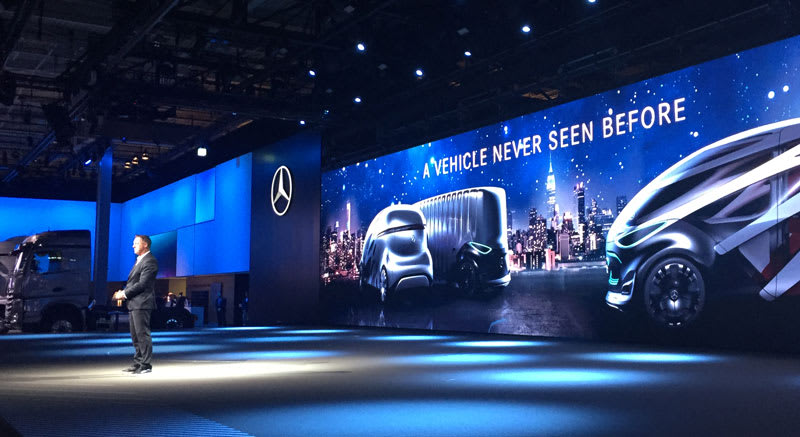
Headline-generating projects like these autonomous concept vans from Mercedes help Daimler gain knowledge that helps them develop real-world products, Daum said.
Photo by Deborah Lockridge.
When looking at the development of new products, Daimler Truck and Bus head Martin Daum says, there are headlines, knowledge, and business. And while business means products that customer can order currently to help them succeed, at the same time there’s the broader economic side of business to consider – and Daum’s not as euphoric about the current hot market as some of his competitive counterparts.
Daum shared his thoughts on these topics in a roundtable discussion at the IAA Commercial Vehicles show in Hanover, Germany, Sept. 19.
From Headlines to Real World
Flashy demonstration vehicles like the fully autonomous van concept that rolled onto the show floor earlier that morning generate headlines, he explained. From there, the company develops knowledge that eventually allows some version of those technologies to appear in real-world vehicles that fleets can order – and that’s the business.
Take the new Mercedes Actros heavy-duty truck, which boasts features such as Active Drive Assist, flat screen panels for a dashboard, and MirrorCam, which replaces the traditional truck mirrors with a camera system for improved visibility and aerodynamics.
When asked whether these features will make their way to North America, Daum said that he was heeding corporate advice to not be the CBS, or “chief bean spiller,” but he told reporters that “you can be sure that everything you’re seen today you’ll see on the streets of the U.S., but I’m not telling you when.”
For instance, the MirrorCam would not be legal in the U.S., where regulations require mirrors. “With conventional trucks in the United States, we have different angles especially when it comes to the front visibility, but we are in talks with legislators to get innovations into the states as well,” he said.
When pressed about what we might see first, Daum said, “Whatever the customer needs most.”

Daimler Truck and Bus head Martin Daum talks to reporters at IAA Commercial Vehicle show in Hannover, Germany.
Photo by Deborah Lockridge
Another example of Daum’s headlines-knowledge-business spectrum would be electric vehicles. Daimler showed off at its IAA booth electric and hybrid vehicles from vans up to heavy trucks and buses – some available today in various markets, such as the eCanter and the new eVito van; some concepts or vehicles in various stages of testing, such as the eActros, an electric Class 8 Fuso, or a fuel cell hybrid Sprinter F-Cell.
There’s talk of hydrogen fuel cells as a way to extend the range of electric trucks, and in fact Daum said Daimler is designing electric drivetrains to have the flexibility to replace batteries with fuel cells and hydrogen tanks.
“I would say we have a long history in [fuel cell research]. We don’t see the technology at the moment ripe for market. It works technology wise, but it’s twice as expensive than today’s electric trucks – which are twice as expense as internal combustion trucks. And we don’t have the hydrogen infrastructure. If there’s a market, we’ll be there.”
Meanwhile, in traditional drivetrains, as the company works to develop trucks to meet the upcoming GHG2 fuel efficiency standards, Daum said, “We still have a lot of things in store. You’ll see a lot of presentations in the next two or three years with significant details on amazing technology with the traditional product. I know already the next phase, and it will be amazing…. We want to lead that market and set the pace.”
What Goes Up Must Come Down
With true German understatement, Daum said, the outlook for 2019 “seems at the moment to be not bad. The sentiments of our customers is strong, the demand for freight is high, freight rates continue to be high, the new trucks are better than trucks still on the road so you see this replacement cycle.”
However, he said, his internal compass from his years heading up Daimler Trucks North America tells him, “I think the markets are, a little bit too high. In years when the market is too high above the long-term average, it foreshadows a valley. The higher it is before, the deeper the valley will be. So I am not rejoicing.”
DTNA is sold out for 2018 and basically for the first half of 2019, Daum said. When asked what his biggest fear for 2019 is, he said, “What can change a strong market? I would say the economy — start a trade war, get into recession in the States. High interest rates... there’s a lot of things on the horizon. But I tell you this is daily life for the executive of a truck company and we’ll deal with it.”
When asked about the Trump administration’s tariffs, Daum declined to comment on specifics, but said, “In general, I am a huge proponent of open markets. We are one globe, we are one people on that globe.”
By working globally, he said, companies and countries alike create a “bigger cake,” a stronger economy to share in. “It doesn’t matter so much what my share is because I have more than I did yesterday. Whoever separates himself from the global market, ultimately that country suffers the most. You get a bigger share, but the cake shrinks. As a global company it’s especially threatening. We are strongly embedded in the local economies we serve. If this global exchange of ideas, people, and goods gets interrupted, then everyone will suffer,” he said, from companies to consumers to the broader economies. “A trade war at the end of the day will have no winner, just losers.”
More Equipment

How Volvo Updated Its D13 for EPA 2027 [Watch]
Volvo’s updated D13 promises lower emissions without sacrificing performance or fuel economy. Take a closer look at what changed inside the engine in this HDT Spotlight video.
Read More →
Michelin Tire Improves Efficiency and Durability for Regional Fleets
The Michelin X Multi Energy D2 is a regional haul drive tire engineered to help fleets improve fuel efficiency, durability and traction in demanding stop-and-go operations.
Read More →
ZF Expands Commercial Vehicle Push in North America
ZF is expanding its North American commercial-vehicle presence with new transmission applications, electrification, trailer technology and autonomous-driving systems.
Read More →
Tesla Wants a Self-Driving Semi. Are Cameras Enough?
Could Tesla’s camera-only autonomous driving technology work on an 80,000-pound Semi? In this commentary, HDT's Deborah Lockridge takes a look at Tesla, Cybercab, and how autonomous trucks see the road.
Read More →
Kodiak: Driverless Long-Haul Truck Launch on Track for 2026
Kodiak AI says its driverless long-haul safety case is 93% complete and it remains on track to begin commercial operations by year-end 2026.
Read More →
What DOT’s Automated Vehicle Strategy Means for Trucking
The U.S. Department of Transportation issued a new automated-vehicle strategy that outlines plans for driverless-truck regulations, cross-state freight corridors, and federal safety standards.
Read More →
East Coast Port Launches $45M Electric Truck Push
The Port Authority of New York and New Jersey announced millions in incentives for zero-emission drayage trucks, yard tractors, and new charging hubs near the port.
Read More →
PlusAI Going Public to Fund Autonomous Truck Launch
A SPAC deal could provide PlusAI with up to $300 million as it works toward a 2027 commercial launch of factory-built autonomous trucks.
Read More →
NHTSA Moves to Rewrite Truck Fuel-Economy Rules
The National Highway Traffic Safety Administration says it lacks authority to regulate medium- and heavy-duty truck engines separately from complete vehicles, but the existing standards have not yet been eliminated.
Read More →
Detroit Opens Orders for EPA 2027 Engines
Detroit isn’t starting from scratch to meet EPA 2027 diesel emissions standards. Its Gen 6 DD13 and DD15 engines keep much of today’s platform while updating the fuel and aftertreatment systems.
Read More →