





Related: Daimler Truck, Volvo Group Form Fuel Cell Joint Venture
Daimler to Put Fuel-Cell Electric Truck in Production During Second Half of Decade
Daimler Trucks showed off a Mercedes-Benz concept truck powered by fuel cells, with a range of up to 1,000 kilometers (more than 600 miles). Customer trials are to start in 2023. It also outlined when its battery-electric eActros trucks are projected to be available, with a first look at a long-haul version.
September 17, 2020
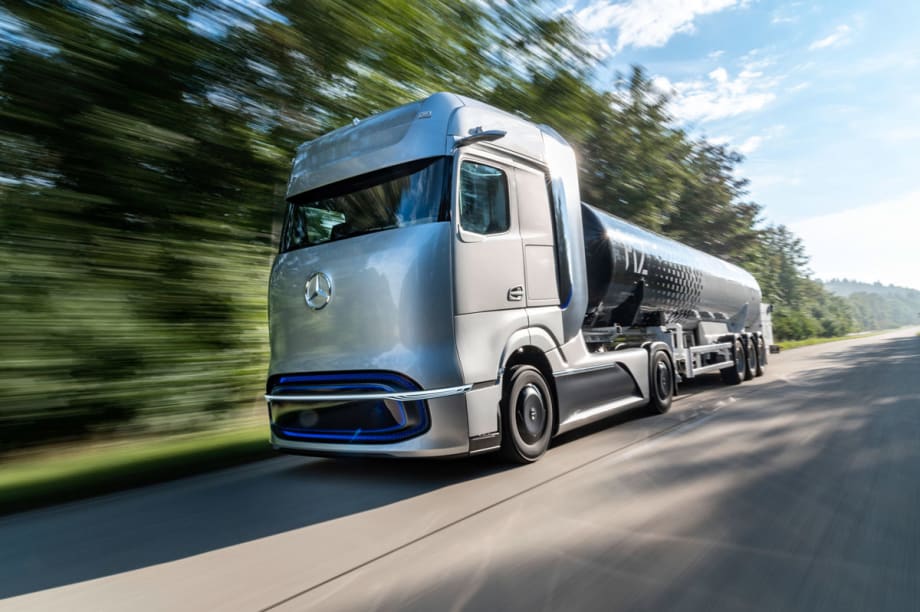
Daimler Trucks plans to begin customer trials of the GenH2 hydrogen fuel-cell truck in 2023.
Photo: Daimler Trucks
5 min to read
Daimler Trucks showed off a Mercedes-Benz concept truck powered by fuel cells, with a range of up to 1,000 kilometers (more than 600 miles), projecting customer trials starting in 2023, and outlined when its battery-electric eActros trucks are projected to be available, including a first look at a long-haul version.
In an event focusing on its technology strategy for the electrification of its vehicles, ranging from urban distribution to international long-haul transport, Daimler focused on the technology for hydrogen-based fuel-cell trucks for the long-haul transport segment.
The Mercedes-Benz GenH2 Truck, which had its world premiere as a concept vehicle, marks the beginning of fuel-cell drive, according to the company. Daimler Trucks plans to begin customer trials of the GenH2 Truck in 2023, with series production to start in the second half of the decade.
Thanks to the use of liquid instead of gaseous hydrogen with its higher energy density, Daimler said its performance will equal that of a comparable conventional diesel truck. The production version of the GenH2 Truck will have a gross vehicle weight of 40 tons and a payload of 25 tons. Two special liquid-hydrogen tanks and a particularly powerful fuel-cell system will make this high payload and long range possible.
Daimler Trucks prefers to use liquid hydrogen (LH2), because in this state, the energy carrier has a far higher energy density in relation to volume than gaseous hydrogen. As a result, the tanks of a fuel-cell truck using liquid hydrogen are much smaller and, due to the lower pressure, significantly lighter. This gives the trucks a larger cargo space and higher payload weight. At the same time, more hydrogen can be carried, which significantly increases the trucks’ range.
Daimler Trucks is pressing ahead with the development of the necessary tank-system technologies to make liquid hydrogen usable also in mobile applications as an energy source for series-produced fuel-cell trucks. The storage of cryogenic liquid hydrogen at -253 degrees Celsius is already common practice in stationary applications, for example in industry or at hydrogen filling stations. This also applies to the transport of liquid hydrogen as cargo.
The two stainless-steel liquid-hydrogen tanks intended for the series version of the GenH2 Truck will have a particularly high storage capacity of 80 kilograms (40 kg each) for covering long distances. The stainless-steel tank system consists of two tubes, one within the other, that are connected to each other and vacuum-insulated. In the series version of the GenH2 Truck, the fuel-cell system is to supply 2 x150 kilowatts and the battery is to provide an additional 400 kW temporarily.
At 70 kWh, the storage capacity of the battery is relatively low, as it is not intended to meet energy needs, but mainly to be switched on to provide situational power support for the fuel cell, for example during peak loads while accelerating or while driving uphill fully loaded. At the same time, the relatively light battery allows a higher payload. It will be recharged in series-production vehicles with braking energy and excess fuel-cell energy.
A core element of the sophisticated operating strategy of the fuel-cell and battery system is a cooling and heating system that keeps all components at the ideal operating temperature, thus ensuring maximum durability. In a pre-series version, the two electric motors are designed for a total of 2 x 230 kW continuous power and 2 x 330 kW maximum power.
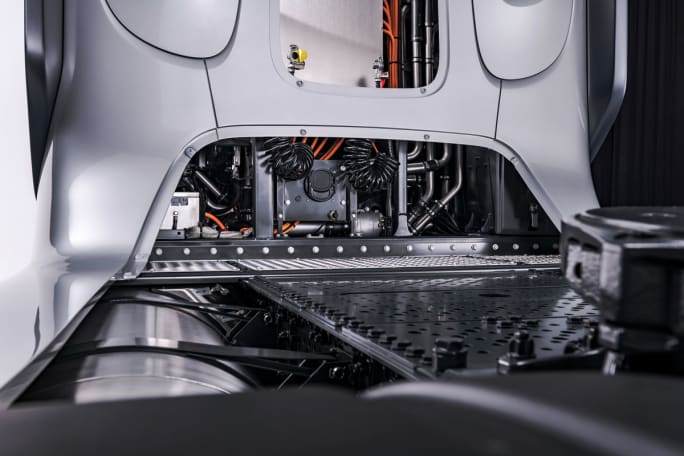
The key to the GenH2's range is using liquified hydrogen rather than storing it as a gas.
Photo: Daimler Trucks
Part of a Larger Electric Truck Portfolio
Daimler also presented for the first time a preview of a battery-powered long-haul truck, the Mercedes-Benz eActros LongHaul, which it said will be ready for series production in 2024. Its range on one battery charge will be approximately 500 kilometers (over 300 miles), and it’s designed to be used on plannable long-haul routes.
In the EU, truck drivers have to take a break of at least 45 minutes after 4.5 hours of driving. During that break, the battery can be charged with a large proportion of the energy needed for the ongoing journey. Daimler is envisioning “depot charging,” with trucking companies setting up charging infrastructure at their depots, rather than waiting for an infrastructure of public charging stations.
The Mercedes-Benz eActros for distribution transport was introduced in 2018 and has been tested intensively since then by customers in everyday transport operations, and Daimler said it will start series production of the truck next year. The range of the series-produced eActros on one battery charge will significantly exceed that of the prototype’s approximately 200 kilometers (about 125 miles), the company said.
Daimler noted that it is pursuing similar vehicle schedules for the North American and Japanese markets. By 2022, Daimler Trucks’ portfolio in its main sales regions – Europe, the U.S., and Japan – will include vehicles with battery-electric drive. The company also has the ambition to offer only new vehicles that are CO2-neutral in driving operation (“from tank to wheel”) in Europe, North America, and Japan by 2039.
The company emphasized that its ePowertrain global platform architecture offers synergies and economies of scale. The ePowertrain will be the technological basis of all medium- and heavy-duty CO2-neutral, all-electric series-produced trucks from Daimler Trucks – whether powered purely by batteries or by hydrogen-based fuel cells. It will feature high levels of performance, efficiency and durability, according to company officials.
“With our alternative drive concepts from Mercedes-Benz – the GenH2 Truck, the eActros LongHaul, and the eActros – and our electric trucks of the Freightliner and Fuso brands, we have a clear focus on customer requirements and are creating genuine locally CO2-neutral alternatives for them,” said Martin Daum, chairman of the board of management of Daimler Truck AG.
More Fuel Smarts

How Volvo Updated Its D13 for EPA 2027 [Watch]
Volvo’s updated D13 promises lower emissions without sacrificing performance or fuel economy. Take a closer look at what changed inside the engine in this HDT Spotlight video.
Read More →
Diesel Price Spike Shortens Payback for Natural Gas Trucks, Report Says
Energy Vision estimates fleets could recover the higher purchase price of an RNG-fueled Class 8 tractor in 1.3 to 2.8 years under current fuel-price scenarios.
Read More →
Calstart Becomes Catalyst Mobility, Reflecting Broader Focus
Calstart is now Catalyst Mobility, reflecting the nonprofit’s growing national role in clean transportation, including zero-emission trucks, infrastructure and incentive programs.
Read More →

Record Diesel Prices Squeeze Trucking Fleets
Average U.S. diesel prices have climbed to nearly $6 a gallon, surpassing the 2022 record as tight refinery capacity and Middle East disruptions keep fuel costs elevated.
Read More →
Sponsored•September 9, 2026
How Fuel Delivery Shapes Engine Performance
Fuel delivery depends on more than what happens at the injector. For fleet, maintenance and technical professionals, looking at the full path from pump to injector can provide useful context for understanding engine performance.
Read More →
East Coast Port Launches $45M Electric Truck Push
The Port Authority of New York and New Jersey announced millions in incentives for zero-emission drayage trucks, yard tractors, and new charging hubs near the port.
Read More →
California Bill Could Shed Light on Electric Truck Prices
Why do battery-electric Class 8 trucks remain so expensive? A California bill headed to Gov. Gavin Newsom would give fleets and state agencies more visibility into what manufacturers charge.
Read More →
Detroit Opens Orders for EPA 2027 Engines
Detroit isn’t starting from scratch to meet EPA 2027 diesel emissions standards. Its Gen 6 DD13 and DD15 engines keep much of today’s platform while updating the fuel and aftertreatment systems.
Read More →
Zero-Emission Truck Corridor Planned for West Coast
California, Oregon, Washington, British Columbia and Baja California are coordinating plans for truck charging and hydrogen fueling from Canada to Mexico.
Read More →
A Closer Look at Kenworth’s Electric T880E Vocational Truck [Video]
Learn more about Kenworth's T880E battery-electric vocational truck at the Paccar Technical Center, including its range, applications, upfitting considerations, and PTO options, in this HDT Spotlight video.
Read More →