




Cummins Developing Engine Platforms to Run on Alternative Fuels
Cummins says new internal combustion engines running on clean diesel, gasoline, natural gas, propane, and hydrogen will help fleets on the path to zero emissions.


“Having a variety of lower carbon options is particularly important considering the variation in duty cycles and operating environments across the many markets we serve," explained Srikanth Padmanabhan, president, Cummins Engine Business.
Photo: Screen capture from virtual press conference
Cummins is pursuing a “fuel-agnostic” strategy to provide lower-carbon, alternative-fuel internal combustion engines in a way that makes it easier for fleets to meet sustainability goals on the path to full zero-emission drivetrains.
The company’s B, L and X-Series engine portfolios for medium- and heavy-duty vehicles will see the addition of versions that operate on fuels such as gasoline, natural gas, hydrogen, and propane. The new engines will use engine blocks and core components that share common architectures and will be optimized for different low-carbon fuel types. Each engine version will operate using a different, single fuel.
Calling climate change “the existential crisis of our time,” Srikanth Padmanabhan, president, Cummins Engine Business, said in a Feb. 14 press conference that “getting to zero is not a light-switch event. Carbon emissions that we put into the atmosphere today cannot be taken back. This means anything we can do to start reducing the carbon footprint today is a win for the planet.
“We know our planet cannot wait for the perfect solution.”
These new fuel-agnostic engine platforms will feature a series of engine versions that are derived from a common base engine, which means they have a high degree of parts commonality — 80%. Below the head gasket of each engine will largely have similar components. Above the head gasket will have different components for different fuel types.
The parts commonality will make it easier for fleets to add these alternative-fuel engines into their operations and for vehicle manufacturers to integrate into their production lines.
The parts commonality and the fact that these engines will look familiar to technicians will allow fleets to integrate alternative fuels into their operations without the steep learning curve that exists with battery-electric powertrains, said Jonathon White, vice president of engineering. “This makes them an economically viable, scalable, and eco-friendly solution that can be adopted today.
“This unique technology approach will allow end users to more seamlessly pick the right powertrain for their application with the lowest CO2 impact,” he said.
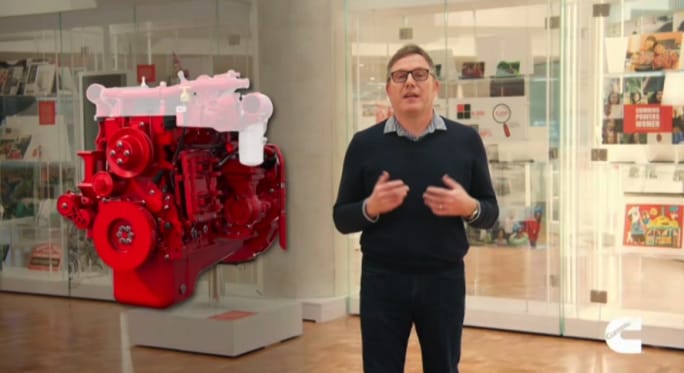
Below the head gasket of each engine will largely have similar components. Above the head gasket will have different components for different fuel types, explained Jonathon White, vice president of engineering.
Photo: Screen capture from virtual press conference
“Having a variety of lower-carbon options is particularly important considering the variation in duty cycles and operating environments across the many markets we serve," explained Padmanabhan. “There is no single solution or ‘magic bullet’ that will work for all application types or all end users.”
Cummins' Fuel-Agnostic Engine Platforms
The B6.7 line will be offered in clean diesel, natural gas, gasoline, propane, and hydrogen versions. The L9 and X15 lines will be available in clean diesel, natural gas, and hydrogen versions. Certain fuels may not be available in some states depending on emissions regulations.
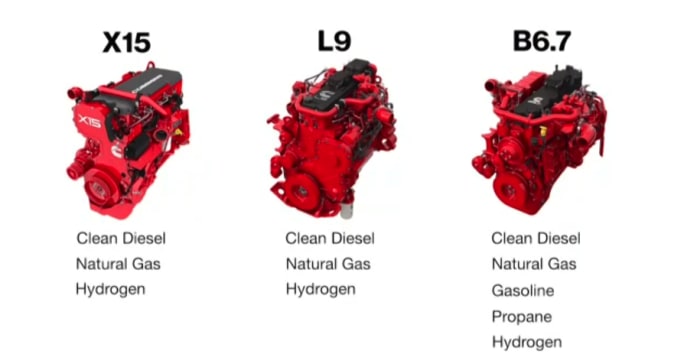
Cummins' B6.7 line will be offered in clean diesel, natural gas, gasoline, propane, and hydrogen versions. The L9 and X15 lines will be available in clean diesel, natural gas, and hydrogen versions.
Photo: Screen capture from virtual press conference
The new engines will start rolling out in 2024. For the B platform, the first will be a gasoline engine. For the 15-liter, natural gas is the first, with clean diesel shortly afterward.
Already, Werner Enterprises is set to test the new natural gas and hydrogen ICE versions in its fleet.
Cummins officials pointed out that the company already added a natural-gas version of its X15 engine, making natural-gas engines an option for a wider range of applications. “We truly think the 15L can bring natural gas to the long-haul market and other duty cycles,” said Brett Merritt, VP, on-highway.
While the unified platform will feature compressed ignition for the diesel engines, all the others will use spark ignition, to provide as many commonalities as possible between engines.
The new approach may even allow Cummins to offer a gasoline version for heavier pickup trucks that currently need diesel engines for the durability and performance those engines bring, Padmanahban said.
The up-front cost of the new "fuel-agnostic" engines will be much lower than moving to fully electric or fuel cell options, said Amy Boerger, vice president, North American On Highway, lowering the barrier to entry. "The architecture and footprint will be similar across current platforms so will be easier for OEMs to integrate.”
Asked for more detail about how much more these engines will be than current diesel technology, Merritt said that with stricter emissions regulations going into effect starting in 2024, gasoline and propane engines will be very similar to what we see today. Natural-gas engines currently command more of a premium, he said, but “our anticipation is that there is a point where that starts to come down,” as greater scale is achieved and the parts commonality allows efficiencies in production. Cummins expects hydrogen ICE engines to have a similar price premium as natural gas.
Padmanahban pointed out that as emissions regulations continue to tighten, diesel engines will need more complex aftertreatment, driving up cost and complexity. Natural gas, however, will not, and hydrogen is expected to be the same. “The lower the CO2 footprint (of the fuel) is, the less we need to clean. As long as you have less to clean up, there’s going to be less aftertreatment.”
Beyond the engines, Merritt pointed out that Cummins is also working on advancing the fuel systems used, referencing its recent 50% equity interest in Momentum Fuel Technologies from Rush Enterprises, “so the truck is truly made in an integrated fashion to address the larger market, not just the niche market we see currently.”
Destination Zero
These new products are part of Cummins’ “destination zero” strategy to reach net-zero emissions by 2050. Cummins is committed to developing battery-electric and hydrogen-fuel-cell powertrains, but right now, most fleets can’t quickly transition to zero-emissions technology.
Padmanabhan said Cummins sees these lower-carbon-fuel internal-combustion engines as a transitionary technology to full battery-electric and fuel-cell-electric vehicles.
When asked about the pros and cons of hydrogen internal-combustion engines vs. fuel-cell electric, Padmanahban said, “It’s just a question of time. Fuel-cell electric eventually will be the technology. But today if you have a diesel engine and can just substitute components like the ignition system, the cost for that is going to be significantly lower than a FCEV powertrain would be. It’s going to take a while before FCEV is ready… so this is what I would call for the next 15 years or so a good transition technology.”
He pointed out that the hydrogen engines will use the same tanks as is being used for Cummins’ natural-gas engines.
Company officials also acknowledged that along with new products, there needs to be change in the energy sources that power them. When you look at “wheel-to-well” emissions, battery-electric vehicles may not be a cleaner choice if the electricity is being generated by coal-fired power plants. Most hydrogen currently produced is “gray” hydrogen, a process that creates CO2 emissions.
“There is a lot of work on green hydrogen that we need to do,” Padmanahban said. Green hydrogen makes up only 1% of hydrogen production today.
More Fuel Smarts

How Volvo Updated Its D13 for EPA 2027 [Watch]
Volvo’s updated D13 promises lower emissions without sacrificing performance or fuel economy. Take a closer look at what changed inside the engine in this HDT Spotlight video.
Read More →
Diesel Price Spike Shortens Payback for Natural Gas Trucks, Report Says
Energy Vision estimates fleets could recover the higher purchase price of an RNG-fueled Class 8 tractor in 1.3 to 2.8 years under current fuel-price scenarios.
Read More →
Calstart Becomes Catalyst Mobility, Reflecting Broader Focus
Calstart is now Catalyst Mobility, reflecting the nonprofit’s growing national role in clean transportation, including zero-emission trucks, infrastructure and incentive programs.
Read More →

Record Diesel Prices Squeeze Trucking Fleets
Average U.S. diesel prices have climbed to nearly $6 a gallon, surpassing the 2022 record as tight refinery capacity and Middle East disruptions keep fuel costs elevated.
Read More →
How Fuel Delivery Shapes Engine Performance
Fuel delivery depends on more than what happens at the injector. For fleet, maintenance and technical professionals, looking at the full path from pump to injector can provide useful context for understanding engine performance.
Read More →
East Coast Port Launches $45M Electric Truck Push
The Port Authority of New York and New Jersey announced millions in incentives for zero-emission drayage trucks, yard tractors, and new charging hubs near the port.
Read More →
California Bill Could Shed Light on Electric Truck Prices
Why do battery-electric Class 8 trucks remain so expensive? A California bill headed to Gov. Gavin Newsom would give fleets and state agencies more visibility into what manufacturers charge.
Read More →
Detroit Opens Orders for EPA 2027 Engines
Detroit isn’t starting from scratch to meet EPA 2027 diesel emissions standards. Its Gen 6 DD13 and DD15 engines keep much of today’s platform while updating the fuel and aftertreatment systems.
Read More →
Zero-Emission Truck Corridor Planned for West Coast
California, Oregon, Washington, British Columbia and Baja California are coordinating plans for truck charging and hydrogen fueling from Canada to Mexico.
Read More →
A Closer Look at Kenworth’s Electric T880E Vocational Truck [Video]
Learn more about Kenworth's T880E battery-electric vocational truck at the Paccar Technical Center, including its range, applications, upfitting considerations, and PTO options, in this HDT Spotlight video.
Read More →