




Convoy, Flexport Link Freight-Tech Networks
Two major freight-tech logistics startups are linking their networks to provide seamless shipping across land, sea, and air – which will offer fleets working with them access to more loads.


The Flexport-Convoy partnership will give better visibility to shippers.
Photo: Flexport
Two major freight-tech logistics startups are linking their networks to provide seamless shipping across land, sea, and air – which will offer fleets working with them access to more loads.
A new partnership between digital-freight-network provider Convoy and global-logistics digital freight forwarder Flexport draws on Flexport’s international client base and Convoy’s North American carrier network. The partnership will give shippers an integrated ocean and truckload service by connecting their respective technology platforms.
With Flexport gaining direct access to the carrier network Convoy created for inbound shippers, it provides more opportunities for the carriers in that network as the transportation provider of choice.
Traditionally, according to the Convoy announcement, it’s been a challenge for shippers to track shipments across a patchwork of logistics providers and digital solutions, as their freight moves from international to domestic endpoints such as distribution centers.
Through this partnership, customers will be able to move their goods via international and domestic transportation, all through the Flexport platform. Capturing all communication, data and reporting in one place will yield greater operational efficiencies, provide customers with an end-to-end view of their supply chain, and help them better understand cost from purchase order to inception to final delivery.
“This partnership represents a shift in the logistics ecosystem, fueled by an increase in collaboration and visibility, thanks to technology,” said Ryan Petersen, CEO and Founder of Flexport. “We’re thrilled to work with Convoy to make what has historically been a complex, fragmented industry more connected and in doing so, progress in our mission to make shipping easier for everyone.”
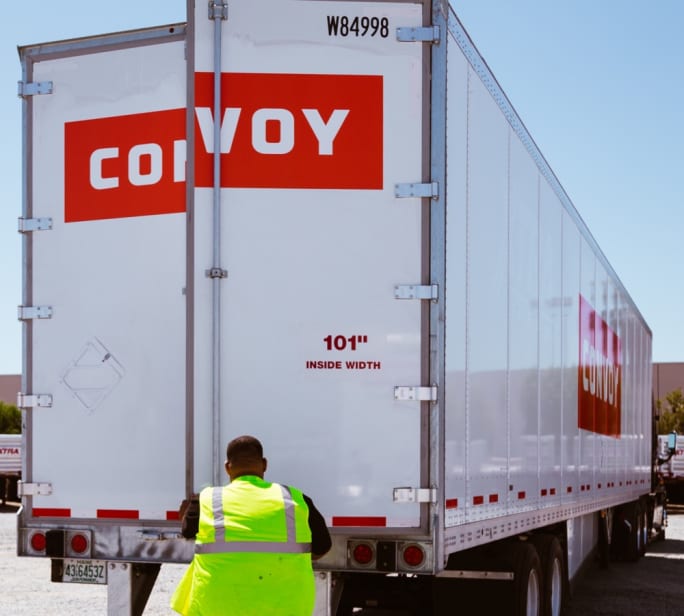
Carriers in Convoy's digital freight network will have access to more loads under the new partnership with Flexport.
Photo: Convoy
Through a multi-phased approach to achieve full system integration, both companies have committed to contributing to the centralized platform. Under the partnership:
Flexport gains access to Convoy’s broad network of carriers as well as deeper integration with Convoy’s products and services, enabling Flexport to scale its truckload service offerings and provide visibility to clients once goods reach domestic ports.
Convoy will integrate directly with Flexport’s operational dashboard, Transmission, and its network of international clients to further grow its domestic marketplace.
Shippers will gain the ability to book end-to-end loads directly on the Flexport platform, with Convoy powering truckload delivery services.
The two technology companies first collaborated in 2018 with Flexport’s adoption of Convoy’s self-serve shipper platform for transactional freight. Over time, Convoy developed dedicated support for Flexport to deploy Convoy’s technology and services for both contractual and non contractual freight, for both drop-and-hook and live loads. In turn, Convoy has adopted Transmission to communicate with Flexport's internal operations teams and clients, ultimately providing a seamless experience and end-to-end supply chain visibility.
More Fleet Management

Why Private Fleets Are Taking More Freight
Private fleets are putting their own trucks on demanding customers and high-cost lanes as companies seek greater control over service, costs, and capacity.
Read More →
Color Match Smarter: Tools That Restore & Perform
For fleet managers and collision repair professionals keeping heavy-duty trucks on the road, getting the color right the first time isn't just about appearance — it's about efficiency, turnaround time, and bottom-line results. Discover how today's digital color tools are transforming the repair process from guesswork to precision.
Read More →
FMCSA Pauses Biennial-Update Enforcement Amid Motus Transition
Carriers whose updates were due on or after June 1 have more time, while FMCSA works to stabilize its new registration system and warns of phishing sites impersonating its new carrier registration system, Motus.
Read More →


2026 Blueprint for Countering Smarter Supply Chain Theft
Cargo theft is no longer just the cost of doing business. It's a multi-billion-dollar criminal enterprise exploiting vulnerabilities across your fleet, drivers, and supply chain.
Read More →
How Telematics Improves Visibility, Control, and Performance in Refrigerated Fleets
Explore how telematics help refrigerated fleets improve visibility, uptime, efficiency, compliance, and cargo protection across connected cold chain operations.
Read More →
What the U.S.-Canada Trade War Means for Trucking
Escalating U.S.-Canada tariffs could disrupt cross-border freight, reduce truck volumes, raise costs, and create new uncertainty for carriers on both sides of the border.
Read More →
What Are Trucking’s Top Concerns for 2026?
The American Transportation Research Institute wants to know what's worrying trucking fleet managers, drivers, and other stakeholders in its annual Industry Issues survey.
Read More →
American Trucking Associations Looks for a New Leader
ATA President and CEO Chris Spear abruptly left his job at the association on August 21, at a pivotal time for the trucking industry.
Read More →
Public Wi-Fi Cybersecurity Risks: How Truck Drivers and Fleets Can Protect Their Data
Public Wi-Fi can expose truck drivers and fleets to credential theft, malware, and other cyber threats. Here’s how to reduce the risk on the road.
Read More →
For Nicky Cupp, Fleet Innovation Starts With Frustration
HDT Truck Fleet Innovator Nicky Cupp turns everyday pain points at Fraley & Schilling into opportunities for better technology and smarter processes.
Read More →