




Congressional Budget Doesn’t Cut Highway Funding
Less than a week after the U.S. House passed the budget deal agreed upon by both chambers, the Senate on Wednesday passed the bill that outlines spending levels for two years by a vote of 64-36.


Less than a week after the U.S. House passed the budget deal agreed upon by both chambers, the Senate on Wednesday passed the bill that outlines spending levels for two years by a vote of 64-36.
The agreement came after weeks of close negotiation between House Budget Committee Chair Paul Ryan, R-Wisc., and Senate Budget Committee Chair Patty Murray, D-Wash.
The Bipartisan Budget Act of 2013, which passed the House last week by a vote of 332 to 94, sets overall discretionary spending for the current fiscal year, which began Oct. 1 at $1.012 trillion. This number is roughly halfway between what the Senate originally wanted ($1.058 trillion) and what the House was aiming for ($967 billion). That $967 billion level for 2014 was set as part of the Budget Control Act of 2011. The measure provides $63 billion (split evenly between defense and non-defense programs) in sequester relief during the next two years, which was fully offset by savings found in other areas. Defense discretionary spending for fiscal year 2014 would stand at $520.5 billion and non-defense discretionary spending would be set at $491.8 billion. The Congressional Budget Office reported that the budget agreement would cut the federal deficit by $85 billion through the next 10 years.
The budget deal likely will not have an impact on the Federal-aid Highway program, the highway safety programs at the National Highway Traffic Safety Administration and the Federal Motor Carrier Safety Administration or the Federal Transit Administration programs funded through the Highway Trust Fund. These programs are funded by contract authority and therefore not part of the discretionary spending caps in the budget deal.
The measure fails to address the upcoming insolvency of the Highway Trust fund, used to pay for federal road and bridge projects, but opens up parts of the Gulf of Mexico to oil drilling that have been off limits since 2000. Even some lawmakers who aren’t exactly in favor of the this part of the plan supported it, pointing out that without the new law, there would be no rules when it comes to drilling in the area, because a moratorium on drilling in the area expires at the end of the year.
"This bill isn't exactly what I would have written on my own, and I'm pretty sure it's not what Chairman Ryan would have written on his own," said Murray in a speech before the Senate vote. "It's a compromise—and that means neither side got everything they wanted, and both sides had to give a bit... I am hopeful this deal can be a foundation for continued bipartisan work, because we have so many big challenges we need to tackle for the families and communities we represent."
The bill now heads to President Obama for his signature.
More Drivers

FMCSA Moves to Codify English Language Requirements for Commercial Drivers
By changing regulations on English-language proficiency requirements for commercial drivers, rather than relying on a guidance memo, the FMCSA said future administrations won't be able to walk back the Trump administration's stricter enforcement with just a memo.
Read More →
Drivers Put Western Star Trucks to the Test at Star Nation Experience
Watch to get an inside look at the Western Star trucks, technology, and community behind the Star Nation Experience 2026!
Read More →
Trump Administration Looks to Put More Veterans Behind the Wheel
The Freedom Haulers program pulls together existing and expanded programs at several federal agencies to recruit veterans to drive commercial heavy-duty trucks and cut the red tape for them to get a CDL, training, and employment.
Read More →
Putting Mack’s Command Steer to the Test
A test drive of Mack’s Command Steer active steering system evaluates how it can make truck driving easier and less tiring.
Read More →
Competition Heating Up for Truck Drivers
New report reveals rising driver hiring costs, the return of sign-on bonuses, growing AI advantages, and the operational factors shaping driver retention.
Read More →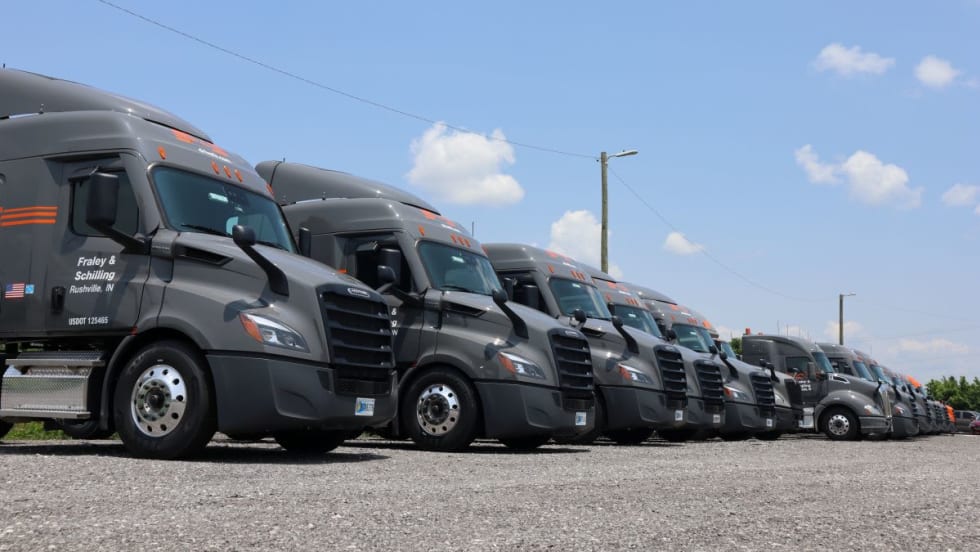
How Fraley & Schilling Improved Logbook Compliance by Over 50%
Fraley & Schilling needed a way to close a compliance workflow gap in its ELD system without adding more work from driver training, reminders, and back-office follow-ups. It found the answer in a custom driver app.
Read More →
Volvo Goes Gaming
Volvo has roared into American Truck Simulator with two new flagship trucks.
Read More →
What the Best Fleets to Drive For Teach About Driver Retention
Survey fatigue, AI-powered routing, owner-operator expectations, and the decline of social media all emerged as themes from this year's Best Fleets to Drive For program.
Read More →
Driver Retention Lessons From the Best Fleets to Drive For
What separates trucking's best workplaces from the rest? Jane Jazrawy shares the biggest lessons from this year's Best Fleets to Drive For program on driver retention, communication, AI, and workforce trends on the HDT Talks Trucking podcast.
Read More →
Farewell, CDL: Why I'm Giving Up My Commercial Driver's License
After more than 20 years as a CDL holder, HDT Executive Editor Jack Roberts is letting his commercial license expire. Not because he wants to — but because trucking's nuclear verdict crisis has made the risks of public-road test drives too great for editors, manufacturers, and everyone involved.
Read More →