




Clarios Inks Sodium-Ion Battery Deal
Clarios has signed an agreement with Altris aimed at accelerating the development of low-voltage sodium-iron battery systems and technology for commercial vehicles.

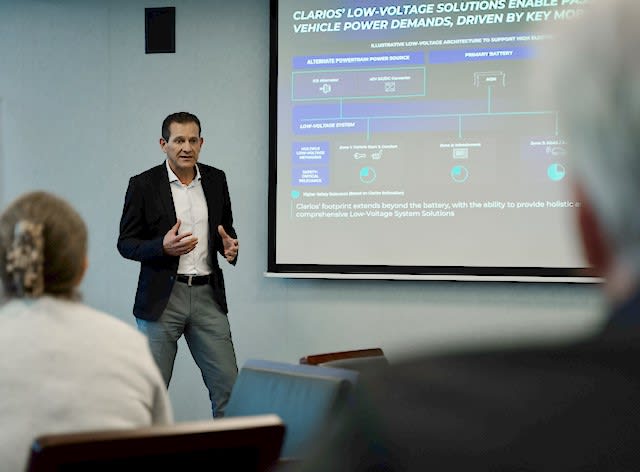
Federico Morales-Zimmermann, vice president and general manager for global OEM customers, products and engineering, Clarios, discusses sodium-ion battery technology at a press briefing in Hannover, Germany, in September, 2024.
Photo: Tara Hamp
Clarios, a leading developer of global low-voltage battery solutions, announced a strategic investment in Altris, a pioneer in sustainable sodium-ion battery technology. The aim of the partnership is the eventual manufacturing of low-voltage, sodium-ion (Na-ion) batteries for the automotive sector.
This equity stake builds on a joint development agreement (JDA) between Clarios, producer of one in three of the world’s low-voltage car batteries, and Altris, a leader in sodium-ion cathode material and battery cell technology, focused on low-voltage Na-ion batteries.
Conflict-Free Battery Materials
Clarios will leverage its expertise in Battery Management Systems (BMS), software, and system integration to design the Na-ion low-voltage automotive battery system to optimize battery performance.
Altris will focus on developing the sodium-ion cell technology for this low-voltage application. Every vehicle, including hybrid electric and fully electric vehicles, requires a low-voltage energy source to power an increased number of software-based functions such as steer-by-wire, brake-by-wire, autonomous functions, and enhanced in cabin experiences.
Clarios expects its investment to initially enable Altris to finalize and start pilot production of Na-ion automotive batteries, followed by commercial production beginning in 2026.
The Clarios low-voltage system architecture, comprising multiple networks and battery power sources, is essential for powering critical safety features and ensuring redundancy in vehicle electrical systems.
Sodium-ion batteries are well suited to meet these increased power demands, according to Clarios.
At the same time, they are inherently sustainable and easy to recycle.
“A sodium-ion battery solution perfectly complements our chemistry-agnostic portfolio, neatly dovetailing with lithium-ion and lead-acid options to capture the best attributes of both: high performance and lower cost,” said Federico Morales-Zimmermann, vice president and general manager, global OEM Customers and technology at Clarios. “A sodium-ion battery system provides agility for automakers seeking options in meeting intensifying low-voltage demands created by advanced vehicle technologies.”
The materials used to produce sodium-ion cells – salt, wood, iron and those found in air – are abundant globally and are free from harmful chemicals or minerals mined in conflict zones.
Developing Na-ion batteries for vehicles would represent an important advancement in automotive battery technology, while advancing the auto industry’s circularity goals, according to Clarios.
Innovation in Battery Design
Clarios will be a member of the Altris Supervisory Board, overseeing the strategic direction and governance of the partnership. The board will consist of experienced professionals in battery technology, automotive industry trends, and corporate governance.
David Patel, vice president and general manager, energy systems at Clarios, will represent Clarios on the Supervisory Board and chair the Technical Committee. This group will oversee the development and implementation of sodium-ion battery technology, ensuring compliance with industry regulations and driving innovation in battery design and performance.
“The Clarios partnership will enable a leap ahead in high-performance sodium-ion automotive batteries by integrating our technology with Clarios’ superior software embedded in its state-of-the-art battery management systems,” said Christer Bergquist, interim CEO of Altris. “Plus, the unmatched global market reach and deep relationships with automakers provides ample opportunities to accelerate commercial deployment.”
More Equipment

How Volvo Updated Its D13 for EPA 2027 [Watch]
Volvo’s updated D13 promises lower emissions without sacrificing performance or fuel economy. Take a closer look at what changed inside the engine in this HDT Spotlight video.
Read More →
Michelin Tire Improves Efficiency and Durability for Regional Fleets
The Michelin X Multi Energy D2 is a regional haul drive tire engineered to help fleets improve fuel efficiency, durability and traction in demanding stop-and-go operations.
Read More →
ZF Expands Commercial Vehicle Push in North America
ZF is expanding its North American commercial-vehicle presence with new transmission applications, electrification, trailer technology and autonomous-driving systems.
Read More →
Tesla Wants a Self-Driving Semi. Are Cameras Enough?
Could Tesla’s camera-only autonomous driving technology work on an 80,000-pound Semi? In this commentary, HDT's Deborah Lockridge takes a look at Tesla, Cybercab, and how autonomous trucks see the road.
Read More →
Kodiak: Driverless Long-Haul Truck Launch on Track for 2026
Kodiak AI says its driverless long-haul safety case is 93% complete and it remains on track to begin commercial operations by year-end 2026.
Read More →
What DOT’s Automated Vehicle Strategy Means for Trucking
The U.S. Department of Transportation issued a new automated-vehicle strategy that outlines plans for driverless-truck regulations, cross-state freight corridors, and federal safety standards.
Read More →
East Coast Port Launches $45M Electric Truck Push
The Port Authority of New York and New Jersey announced millions in incentives for zero-emission drayage trucks, yard tractors, and new charging hubs near the port.
Read More →
PlusAI Going Public to Fund Autonomous Truck Launch
A SPAC deal could provide PlusAI with up to $300 million as it works toward a 2027 commercial launch of factory-built autonomous trucks.
Read More →
NHTSA Moves to Rewrite Truck Fuel-Economy Rules
The National Highway Traffic Safety Administration says it lacks authority to regulate medium- and heavy-duty truck engines separately from complete vehicles, but the existing standards have not yet been eliminated.
Read More →
Detroit Opens Orders for EPA 2027 Engines
Detroit isn’t starting from scratch to meet EPA 2027 diesel emissions standards. Its Gen 6 DD13 and DD15 engines keep much of today’s platform while updating the fuel and aftertreatment systems.
Read More →