




Clarios Developing 24-Volt Lithium Truck Battery
Clarios is showcasing a newly developed lighter, safer, and more robust trucking battery at IAA Transportation show in Hannover, Germany.

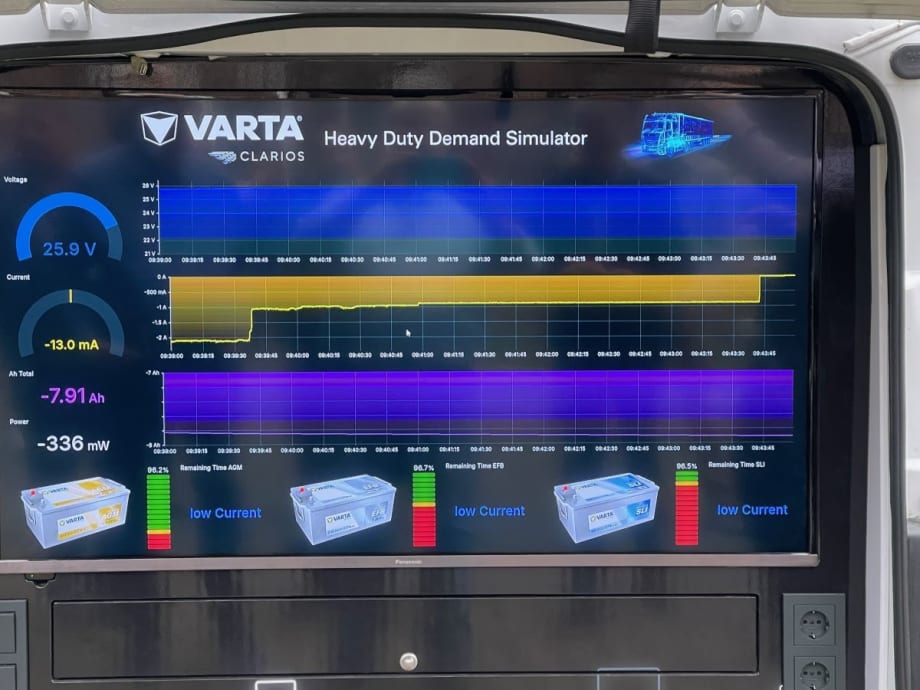
Clarios is dveloping connected batteries that can give both drivers and fleets real-time information on a truck battery's state of charge.
Photo: Jack Roberts
Clarios is a $10 billion global company you've never heard of. Which is funny. Because you probably use its products every day both in your personal vehicles and in the trucks your fleet runs. That's because Clarios is far and away the largest producer of low-voltage automotive batteries in the world, producing over 150 million batteries a year. It's also a technology leader that is stepping out of the shadows and taking a more high-visibility image in the trucking industry now.
Why now? Because, according to company officials, the tidal wave of transformtion sweeping through the trucking industry today is leaving now component or system on trucks alone. Even the humble battery will soon see a host of changes and new introductions from Clarios aimed at dealing with the exponential increase in power demands both internal and external in trucks today.
Moreover Clarios is exploring new types of batteries for commercial vehicles, pioneering connected batteries that can alert drivers to start a truck before charge levels are insuffcient to start the vehicle. The system can also alert technicians when a battery is about to go bad, so it can be replaced before a costly failure on the road happens.
The Demand for More Power
And Clarios kicked off this coming run of new products at the IAA Transportation Show in Hannover, Germany, Clarios announced an agreement to develop 24-volt lithium-ion batteries for heavy-duty applications. Clarios is working together with a major European commercial truck manufacturer on the technology.
Clarios noted that trends in trucking are focused on the integration of more electrical devices, such as parking, heating, and cooling systems, to enhance driver comfort.
Other electrification trends, including the shift of auxiliaries from hydraulic and air pressure systems to electric ones, and the implementation of emerging “by-wire” technologies like brake-by-wire and steer-by-wire, are significantly impacting the low-voltage power network in commercial vehicles and trucks.
These advancements, along with increased demands from Advanced Driver Assist Systems (ADAS), infotainment, and connectivity, are transforming heavy-duty vehicles and raising safety requirements and the need for redundancy in Electrical/Electronic (E/E) architecture.
Current energy demands may require up to 30 percent more battery capacity during an overnight stay, with improved hoteling comfort features contributing to higher electrical loads and anti-idle limitations resulting in deeper charge cycles of up to 80 percent daily.
Clarios noted that lithium-ion systems are an excellent fit for these new demands, offering versatile electrochemistry with multiple design options.
Clarios said its lithium-Ion system is robust enough to withstand the harsh vibrations of over-the-road trucking and integrates seamlessly with all necessary safety and autonomous-driving functions.
Better Power Management
The enhanced performance supports overnight stays without idling and powers the low-voltage network, enabling cabin comfort features and key-off loads, such as over-the-air software updates when needed.
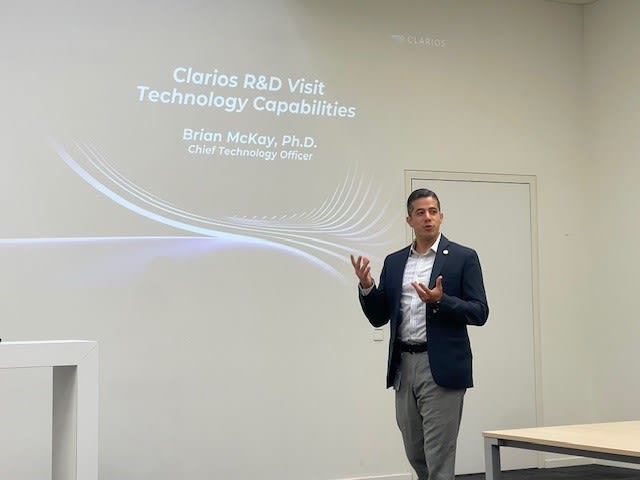
Brian McKay, chief technology officer, Clarios, previews developing battery technologies at company's massive battery plant in Hannover, Germany during IAA 2024.
Photo: Jack Roberts
In line with its commitment to expanding the portfolio beyond current AGM battery offerings, Clarios said it is also exploring future technologies, including Sodium-Ion and other chemistries.
This approach allows Clarios to remain adaptable and responsive to the evolving needs of the heavy-duty market, without being confined to a single technology.
“Battery failure can account for as much as 20 percent of a truck’s downtime,” said Federico Morales Zimmermann, vice president and GM, Global Customers, Products and Engineering at Clarios. “Our new 24-volt lithium-ion battery for heavy-duty fleets not only addresses this challenge by reducing downtime but also introduces advanced energy management capabilities that optimize the overall efficiency of fleet operations. By integrating smart diagnostics and predictive maintenance features, these batteries allow operators to anticipate and prevent failures before they occur, resulting in significant savings on emergency repairs and premature replacements. We are planning to market this development in EMEA under VARTA Automotive, Europe’s leading brand for low-voltage batteries, further solidifying our position as innovators in fleet electrification and power management solutions.”
More Equipment

How Volvo Updated Its D13 for EPA 2027 [Watch]
Volvo’s updated D13 promises lower emissions without sacrificing performance or fuel economy. Take a closer look at what changed inside the engine in this HDT Spotlight video.
Read More →
Michelin Tire Improves Efficiency and Durability for Regional Fleets
The Michelin X Multi Energy D2 is a regional haul drive tire engineered to help fleets improve fuel efficiency, durability and traction in demanding stop-and-go operations.
Read More →
ZF Expands Commercial Vehicle Push in North America
ZF is expanding its North American commercial-vehicle presence with new transmission applications, electrification, trailer technology and autonomous-driving systems.
Read More →
Tesla Wants a Self-Driving Semi. Are Cameras Enough?
Could Tesla’s camera-only autonomous driving technology work on an 80,000-pound Semi? In this commentary, HDT's Deborah Lockridge takes a look at Tesla, Cybercab, and how autonomous trucks see the road.
Read More →
Kodiak: Driverless Long-Haul Truck Launch on Track for 2026
Kodiak AI says its driverless long-haul safety case is 93% complete and it remains on track to begin commercial operations by year-end 2026.
Read More →
What DOT’s Automated Vehicle Strategy Means for Trucking
The U.S. Department of Transportation issued a new automated-vehicle strategy that outlines plans for driverless-truck regulations, cross-state freight corridors, and federal safety standards.
Read More →
East Coast Port Launches $45M Electric Truck Push
The Port Authority of New York and New Jersey announced millions in incentives for zero-emission drayage trucks, yard tractors, and new charging hubs near the port.
Read More →
PlusAI Going Public to Fund Autonomous Truck Launch
A SPAC deal could provide PlusAI with up to $300 million as it works toward a 2027 commercial launch of factory-built autonomous trucks.
Read More →
NHTSA Moves to Rewrite Truck Fuel-Economy Rules
The National Highway Traffic Safety Administration says it lacks authority to regulate medium- and heavy-duty truck engines separately from complete vehicles, but the existing standards have not yet been eliminated.
Read More →
Detroit Opens Orders for EPA 2027 Engines
Detroit isn’t starting from scratch to meet EPA 2027 diesel emissions standards. Its Gen 6 DD13 and DD15 engines keep much of today’s platform while updating the fuel and aftertreatment systems.
Read More →