




Cascadia Evolution, M2 Models Leading Freightliner to “Best Year Ever"
Lampert attributes Freightliner’s market-leading position with a product lineup that is address customers key concerns: fuel economy and the cost of operation.

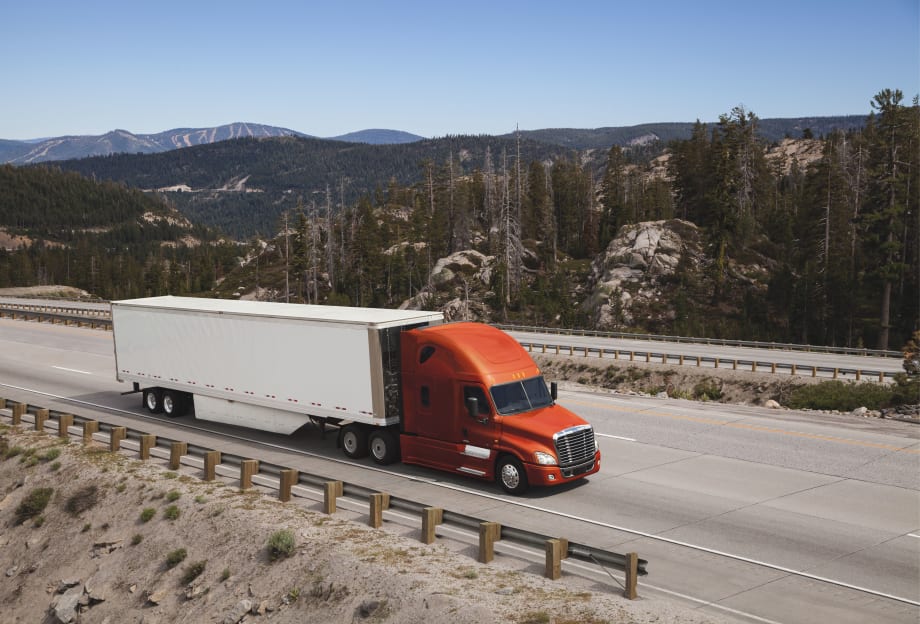
NAPA, Calif. – Freightliner’s Cascadia Evolution and the M2 chassis have pushed Daimler Trucks North America’s market share to 39% year-to-date. Mark Lampert, senior vice-president of sales and marketing, says he expects to finish 2013 calendar with record share levels.
At a press gathering in Napa, Freightliner announced that orders for the 2014 Cascadia Evolution has surpassed 15,000 since the model's start of production in March 2013. Additionally, sales of the M2 product line in Class 6, 7 and 8 segments totaled 19,472 units.
“We’ll see some decline from the 39%, but in total, it will be our best year ever,” Lampert says.
Lampert forecasts total NAFTA Class 8 sales for 2013 will probably down by 5% to 7%, while Class 6 and 7 sales will be up 7% to 8% in total.
“We’re expecting combined Class 6 through 8 to be about 330,000 units, down from 344,227 in 2012,” he said. “We’ll see a slight contraction in Class 8 sales while Class 6 and 7 will see slight growth.”
While 2013 won’t be a spectacular year for the Class 8 NAFTA market, it’s on track to be a good one, and Freightliner is sitting comfortably at the top of the heap. Wards Auto figures show Freightliner rising through 2011, 2012, and 2013 from 30.5% market share in the U.S. to 39% 2013 year-to-date.
“What pleases us most is that we’re taking share from everyone,” Lampert says. “We’re up a total of 6.6 market share points, while all other Class 8 manufacturers are down. Our growth is coming at the expense of everybody year-to-date.”
Lampert attributes Freightliner’s market-leading position with a product lineup that is address customers key concerns: fuel economy and the cost of operation.
Lampert says customer have come to a point where they have allowed their truck to run longer than 500,000 miles and they are seeing operating and maintenance costs skyrocket. When some of today’s six- or seven-year-old trucks were new, they were seeing maintenance costs of around 2.5 cent-per-mile. “Those cost have ballooned now to 16 or 18 cents per mile,” Lampert notes. “On top of that, many of those trucks are EPA ’07 generation technology, which is some of the worst we’ve had in terms of fuel economy.”
Freightliner says the 2014 Cascadia Evolution features aerodynamic and efficiency improvements that deliver up to an additional 7% improvement in fuel economy over an EPA 2010-compliant Cascadia, and up to 5% improvement in fuel efficiency over the 2013 Cascadia with first-generation aerodynamic enhancements. They didn’t speculate what the incremental improvement might be between an EPA ’07 engine and the current generation DD15, but as Lampert points out, cost reduction in a sluggish freight market is paramount.
“The value proposition the customers have recognized is taking maintenance costs down from 16 to 18 cents back to 2 cents and improving fuel economy by about a mile per gallon,” says Lampert. “That’s obviously driving a lot of what we’re seeing in the market place.
Meduim Duty Market Share
Lampert emphasized the importance of the medium-duty Class 6 and 7 market place to Freightliner, saying since 2011, market share has grown to 45.4% of North American retail sales – including the M2 product line, the Custom Chassis business and the bus business, a total of everything register as Class 6 or 7.
“Year-to-date, ’13 versus ’12, we’re up 7.7 market share points, Paccar is down 1.8, Ford is up 4.8, Hino is down 1 and Navistar is down 9.3 market share point” Lampert says. “When you look at order intake for NAFTA, our M2 business alone is bigger than a lot of out competitors’ total class 6 through 8 business.”
In the vocational segment, Freightliner has more than doubled its market share from just under 16% in 2008 to 33.9% as of March 2013.
On a larger scale, Lampert says the global market for commercial vehicles should be up slightly from calendar 2012, but in the key markets for Daimler Trucks -- NAFTA, Japan and the Eurozone -- sales will be down from last year.
More Fleet Management

Color Match Smarter: Tools That Restore & Perform
For fleet managers and collision repair professionals keeping heavy-duty trucks on the road, getting the color right the first time isn't just about appearance — it's about efficiency, turnaround time, and bottom-line results. Discover how today's digital color tools are transforming the repair process from guesswork to precision.
Read More →
FMCSA Pauses Biennial-Update Enforcement Amid Motus Transition
Carriers whose updates were due on or after June 1 have more time, while FMCSA works to stabilize its new registration system and warns of phishing sites impersonating its new carrier registration system, Motus.
Read More →
2026 Blueprint for Countering Smarter Supply Chain Theft
Cargo theft is no longer just the cost of doing business. It's a multi-billion-dollar criminal enterprise exploiting vulnerabilities across your fleet, drivers, and supply chain.
Read More →


How Telematics Improves Visibility, Control, and Performance in Refrigerated Fleets
Explore how telematics help refrigerated fleets improve visibility, uptime, efficiency, compliance, and cargo protection across connected cold chain operations.
Read More →
What the U.S.-Canada Trade War Means for Trucking
Escalating U.S.-Canada tariffs could disrupt cross-border freight, reduce truck volumes, raise costs, and create new uncertainty for carriers on both sides of the border.
Read More →
What Are Trucking’s Top Concerns for 2026?
The American Transportation Research Institute wants to know what's worrying trucking fleet managers, drivers, and other stakeholders in its annual Industry Issues survey.
Read More →
American Trucking Associations Looks for a New Leader
ATA President and CEO Chris Spear abruptly left his job at the association on August 21, at a pivotal time for the trucking industry.
Read More →
Public Wi-Fi Cybersecurity Risks: How Truck Drivers and Fleets Can Protect Their Data
Public Wi-Fi can expose truck drivers and fleets to credential theft, malware, and other cyber threats. Here’s how to reduce the risk on the road.
Read More →
For Nicky Cupp, Fleet Innovation Starts With Frustration
HDT Truck Fleet Innovator Nicky Cupp turns everyday pain points at Fraley & Schilling into opportunities for better technology and smarter processes.
Read More →
Adam Buttgenbach’s Approach to Electric Trucks: Start With Where They Fit
HDT Truck Fleet Innovator Adam Buttgenbach helped PepsiCo build one of North America’s largest EV fleets by focusing on where electric trucks make operational sense.
Read More →