




Carriers Could Pay Higher Wages to Address Driver Shortage
A shortage of experienced drivers means carriers are hesitant to increase capacity, despite rising carrier costs and rates, according to the quarterly Transport Capital Partners Survey. Expect increases in driver wages this year as a result.
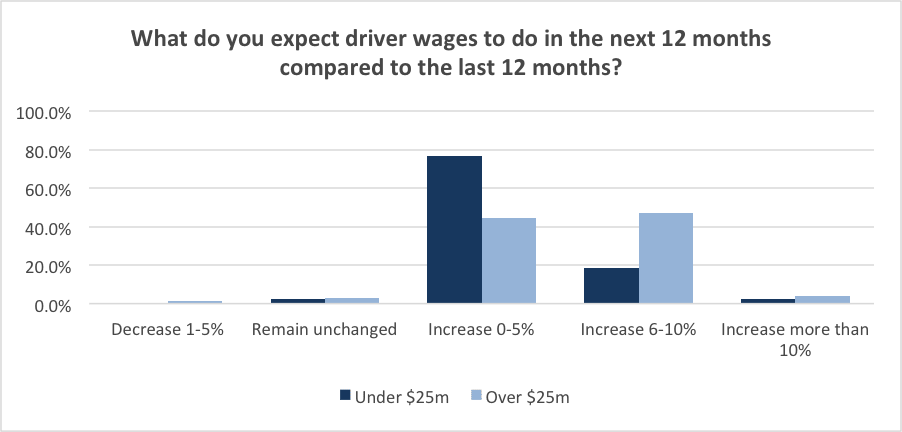
Carriers of all sizes expect driver wages to increase in 2015. Graph by Transport Capital Partners.
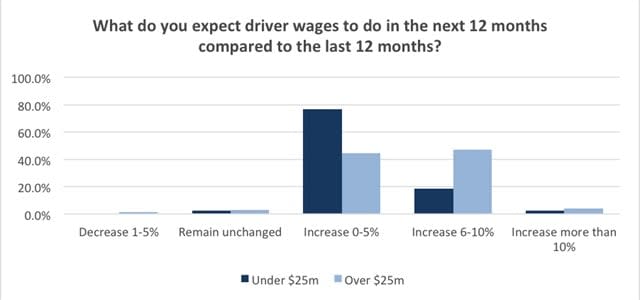
Carriers of all sizes expect driver wages to increase in 2015. Graph by Transport Capital Partners.
A shortage of experienced drivers means carriers are hesitant to increase capacity, despite rising carrier costs and rates, according to the quarterly Transport Capital Partners Survey. To address the problem, carriers surveyed expect driver wages to increase by up to 10 percent in 2015.
In the TCP survey, more than 90% of carriers expected driver wages to increase by 6-10%, double the expectation from six months ago.
“Carriers remain hesitant to add capacity because of the shortage of experienced drivers, with replacement far outpacing additions on order boards for new tractors,” said Richard Mikes, TCP partner and survey leader.
The carriers in the survey were split by size into under $25 million in revenues and over $25 million. Larger carriers were more apt to predict a 6-10% increase in wages, while smaller carriers felt it was more likely to be in the 0-5% range.
The wage increase is part of an effort to attract experienced applicants who often go to other sectors like construction that can offer more benefits to drivers who want regular hours and access to better pay. The higher rates are being plowed into wages and other costs.
“Revenue from rate increases will go into purchasing new equipment, driver wages, rising maintenance costs and regulatory costs,” said Steven Dutro, TCP Partner.
Carriers also overwhelmingly support proposals to allow drivers under 21 years old to drive with proper training, in interstate commerce. As much as 84% of carriers support it, including smaller carriers that typically don’t hire inexperienced drivers.
More Drivers

FMCSA Removes 110 Truck Driver Training Schools from Certified ELDT List
Federal regulators also are targeting more than 160 additional training providers and launching a nationwide audit of third-party CDL skills testers as part of a broader crackdown on trucking fraud.
Read More →
Hours of Service Pilot Programs: FMCSA Readies for 2027 Rollout
Two pilot programs could eventually reshape hours-of-service rules, giving truck drivers options to pause their 14-hour clock or use longer split sleeper rest periods.
Read More →
Medical Cards, English Proficiency Reshape Roadcheck Violations
Medical-card violations jumped to the top of the driver out-of-service list during CVSA’s 2026 International Roadcheck, while English-language proficiency violations appeared among the leading violations for the first time.
Read More →
Driver Trust Can Make or Break the Success of Fleet Safety Technology
New Teletrac Navman research suggests that onboarding, transparency about driver data, and positive feedback can play a significant role in how commercial drivers respond to safety and coaching technology.
Read More →
EEOC Sues KLLM Over Alleged Sex Discrimination in Driver Training
KLLM is facing a federal sex-discrimination lawsuit over policies the EEOC alleges put female truck driver trainees at a disadvantage.
Read More →
FMCSA Moves to Codify English Language Requirements for Commercial Drivers
By changing regulations on English-language proficiency requirements for commercial drivers, rather than relying on a guidance memo, the FMCSA said future administrations won't be able to walk back the Trump administration's stricter enforcement with just a memo.
Read More →
Drivers Put Western Star Trucks to the Test at Star Nation Experience
Watch to get an inside look at the Western Star trucks, technology, and community behind the Star Nation Experience 2026!
Read More →
Trump Administration Looks to Put More Veterans Behind the Wheel
The Freedom Haulers program pulls together existing and expanded programs at several federal agencies to recruit veterans to drive commercial heavy-duty trucks and cut the red tape for them to get a CDL, training, and employment.
Read More →
Putting Mack’s Command Steer to the Test
A test drive of Mack’s Command Steer active steering system evaluates how it can make truck driving easier and less tiring.
Read More →
Competition Heating Up for Truck Drivers
New report reveals rising driver hiring costs, the return of sign-on bonuses, growing AI advantages, and the operational factors shaping driver retention.
Read More →