





Related: HDT's Top Green Fleets of 2018
Bipartisan Effort on Capitol Hill Aims to Extend Alt-Fuel Tax Credits
A bipartisan push is under way in Congress to extend through this year certain tax credits that promote the adoption of alternatively powered vehicles.
March 1, 2019
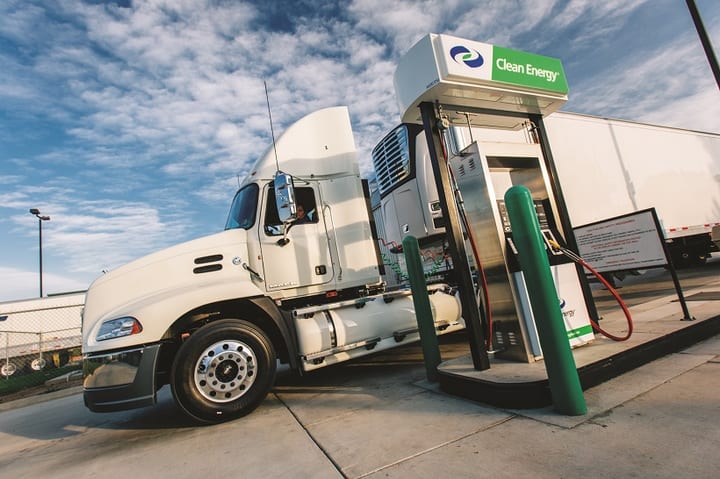
The new bill would extend federal alt-fuel related tax credits at their current level for 2018 and 2019.
Photo: Clean Energy Fuels
4 min to read
A bipartisan push is under way on Capitol Hill to extend through this year certain tax credits that promote the adoption of alternatively powered vehicles.
These include an excise tax credit of $0.50 per gallon on alternative fuels; a tax credit of $1 per gallon on biodiesel and renewable diesel; a credit for purchasing new, qualified fuel-cell motor vehicles; and a credit for installing alternative fuel vehicle-refueling property.
Legislation authorizing those and a laundry list of other tax credits is necessary because the prior Congress failed to extend the credits before they expired by the end of last year.
The new bill, the Tax Extender and Disaster Relief Act of 2019, was introduced on Feb. 28 by Senate Finance Committee Chairman Chuck Grassley (R-IA) and the committee’s Ranking Member Ron Wyden (D-OR). The measure would extend credits at their current level for 2018 and 2019. There are currently 26 provisions that expired at the end of 2017 and three others that expired at the end of 2018.
Here is the specific language of the bill regarding the biodiesel fuel, fuel-cell vehicle, and vehicle-refueling credits:
Excise tax credits relating to alternative fuels: The provision provides through 2019 a $0.50-per-gallon excise-tax credit or payment for alternative fuel and a $0.50-per-gallon credit for alternative fuel mixed with traditional fuel. The alternative fuel credit is for fuel used in a motor vehicle, motor boat, or airplane and the mixture credit is not limited to transportation. Additionally, the provision modifies the mixture component of the credit by specifying that liquefied petroleum gas, compressed or liquefied natural gas, and compressed or liquefied gas derived from biomass, are not eligible to be included in an alternative fuel mixture.
Biodiesel and renewable diesel incentives: The provision extends through 2019 a $1.00-per-gallon tax credit for biodiesel and biodiesel mixtures, and the small agri-biodiesel producer credit of 10 cents per gallon. Additionally, the provision treats renewable diesel the same as biodiesel, except there is no small producer credit. The credit may be taken as an income tax credit, and the mixture credit may be taken as an excise tax payment or credit.
Credit for new qualified fuel-cell motor vehicles: The provision extends through 2019 a credit for purchases of new qualified fuel cell motor vehicles. The provision allows a credit of between $4,000 and $40,000, depending on the weight of the vehicle, for the purchase of such vehicles. Other vehicles, depending on their fuel efficiency, qualify for an additional $1,000 to $4,000 credit.
Credit for alternative fuel vehicle refueling property: The provision extends through 2019 a credit for the installation of alternative fuel vehicle refueling property placed in service before 2020 Available for property that dispenses alternative fuels including ethanol, biodiesel, natural gas, hydrogen, and electricity, the credit is capped at $30,000 per location for business property and $1,000 for property installed at a principal residence.
“Congress needs to get out of this bad habit of regular retroactive extensions of these tax provisions,” said Sen. Grassley in a joint statement. “The whole point of these federal tax incentives is to encourage certain behaviors, especially investments in alternative energies, energy efficiency and transportation. The best way to do that is ahead of time, not retroactively.
Grassely added that many business decisions were made last year based on the “reasonable expectation that they [tax credits] would be extended, since it’s what Congress has consistently done in the past. I hope the House of Representatives acts soon since taxpayers affected by these expired provisions have to file their tax returns in the coming weeks. Thousands of jobs across the country depend on it.”
“It’s important this is a two-year bill covering 2019, and it includes key renewable energy incentives I’m proud to fight for,” said Sen. Widen. “Filing season for 2018 is already underway, so the Congress should act on this quickly.”
Natural-gas vehicle advocacy group NGV America along with nearly 700 users, retailers, customers, fleet managers, utilities, and producers of alternative transportation fuels have lobbied Congress to reinstate the alternative-fuels tax credit, which allows for the offer $.50 per gasoline gallon equivalent (GGE) credit on certain transportation fuels.
A letter the groups have sent to the Senate and House finance committee leaders contends that extending the AFTC will bring “significant environmental benefits, improved air quality, and enhance our energy independence by lowering our dependence on foreign oil. Renewal of the AFTC also promotes increased private-sector investment in infrastructure and equipment, which leads to more jobs and economic output.”
More Fuel Smarts

How Volvo Updated Its D13 for EPA 2027 [Watch]
Volvo’s updated D13 promises lower emissions without sacrificing performance or fuel economy. Take a closer look at what changed inside the engine in this HDT Spotlight video.
Read More →
Diesel Price Spike Shortens Payback for Natural Gas Trucks, Report Says
Energy Vision estimates fleets could recover the higher purchase price of an RNG-fueled Class 8 tractor in 1.3 to 2.8 years under current fuel-price scenarios.
Read More →
Calstart Becomes Catalyst Mobility, Reflecting Broader Focus
Calstart is now Catalyst Mobility, reflecting the nonprofit’s growing national role in clean transportation, including zero-emission trucks, infrastructure and incentive programs.
Read More →

Record Diesel Prices Squeeze Trucking Fleets
Average U.S. diesel prices have climbed to nearly $6 a gallon, surpassing the 2022 record as tight refinery capacity and Middle East disruptions keep fuel costs elevated.
Read More →
Sponsored•September 9, 2026
How Fuel Delivery Shapes Engine Performance
Fuel delivery depends on more than what happens at the injector. For fleet, maintenance and technical professionals, looking at the full path from pump to injector can provide useful context for understanding engine performance.
Read More →
East Coast Port Launches $45M Electric Truck Push
The Port Authority of New York and New Jersey announced millions in incentives for zero-emission drayage trucks, yard tractors, and new charging hubs near the port.
Read More →
California Bill Could Shed Light on Electric Truck Prices
Why do battery-electric Class 8 trucks remain so expensive? A California bill headed to Gov. Gavin Newsom would give fleets and state agencies more visibility into what manufacturers charge.
Read More →
Detroit Opens Orders for EPA 2027 Engines
Detroit isn’t starting from scratch to meet EPA 2027 diesel emissions standards. Its Gen 6 DD13 and DD15 engines keep much of today’s platform while updating the fuel and aftertreatment systems.
Read More →
Zero-Emission Truck Corridor Planned for West Coast
California, Oregon, Washington, British Columbia and Baja California are coordinating plans for truck charging and hydrogen fueling from Canada to Mexico.
Read More →
A Closer Look at Kenworth’s Electric T880E Vocational Truck [Video]
Learn more about Kenworth's T880E battery-electric vocational truck at the Paccar Technical Center, including its range, applications, upfitting considerations, and PTO options, in this HDT Spotlight video.
Read More →