




Bosch Developing Hydrogen Fuel Cell Technology
Bosch has formed an alliance with Powercell Sweden AB, a Swedish manufacturer of fuel-cell stacks, to research and develop fuel cell technology with an initial emphasis on commercial vehicles such as the Nikola Two.

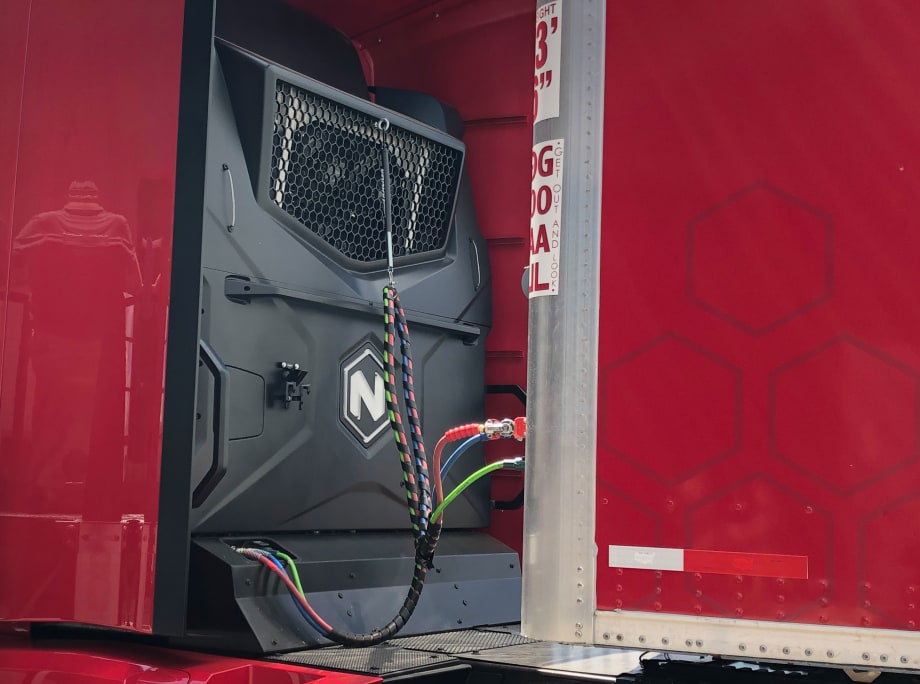
Bosch said a new partnershiip with Powercell Sweden AB will boost research and development of polymer-electrolyte membrane (PEM) fuel cells, like this Bosch system mounted on the Nikola Two hydrogen-electric tractor.
Photo: Jim Park
German automotive supplier Bosch announced that it is entering the market for mobile fuel cells in an effort to power both trucks and cars with this emerging powertrain technology.
Bosch said it has formed an alliance with Powercell Sweden AB, a Swedish manufacturer of fuel-cell stacks, which form the core component in a hydrogen fuel cell and convert the gas into electricity. Under the agreement, the two partners will work jointly to make the polymer-electrolyte membrane (PEM) fuel cell ready for serial production. Bosch will then manufacture this technology under license for the global automotive market.
In a press statement, Bosch officials said the company believes the best opportunities for broad adoption of fuel-cell technology are in the commercial-vehicle market.
The European Union's fleet requirements for trucks call for a reduction of CO2 emissions by 15% on average by 2025, and 30% by 2030. Bosch’s view is that this target can only be reached by electrifying more and more of the powertrain, with hydrogen fuel cells playing a major role in reaching that goal.
Nikola Motor Co. is developing hydrogen fuel cell heavy-duty trucks for both Europe and the U.S., and Bosch was a big part of the recent roll-out of the Nikola Two (for the U.S.) and the Nikola Tre (for Europe) at an event dubbed Nikola World.
Once the technology has been proven in heavy commercial vehicles, the company said, it will then increasingly find its way into passenger cars. For this longer-term goal to happen, the cost of fuel-cell systems needs to be progressively reduced, particularly the "stack," which the company identifies as the most expensive component in a hydrogen fuel cell system, accounting for nearly two-thirds of the cost.
“Through commercialization and widespread marketing of this technology, Bosch will achieve economies of scale and push down costs,” said Stefan Hartung, member of the Bosch board of management and chairman of its Mobility Solutions business sector. “In the fuel-cell domain, Bosch already has a strong hand, and the alliance with Powercell makes it even stronger. Commercializing technology is one of our strengths. We are now going to take on this task with determination and develop this market.”
Costs also have to fall when it comes to hydrogen as a fuel source, Hartung added. Currently, hydrogen is mainly produced for industrial applications, at a per-kilogram price that frequently exceeds five euros, although he noted that production grows, that price should fall. Hartung said the production of hydrogen can be climate-neutral, with various industrial enterprises currently working on perfecting that process.
One kilogram of hydrogen contains as much energy as about three liters of diesel. For 100 kilometers, a modern 40-ton truck requires seven to eight kilograms of hydrogen. In addition, Bosch said, there is a small network of more than 60 hydrogen filling stations in Germany, and this number is set to rise. Hydrogen tanks on commercial vehicles can be refilled with highly compressed gas in a matter of minutes.
Once a vehicle is fueled, hydrogen in the fuel cell (or fuel-cell stack as an assembly of such cells is called) reacts with oxygen, which creates both electricity and water as a byproduct. This can be used either to recharge a battery in the vehicle or to directly power the electric motor. By flexibly combining two or more stacks, Bosch said, the power requirements of all kinds of vehicles can be covered, from passenger cars to heavy trucks.
“Think of a hydrogen fuel cell system like a hybrid powertrain,” Jason Roycht, head of commercial and off-road vehicles for Bosch North America, told HDT executive editor Jim Park at the Nikola Two launch in April. “Ideally, we want to run a truck as much as possible off of the fuel cell. But there are certain situations where the battery can boost the performance of the fuel cell – in a start-up situation, or on a steep grade that requires more energy to get up than the fuel cell can put it. In that case, the stored energy can be used to help provide additional boost to the drivetrain. So in many ways, the battery is sort of like a buffer between the fuel cell and the electric powertrain."
Powercell is gradually moving from manual production of fuel cell stacks to ramp-up of a semi-automatic production. Its stacks provide an output of up to 125 kilowatts. Headquartered in Göteborg, Sweden, the company was spun off from the Volvo Group in 2008. It already supplies fuel cells for use as prototypes in trucks and cars.
Bosch also has a lot of expertise in fuel-cell technology. The supplier of technology and services sees itself as a systems supplier, and already has a broad portfolio of components for fuel cells in trucks and cars. These include an air compressor with power electronics and a control unit with sensors.
More Fuel Smarts
Electric Yard Tractors Move Beyond Pilots
Operating-cost savings have overtaken sustainability goals as the leading reason surveyed fleets are adopting battery-electric terminal tractors, according to new NACFE research.
Read More →
Geotab Links Fleet Card to Vehicle Data
The new card combines fuel discounts with telematics-based purchase controls. Geotab’s analysis also points to potential savings from choosing lower-priced fuel stops.
Read More →
Fleet Economics Shape Electric Truck Outlook
ACT Research expects costs, charging infrastructure, and technology improvements to drive zero-emission commercial vehicle adoption as federal regulations and incentives retreat.
Read More →
Wex Adds Cardless Fuel Payments for Over-the-Road Customers
A new fuel card feature for Wex customers offers convenience and security.
Read More →
New California Law Could Shed Light on Electric Truck Prices
Why do battery-electric Class 8 trucks remain so expensive? A California bill signed by Gov. Gavin Newsom would give fleets and state agencies more visibility into what manufacturers charge.
Read More →
How Volvo Updated Its D13 for EPA 2027 [Watch]
Volvo’s updated D13 promises lower emissions without sacrificing performance or fuel economy. Take a closer look at what changed inside the engine in this HDT Spotlight video.
Read More →
Diesel Price Spike Shortens Payback for Natural Gas Trucks, Report Says
Energy Vision estimates fleets could recover the higher purchase price of an RNG-fueled Class 8 tractor in 1.3 to 2.8 years under current fuel-price scenarios.
Read More →
Calstart Becomes Catalyst Mobility, Reflecting Broader Focus
Calstart is now Catalyst Mobility, reflecting the nonprofit’s growing national role in clean transportation, including zero-emission trucks, infrastructure and incentive programs.
Read More →
Record Diesel Prices Squeeze Trucking Fleets
Average U.S. diesel prices have climbed to nearly $6 a gallon, surpassing the 2022 record as tight refinery capacity and Middle East disruptions keep fuel costs elevated.
Read More →
East Coast Port Launches $45M Electric Truck Push
The Port Authority of New York and New Jersey announced millions in incentives for zero-emission drayage trucks, yard tractors, and new charging hubs near the port.
Read More →