




Texas Trucking Exec on Cross-Border Delays
While the Mexican government recently appeared to be pointing a finger at the governor of Texas for slowing trade, delays during periods of increased inspections at border crossings are a part of doing business for the state’s trucking industry.

Recent border delays for commercial trucks highlight an occasional challenge of trucking in Texas.
Photo: Canva/HDT Illustration
While the Mexican government recently appeared to be pointing a finger back at the governor of Texas for slowing trade, delays during periods of increased inspections at border crossings are a part of doing business for the state’s trucking industry.
Texas Gov. Greg Abbott’s Operation Lone Star, a multi-jurisdictional plan to address border security that deploys assets from the Texas National Guard and the Texas Department of Public Safety, at times causes delays for commercial trucking.
Just last week at the crossing between Matamoros, Mexico, and Brownsville, Texas, lengthy delays were reported as DPS implemented 100% inspection of commercial trucks.
According to Mexico’s Economy Department, some commercial vehicles were delayed up to 27 hours, and the actions prompted a comment by the department that stated, “the imposition of these inspections is creating millions in losses for both Mexican and U.S. firms.”
Trucking Delays at Border Aren't New
Back in April 2022, similar enforcement spanning an eight-day period caused comparable lengthy delays. But such periods of thorough inspections are naturally a part of doing business, according to John D. Esparza, president and CEO of the Texas Trucking Association.
“We’re wonderfully geographically located for the rest of the country to be a carburetor for freight going in all different directions,” Esparza told HDT in an interview. “Approximately two-thirds of all the miles of the US-Mexico border, through four states, are in Texas. It's not a surprise that Texas is to Mexico as Mexico is to Texas — the largest trade partner that we have.”
He said there is “nothing but growth expected” in trade relations between Texas and Mexico and his state focuses heavily on the relationship and continues to facilitate trade in the spirit of the NAFTA agreement.
Esparza said many positive things have resulted, but there are also challenges with delays, safety and security, and the politics between the State of Texas and President Joe Biden’s administration.
“The reality is, there's a lot of activity on the border that has to be dealt with, that is in the environment, that freight must move through. That often causes delays at times,” he said.
Security at Border a Reality
Esparza said he understands the need to add extra security that at times causes delays. Even though the recent delays at the Brownsville-Matamoros gained a lot of attention from the media, there are also other times that officials must act on security concerns. For instance, a few months ago security was heightened at a bridge crossing in El Paso. That caused similar delays to the ones seen in Brownsville, he pointed out.
But he said often officials must act on security concerns and it may not be in the best interest of public safety to reveal specifics of potential threats or situations.
“We’re all about supporting the efforts to keep things safe at the border and to keep our drivers and freight moving at the border. That often causes delays at times. We don't like to see them any more than anybody else does because as has been proven, when we see those delays, it has a direct economic impact that resonates throughout the country, not just Texas,” Esparaza said.
Texas DPS Doing Their Job
Esparaza said he supports the efforts of Texas DPS officers, seeing them as an ally rather than an opposition to trucking and the flow of commerce.
“If we've got concerns, whether it's human trafficking, or fentanyl, or whatever it is, we need them to do their job. And we need more of them because there's more and more freight moving across these borders on a regular basis,” Esparza added.
There is an increased need for law enforcement since there are many more trucks now crossing the border. He explained that truck crossings have more than doubled and as an example detailed how in 2006 there were roughly 6,500 to 7,000 crossings a day just in Laredo. Now, he says there are nearly 18,000 daily crossings there. Currently, there are 28 border crossings, however, only 13 are designated for commercial traffic with three more planned for the future, according to Esparaza.
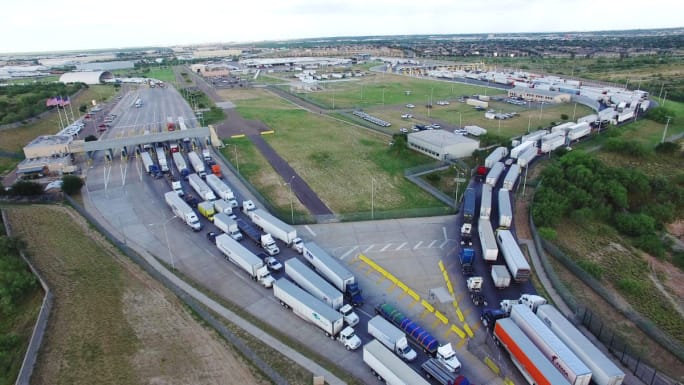
Trucks are shown crossing the border in Laredo, Texas, at the World Trade Bridge.
Photo: Laredo Motor Carriers Association
More Cross-Border Trucking on the Way
“We've got private development that is being negotiated as we speak with private investors on the U.S.-Mexico border in Texas, looking to create more lanes for commercial traffic. That’s the reality of where we sit today,” he said.
Esparza serves on the Border Trade Advisory Committee, a group created by the state legislature in 2001 to define and develop a strategy and make recommendations to the commission and the governor for addressing the highest priority border trade transportation challenges. He sees a key thing that needs improvement, but that would need to be done at the federal level.
“We are due an overhaul of our visa system. And for trucking, there's not really a good visa that's specific for the truck driver, the employee. We don't have a good fit there; there's a frustration that has been there for quite a while in the process and program that we have in place. It needs an overhaul,” Esparza said.
More Fleet Management

Color Match Smarter: Tools That Restore & Perform
For fleet managers and collision repair professionals keeping heavy-duty trucks on the road, getting the color right the first time isn't just about appearance — it's about efficiency, turnaround time, and bottom-line results. Discover how today's digital color tools are transforming the repair process from guesswork to precision.
Read More →
FMCSA Pauses Biennial-Update Enforcement Amid Motus Transition
Carriers whose updates were due on or after June 1 have more time, while FMCSA works to stabilize its new registration system and warns of phishing sites impersonating its new carrier registration system, Motus.
Read More →
2026 Blueprint for Countering Smarter Supply Chain Theft
Cargo theft is no longer just the cost of doing business. It's a multi-billion-dollar criminal enterprise exploiting vulnerabilities across your fleet, drivers, and supply chain.
Read More →


How Telematics Improves Visibility, Control, and Performance in Refrigerated Fleets
Explore how telematics help refrigerated fleets improve visibility, uptime, efficiency, compliance, and cargo protection across connected cold chain operations.
Read More →
What the U.S.-Canada Trade War Means for Trucking
Escalating U.S.-Canada tariffs could disrupt cross-border freight, reduce truck volumes, raise costs, and create new uncertainty for carriers on both sides of the border.
Read More →
What Are Trucking’s Top Concerns for 2026?
The American Transportation Research Institute wants to know what's worrying trucking fleet managers, drivers, and other stakeholders in its annual Industry Issues survey.
Read More →
American Trucking Associations Looks for a New Leader
ATA President and CEO Chris Spear abruptly left his job at the association on August 21, at a pivotal time for the trucking industry.
Read More →
Public Wi-Fi Cybersecurity Risks: How Truck Drivers and Fleets Can Protect Their Data
Public Wi-Fi can expose truck drivers and fleets to credential theft, malware, and other cyber threats. Here’s how to reduce the risk on the road.
Read More →
For Nicky Cupp, Fleet Innovation Starts With Frustration
HDT Truck Fleet Innovator Nicky Cupp turns everyday pain points at Fraley & Schilling into opportunities for better technology and smarter processes.
Read More →
Adam Buttgenbach’s Approach to Electric Trucks: Start With Where They Fit
HDT Truck Fleet Innovator Adam Buttgenbach helped PepsiCo build one of North America’s largest EV fleets by focusing on where electric trucks make operational sense.
Read More →