




Related: NHTSA Urged to Mandate Truck Crash Avoidance Technology
Bendix Launches Wingman Fusion Driver Assistance System
Bendix has launched Wingman Fusion, the company’s new flagship driver assistance system that combines several safety technologies in a single package, the company announced this week at the Mid-America Trucking Show.
by Staff
March 25, 2015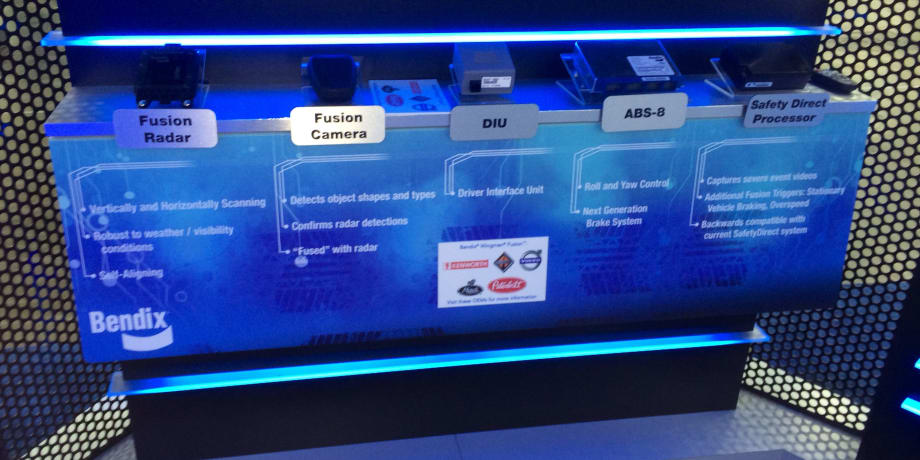
A display showing the various safety technologies Bendix offers. Photo: David Cullen
3 min to read
A display showing the various safety technologies Bendix offers.Photo: David Cullen
Bendix has launched Wingman Fusion, the company’s new flagship driver assistance system that combines several safety technologies in a single package, the company announced this week at the Mid-America Trucking Show.
Wingman Fusion combines the suite of Bendix safety technologies into a more comprehensive driver assistance system. These technologies include radar, camera, brakes, and SafetyDirect. The sensors and systems share situational data to enable stationary vehicle braking as well as overspeed alert and action.
“Wingman Fusion represents a pioneering technological stride that is far more than simply the collection of its parts,” said Scott Burkhart, Bendix vice president of sales, marketing and business development. “It offers an all-inclusive, better performing safety option for fleets which is supported by a single, leading-edge manufacturer.”
Wingman Fusion integrates technology from other Bendix components and systems including Bendix ESP, Bendix Wingman Advanced collision mitigation technology, and AutoVue Lane Departure Warning System.
Wingman makes stationary vehicle braking possible by combining radar and camera data to detect vehicles ahead. When the system notices a stationary, metallic, in-lane object as a vehicle it can notify the driver up to 3.5 seconds before potential impact. If the driver takes no action the system can automatically engage brakes to lessen the severity of collision or possibly avoid it all together.
“The usefulness of stationary vehicle braking is best illustrated by imagining a stalled vehicle or a line of stopped traffic, which may not be immediately recognized by even a skilled, veteran driver,” said TJ Thomas, Bendix director of marketing and customer solutions, controls group. “Without Wingman Fusion’s automatic alert and braking, it may be too late to avert an impact.”
Wingman Fusions overspeed alert and action can be activated at 37 mph and above and uses the system’s camera to read speed limit signs. It works in tandem with Bendix ESP to alert the driver when a vehicle is traveling a specific amount over the posted limit.
The system has two levels of intervention. Level one is an audible warning, initially set for 5 to 9 mph over the limit. Level two is for when a vehicle is 10 mph or more over the speed limit, setting off an audible alert accompanied by a one-second engine de-throttle. When a level two alert is activated, a severe-event notification is sent to the fleet’s back office through SafetyDirect, where it can be used for training and analysis. The level one and two speed thresholds can be customized through Bendix ACom.
With an abundance of input data and sensors set to alert and intervene, the Wingman Fusion system has an alert prioritization feature. If multiple alerts are needed at the same time, the system will arrange them in order of importance and deliver only the most crucial alert to the driver to minimize distraction.
“The need for comprehensive, proactive driver training and safe, alert drivers practicing safe driving habits cannot be replaced by any technology, no matter how advanced,” said Thomas. “But during Wingman Fusion’s extensive testing and demonstration, fleets and drivers regularly provided incredibly positive feedback on the system’s potential for helping to improve fleet operations, driver education, and – what matters to us all the most – highway safety.”
More Fleet Management

Sponsored•September 16, 2026
Color Match Smarter: Tools That Restore & Perform
For fleet managers and collision repair professionals keeping heavy-duty trucks on the road, getting the color right the first time isn't just about appearance — it's about efficiency, turnaround time, and bottom-line results. Discover how today's digital color tools are transforming the repair process from guesswork to precision.
Read More →
FMCSA Pauses Biennial-Update Enforcement Amid Motus Transition
Carriers whose updates were due on or after June 1 have more time, while FMCSA works to stabilize its new registration system and warns of phishing sites impersonating its new carrier registration system, Motus.
Read More →
Sponsored•September 14, 2026
2026 Blueprint for Countering Smarter Supply Chain Theft
Cargo theft is no longer just the cost of doing business. It's a multi-billion-dollar criminal enterprise exploiting vulnerabilities across your fleet, drivers, and supply chain.
Read More →


Sponsored•September 1, 2026
How Telematics Improves Visibility, Control, and Performance in Refrigerated Fleets
Explore how telematics help refrigerated fleets improve visibility, uptime, efficiency, compliance, and cargo protection across connected cold chain operations.
Read More →
What the U.S.-Canada Trade War Means for Trucking
Escalating U.S.-Canada tariffs could disrupt cross-border freight, reduce truck volumes, raise costs, and create new uncertainty for carriers on both sides of the border.
Read More →
What Are Trucking’s Top Concerns for 2026?
The American Transportation Research Institute wants to know what's worrying trucking fleet managers, drivers, and other stakeholders in its annual Industry Issues survey.
Read More →
American Trucking Associations Looks for a New Leader
ATA President and CEO Chris Spear abruptly left his job at the association on August 21, at a pivotal time for the trucking industry.
Read More →
Public Wi-Fi Cybersecurity Risks: How Truck Drivers and Fleets Can Protect Their Data
Public Wi-Fi can expose truck drivers and fleets to credential theft, malware, and other cyber threats. Here’s how to reduce the risk on the road.
Read More →
For Nicky Cupp, Fleet Innovation Starts With Frustration
HDT Truck Fleet Innovator Nicky Cupp turns everyday pain points at Fraley & Schilling into opportunities for better technology and smarter processes.
Read More →
Adam Buttgenbach’s Approach to Electric Trucks: Start With Where They Fit
HDT Truck Fleet Innovator Adam Buttgenbach helped PepsiCo build one of North America’s largest EV fleets by focusing on where electric trucks make operational sense.
Read More →